

At Huntress, customer protection shapes how we build and operate. Security isn’t a separate consideration for one team or one phase of development. It runs through the entire process, from product design to threat operations.
That focus continues after release. A new feature is only useful if it helps defenders investigate faster, understand incidents more clearly, or catch activity they'd have otherwise missed. That’s why close collaboration between Product and frontline teams matters so much.
You can already find plenty of detailed examples in our blogs from Dray Agha, Tactical Response, and the DE&TH (Detection Engineering & Threat Hunting) team. But what really drives those stories—and the successes behind them—is how Huntress teams actually use Managed SIEM.
A tight feedback loop between Product and the front lines
It starts with a tight feedback loop between Product and our frontline defenders: Tactical Response, DE&TH, Security Operations Center (SOC), and Adversary Tactics. These teams are often our earliest adopters, testing new features in real environments and giving us early, honest feedback to shape the value and use cases.
Once a capability goes live, it gets put to work immediately by our teams. Whether it’s a major feature like correlation rules or a small quality-of-life improvement like case-insensitive queries, every enhancement is built to reduce detection time and make investigations more efficient. We evaluate success based on real-world impact. We ask ourselves, "Does this help us detect threats faster or catch techniques we couldn’t before?"
Turning log data into faster investigations
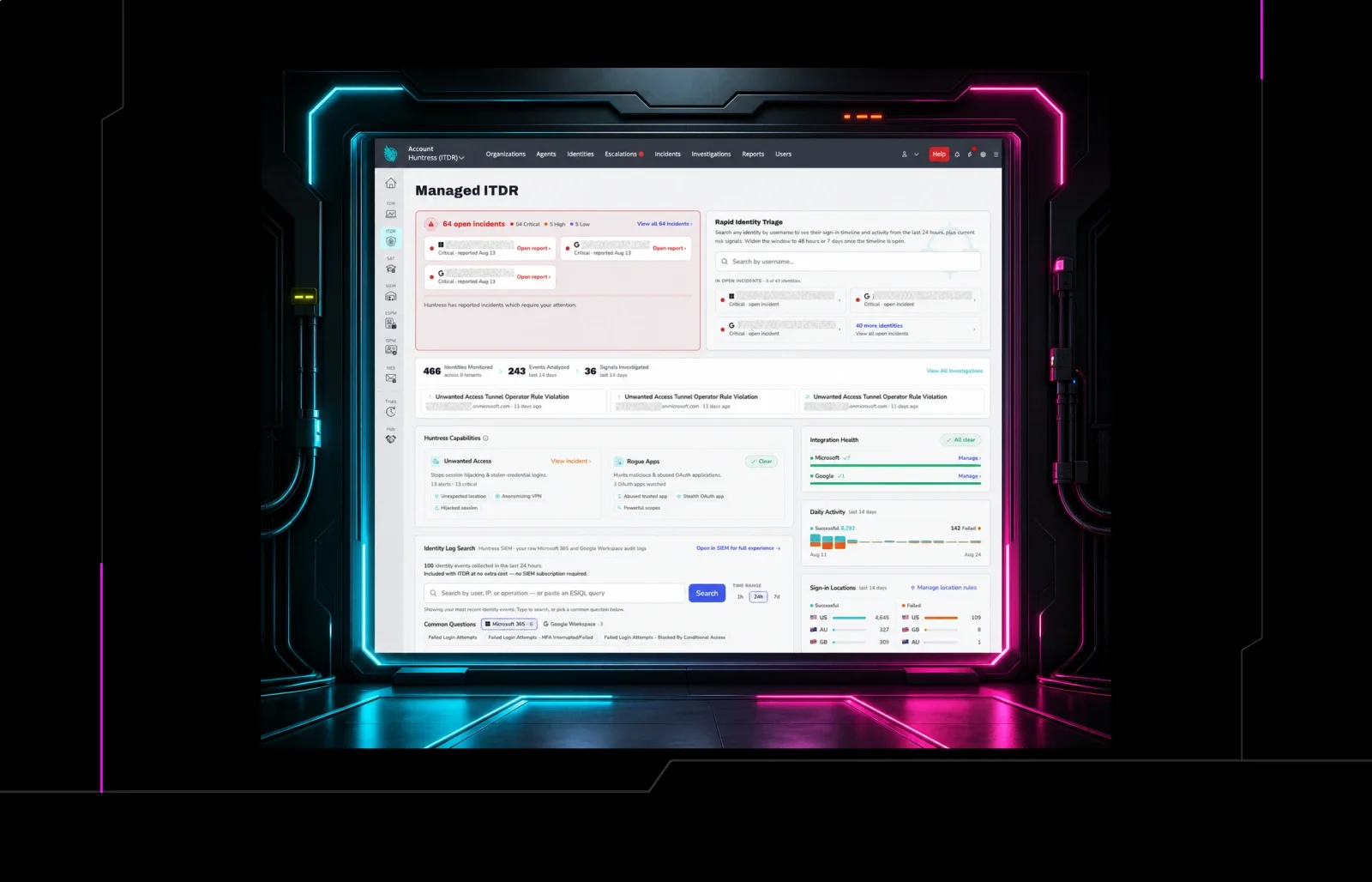
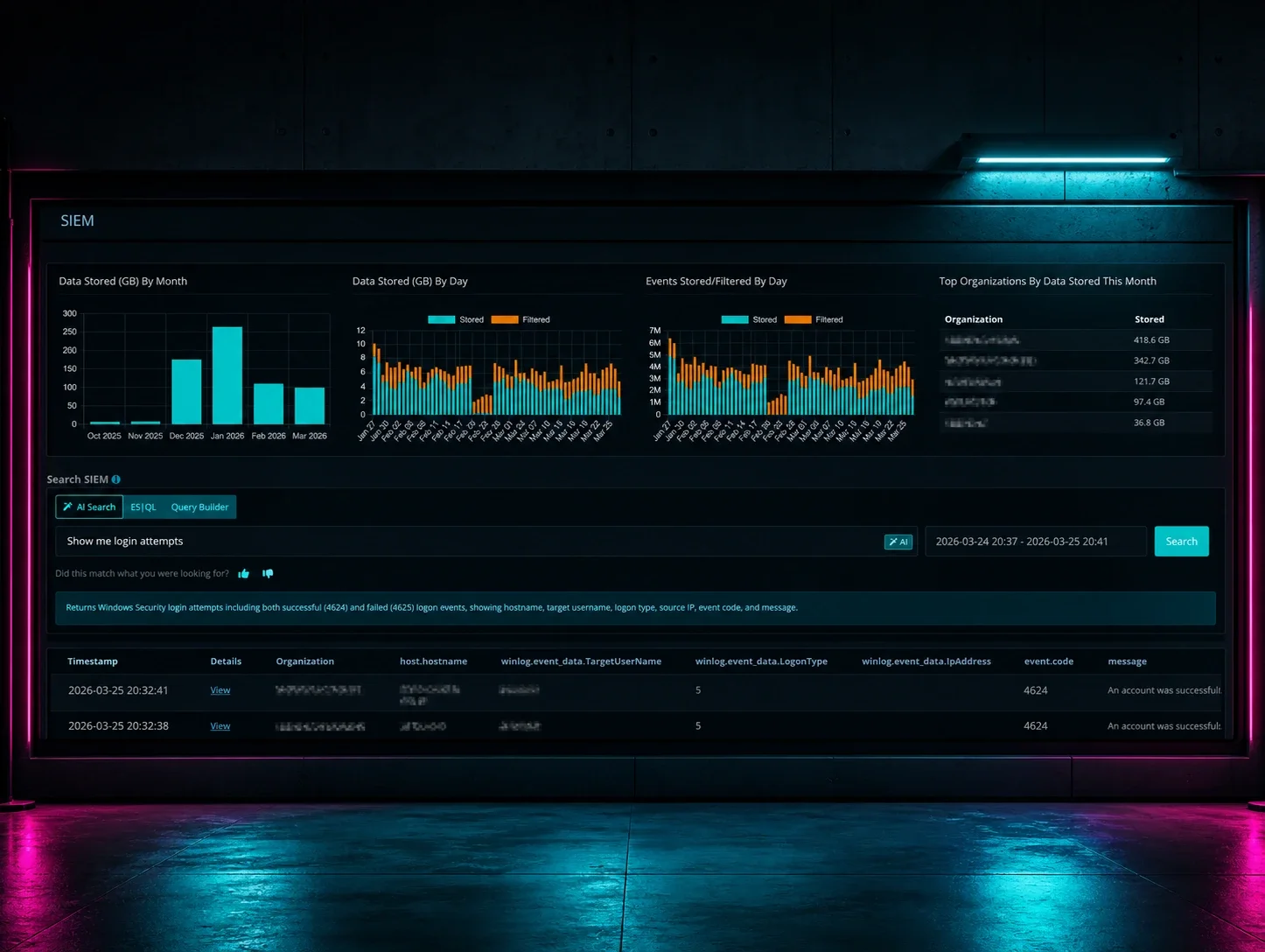
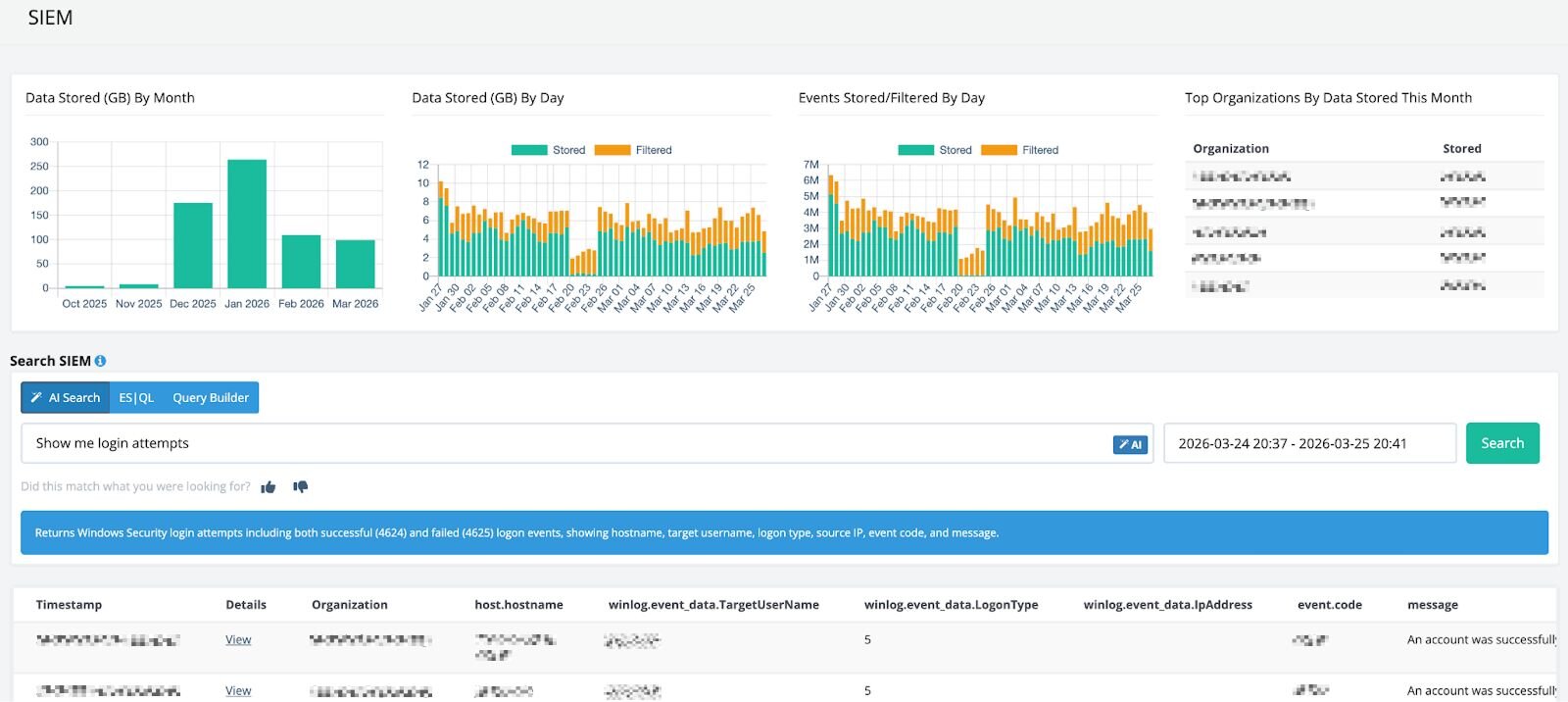
One recent example is our new support for COUNT and COUNT DISTINCT in ES|QL. These functions help our analysts quickly summarize vast amounts of log data to spot anomalies, trends, or one-off behaviors.
Paired with deep knowledge of attacker behavior, this capability helps our Threat Hunting, SOC, and Adversary Tactics teams dig into incidents faster—and often uncover critical insights others would easily miss.
How Huntress teams work together
Each Huntress team plays a unique role in the detection and response lifecycle. But they all work toward the same goal: keeping our customers safe.
Our SOC detects live threats and takes immediate action. Tactical Response is escalated for complex intrusions to identify the blast radius and root cause. The Threat Hunting team searches proactively for emerging and stealthy attacks. Adversary Tactics digs deep into how attackers operate, while our threat researchers and DE&TH team work on turning those insights into automated detections.
It’s a full-circle process: research informs detection, detection informs product, and product empowers protection.
Learning from real incidents
The Managed SIEM product team stays tightly connected to our internal defenders, especially our SOC. Together, we review real incidents to understand what happened, how the attacker got in, and how our customers can prevent it next time.
We don’t perform formal root cause analysis on every case, but thanks to SIEM, we often have a clear picture of what unfolded and how fast we responded.
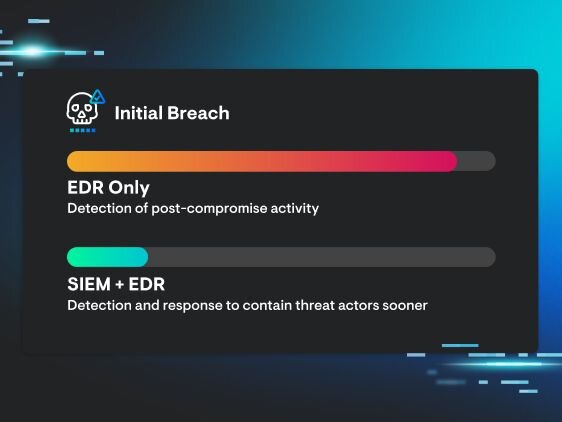
In one case, our Managed Endpoint Detection and Response (EDR) caught a malware infection in progress. The SOC acted immediately, shutting it down before it could spread. But the story didn’t end there.
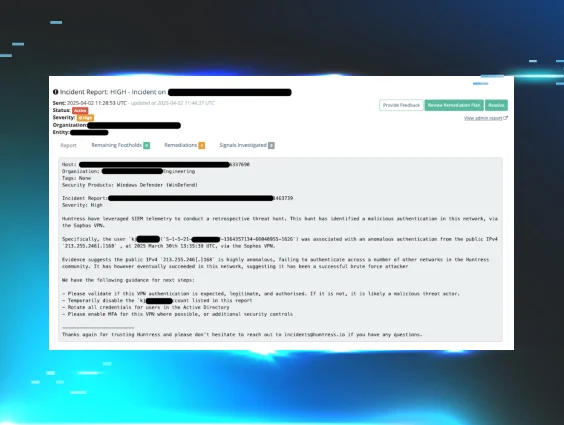
Using firewall and endpoint logs, Managed SIEM helped confirm that no data had been exfiltrated. It gave us historical visibility into that endpoint’s process and network behavior, proving that the rapid detection and response had contained the threat before damage was done.
Detecting what single events can miss
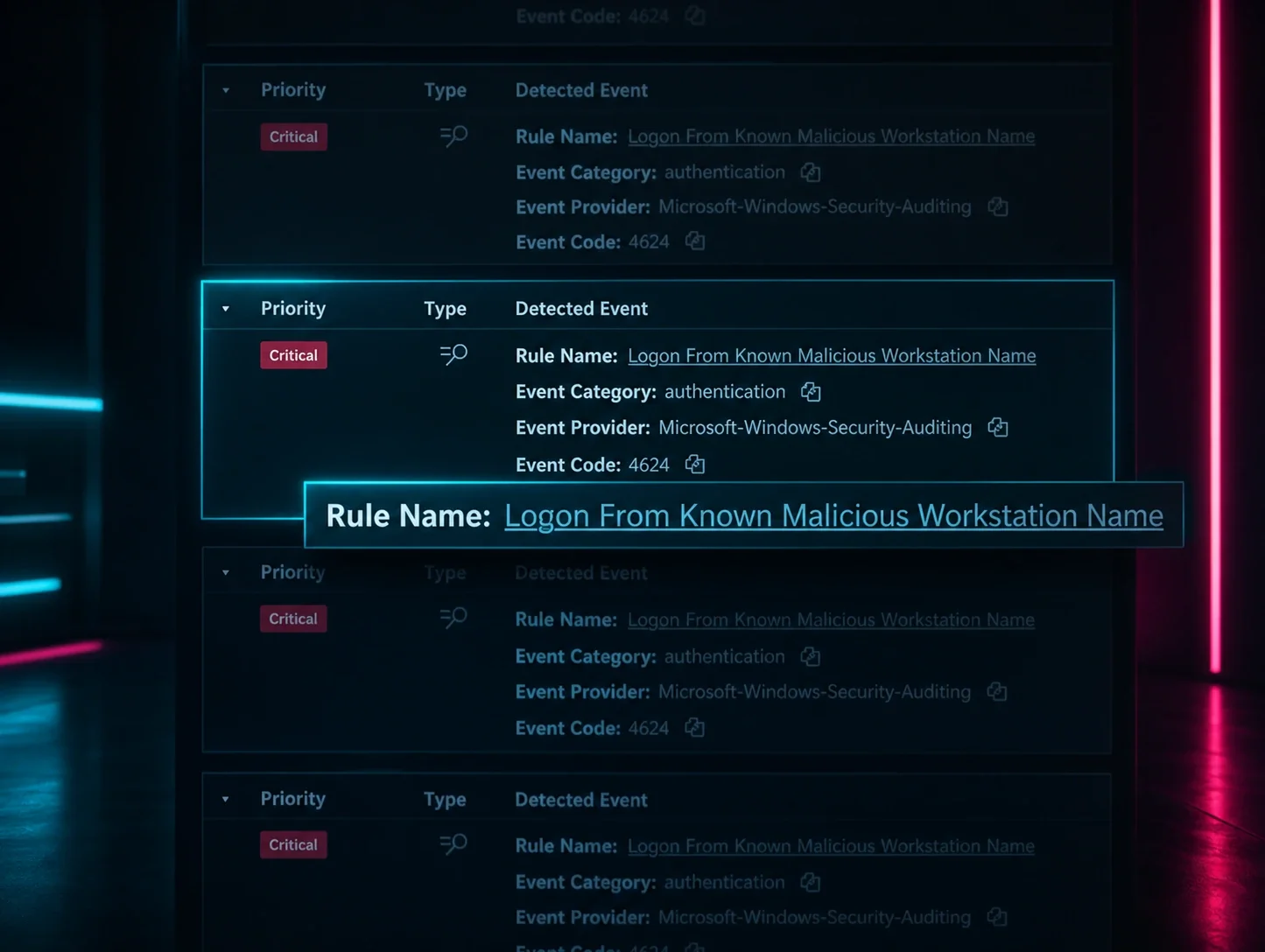
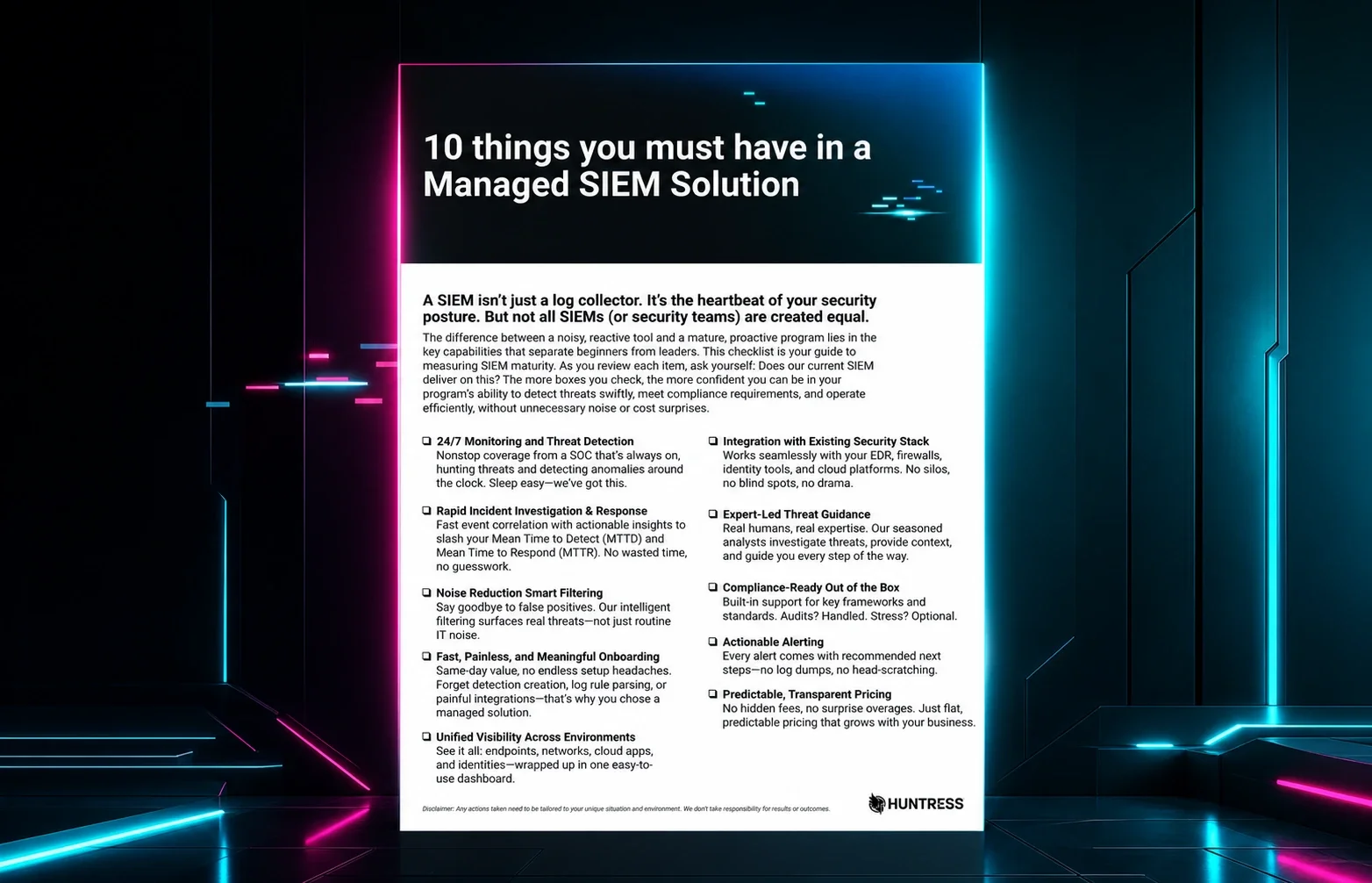
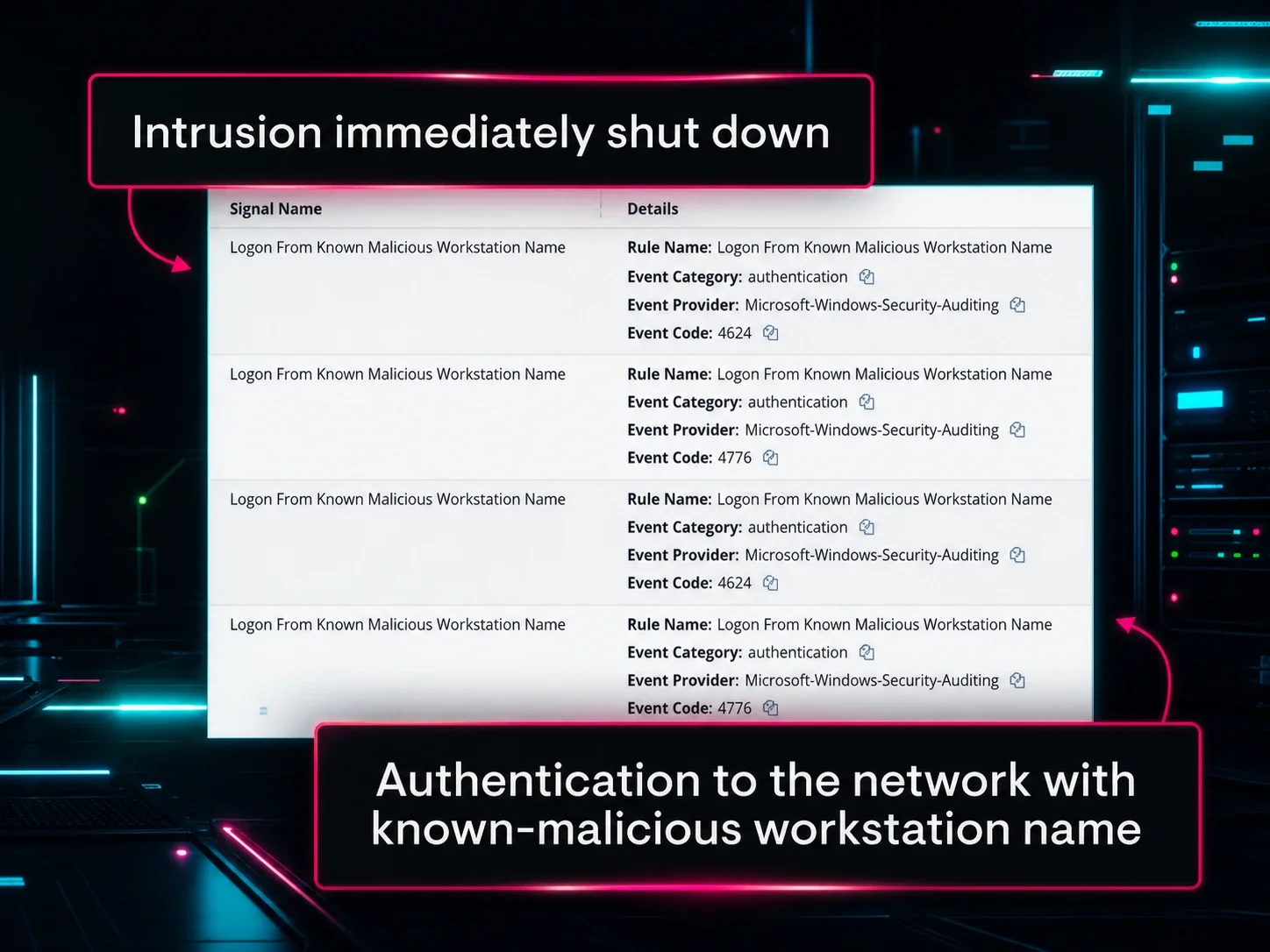
Of course, Managed SIEM isn’t just for after-the-fact analysis. Our team has built a large and growing library of detections based on supported log sources, and more importantly, correlation rules that connect the dots across time, systems, and signals.
Whether it’s spotting brute force attempts, domain reconnaissance, or lateral movement, we detect attacks that don’t reveal themselves in a single event.
And when combined with Managed EDR and Managed Identity Threat Detection and Response (ITDR), Managed SIEM becomes part of a tightly integrated defense, delivering comprehensive visibility across endpoints, identities, and infrastructure.
A SIEM built for lean teams
Traditional SIEMs are noisy, slow, and expensive. Huntress Managed SIEM isn’t.
Built by the teams who use it daily, and tuned for the lean teams who need it most, it delivers real results right away. With a growing library of high-fidelity detections and advanced correlation across time, events, and platforms, it helps identify complex threats like brute force attacks, reconnaissance, and lateral movement before damage is done.
And it’s not just SIEM in isolation. When combined with EDR and ITDR, it forms a unified defense that catches what others miss.
Speed, clarity, and confidence when minutes matter
Your biggest competition isn't necessarily the business across the street. It’s now a cybercriminal organization scaling faster than ever, using the same tools you do. They’re agile, automated, and ruthless. That's why Huntress Managed SIEM gives you an edge, with speed, clarity, and confidence.
Because when minutes matter—and your attackers think like startups—you can’t afford a slow or silent SIEM.
Read more
Managed SIEM DE&TH articles
- "They Got In Through SonicWall. Then They Tried to Kill Every Security Tool"
- "From Code to Coverage (Part 4): Hunting SOAPHound - The (!FALSE) Pattern"
- "From Code to Coverage (Part 3): SDFlags - The Log Field I'd Been Ignoring That Unlocked Attack Path Detection"
- "Active Exploitation of Gladinet CentreStack/Triofox Insecure Cryptography Vulnerability"
- "Multiple RMMs and the Power of a Managed SOC"
- "From Code to Coverage (Part 1): The OID Transformation That Hinders LDAP Detection"
- "PeerBlight Linux Backdoor Exploits React2Shell CVE-2025-55182"
- "Hardening the Hypervisor: Practical Defenses Against Ransomware Targeting ESXi"
- "Velociraptor Misuse, Pt. II: The Eye of the Storm"