Resource Guide
Get practical guidance on endpoint protection, identity security, security awareness training, and building a cybersecurity plan for a lean team.
Small Business Cybersecurity for Lean IT Teams
Growing businesses and lean IT teams face the same phishing, ransomware, credential theft, and business email compromise threats as larger organizations, without the budget or headcount to build a full security team. Huntress gives your IT team managed endpoint and identity protection, 24/7 threat monitoring, and expert-led response without enterprise-level price tags.


Cybersecurity for small business is the combination of people, processes, and technology used to protect company systems, employee identities, data, and customers from unauthorized access, disruption, theft, and fraud. It includes foundational controls like multi-factor authentication (MFA), software updates, secure backups, and employee training, plus continuous detection and response when an attacker gets through.
For a lean IT team, effective cybersecurity isn’t about collecting the most tools. It’s about having the right visibility, clear priorities, and experienced people ready to act before a small incident leads to business-ending downtime.
Attackers don’t ignore smaller organizations. They often target them because a lean IT team may have fewer resources to monitor systems, investigate alerts, and respond around the clock.
Huntress research and the industry data it cites show why small and midsized businesses (SMBs) need a proactive security plan:
A cyberattack can interrupt operations, expose customer data, damage trust, and consume the time your IT team needs to keep the business running. The goal of prioritizing cybersecurity is to reduce the attack surface, detect suspicious activity quickly, and contain threats before they spread.
You’ve got enough on your plate. Cybersecurity shouldn’t become another full-time job for your IT crew.
Huntress gives companies with lean IT teams practical protection that’s easy to deploy, straightforward to manage, and backed by security experts who never clock out.
Get a managed security partner designed for the needs of growing businesses, not a complicated enterprise stack you have to staff and operate yourself.
Huntress integrates with Microsoft Defender and helps your team protect Windows endpoints and Microsoft 365 identities without forcing a rip-and-replace project.
Our human-led, AI-centric Security Operations Center (SOC) investigates threats, provides context, and helps contain incidents around the clock.
Get per-endpoint pricing without hidden tiers or confusing enterprise contracts. You know what you’re paying for and what protection you’re getting.
Huntress helps close the gap for IT teams that don’t have dedicated cybersecurity experts, giving you experienced threat hunters and actionable remediation when you need it.
Small businesses commonly face attacks that start with a user, an identity, an endpoint, or an exposed vulnerability. The most important risks to plan for include:
In Huntress’s June 2025 survey of more than 500 U.S. IT professionals, 54% reported a malware attack in the prior 12 months, 44% reported phishing or spearphishing, and 36% reported business email compromise. Read the Huntress 2025 cybercrime report.
Attackers look for the path of least resistance. Huntress helps close the two paths they target most: your endpoints and your users’ identities.
Huntress is built for busy IT teams that need meaningful protection without more noise.
“Huntress ITDR almost immediately detects business email compromise (BEC). I love the ability to identify unapproved VPN use and access from unapproved locations...It successfully identifies compromises and has few false positives. In the weeks before we used it, we had multiple compromises that had progressed to the point of emails being sent out to all contacts from the compromised user's email box. We have not had even one similar incident in the months of using Huntress.”

“The value Huntress brings to the table for small businesses—at a reasonable price—is huge. You give us the same visibility and reassurance that big businesses have. At the end of the day, everyone’s a target, and attackers are out there hunting for any data they can find and exploit. For us, having that level of capability is a massive win.”
Huntress saved us and saved the practice.



Get practical guidance on endpoint protection, identity security, security awareness training, and building a cybersecurity plan for a lean team.
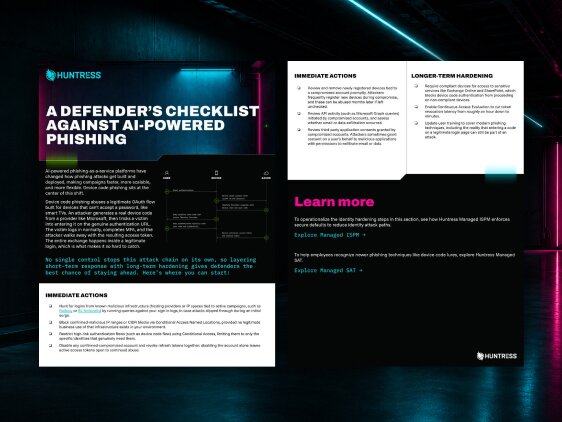
Help your team identify and respond to device-code phishing and other AI-enabled attacks with a practical checklist.
Prioritize high-impact controls like EDR, MFA, centralized logging, tested incident response, and immutable backups.
Small and midsized businesses hold valuable data and depend on connected systems, but many don’t have dedicated cybersecurity experts or 24/7 monitoring. In Huntress and Virtual Intelligence Briefing research, one in four midsized businesses had suffered a cyberattack or wasn’t sure whether it had, and 61% didn’t have dedicated cybersecurity experts. Effective cybersecurity helps reduce the chance of disruption, protect customer trust, and contain threats before they become costly incidents.
Common risks include phishing, AI-powered social engineering, ransomware, business email compromise, credential theft, account takeover, malware, remote-access abuse, and unpatched systems. A strong plan combines MFA, employee training, secure backups, EDR, identity monitoring, and a tested incident response process.
Yes. Huntress is designed to help midsized companies with lean IT teams protect endpoints, Microsoft 365 identities, and business-critical data without building a full in-house security operation. Our services scale with your environment and are designed to minimize the operational burden on your team.
Absolutely. We provide transparent, per-endpoint pricing without hidden tiers or confusing enterprise contracts. You get top-tier protection without a budget-busting security stack. Request pricing today.
Huntress integrates with Microsoft Defender on supported endpoints and monitors Microsoft 365 identities to help protect your users and data from phishing, credential theft, account takeovers, and other identity threats. Learn about Managed Microsoft Defender and Managed ITDR.
Prioritize ongoing, realistic training that reflects how attackers use AI today. Teach employees to spot convincing impersonation, device-code phishing, malicious QR codes, callback scams, suspicious consent requests, and urgent payment or password-reset requests. Pair short, recurring lessons with safe simulations, a clear reporting path, and technical controls that can detect and contain the threats that get through.
Use the Defender’s Checklist Against AI-Powered Phishing as a practical starting point.
Look for a provider that offers 24/7 monitoring, managed detection and response, identity protection, clear remediation guidance, Microsoft 365 compatibility, transparent pricing, and reporting your IT team can act on. The right partner, like Huntress, should extend your team’s capabilities, not create another stream of tools and alerts to manage.