

In manufacturing, a hacked computer is like a wrench in the gears, halting production and losing money—fast.
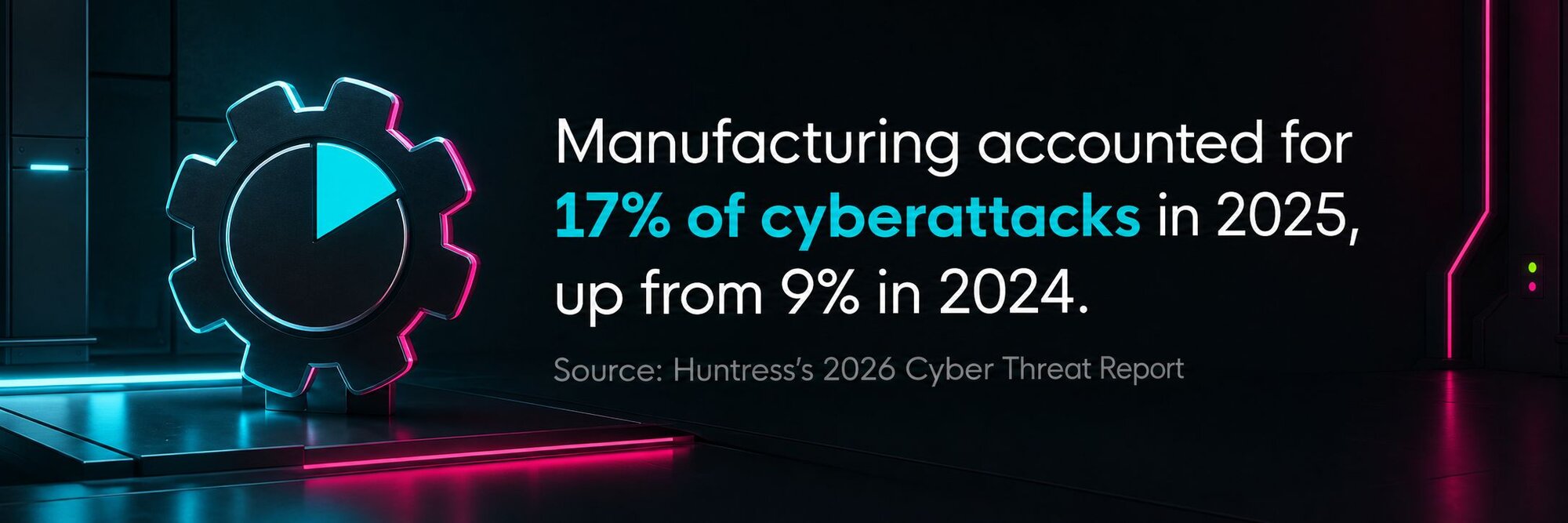
According to our recent cyber threat report, manufacturing made up about 17% of cyber attacks in 2025—a notable jump from 9% in 2024. It’s one of the slightly startling manufacturing cybersecurity trends that we’re seeing in 2026: an increase in attacks. It’s not all bad, though; other trends are showing that manufacturers are playing quick catch-up by implementing new technologies and protections.
Keep reading to discover the top cybersecurity trends in manufacturing that the Huntress team has uncovered for 2026 and beyond.
Trend #1: Ransomware is targeting your uptime, not just your data
Threat actors have figured out that while you might be able to live without your data for a few days, you can’t survive with a dead assembly line. They’re moving past the office network to disrupt the operational technology (OT) systems that keep your machines running.
While the exact cost changes based on what you’re making, the ripple effects are the same across the board:
- Missed shipments: Late deliveries trigger contract penalties and upset your biggest partners.
- Idle labor: You’re still paying for staff and overhead, even if no one can do their job.
- Restart pains: Getting an OT system back online safely takes much longer than a standard IT reboot.
- Safety risks: Sudden shutdowns can damage sensitive equipment or create hazardous conditions for people on the floor or in the plants.
Trend #2: OT, ICS, and IIoT are now in the blast radius
The push for smart factories has removed air gaps in manufacturing, where many industrial control systems (ICS) weren’t connected to the corporate network or directly to the Internet. Between remote access for maintenance, Industrial Internet of Things (IIoT) sensors, and cloud-based performance dashboards, the line between the office network and the shop floor may be gone.
Now, a threat actor doesn't need to walk into your plant with a USB drive; they just need to find one weak point in your corporate network. Once they’re in, those once-isolated systems are suddenly reachable, and because many of them weren't built with modern security in mind, they’re often sitting ducks.
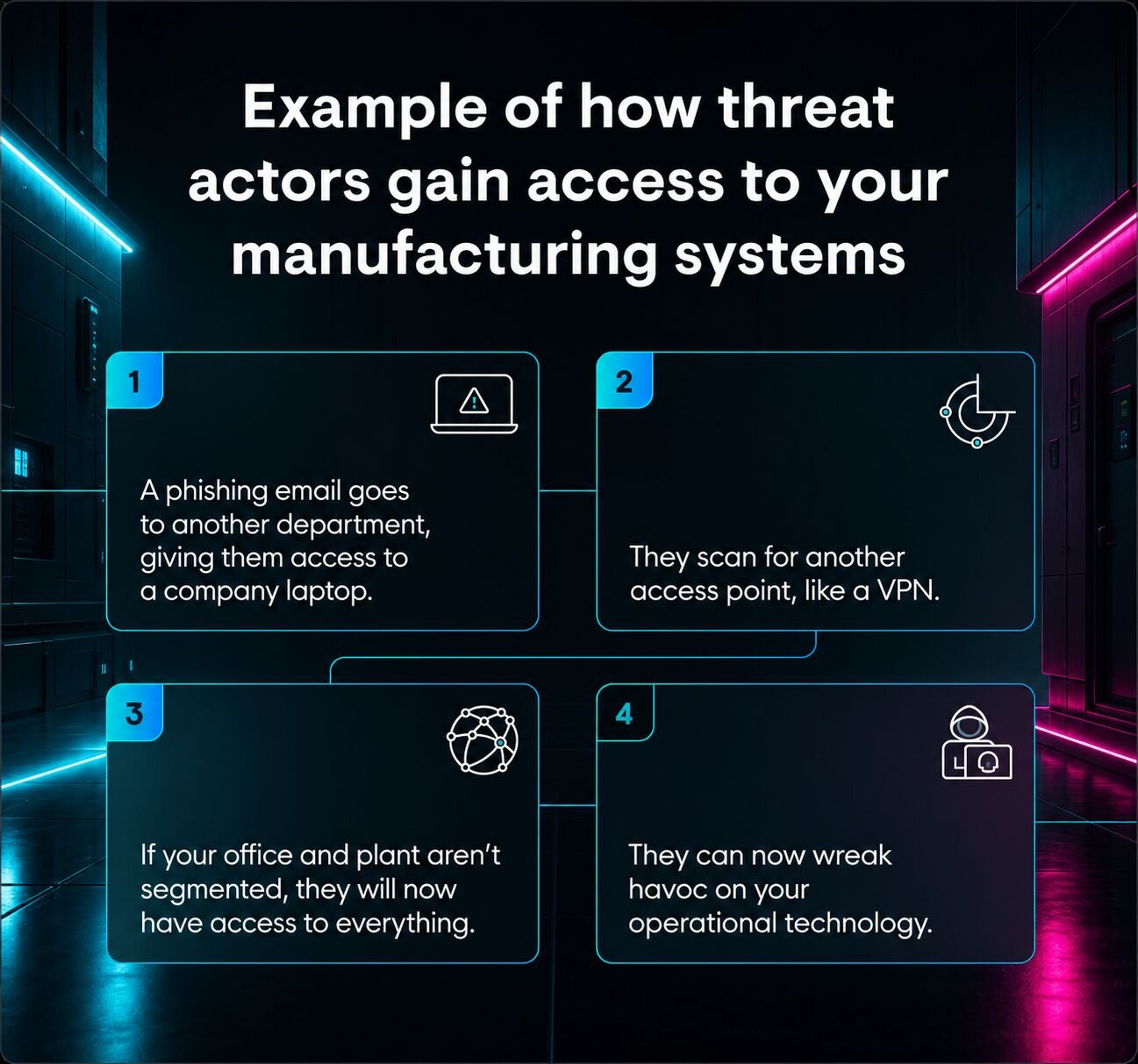
Here is a common path threat actors take to get from a simple email to your control systems:
- The foothold: It starts with a successful phishing email to someone in another department, say Sales or Finance. Now, the attacker has a foot in the door on a standard corporate laptop.
- The bridge: They use that laptop to scan the network, looking for direct access or bridges—like a jump server or a vendor's VPN appliance —to get access to the manufacturing systems.
- The hop: If there aren't strict boundaries (or segmentation) between the office and the plant, they use those stolen credentials to hop into the OT environment. Think of it like a master key—if the door between the finance office and the factory floor isn't strictly guarded, a thief who steals an office key suddenly has total access to the heavy machinery.
- Control: Once they’re in the OT network, they look for MES, Human-Machine Interfaces (HMIs) or Programmable Logic Controllers (PLCs). From here, they can change recipe values, stop belts, or even disable safety sensors.
Trend #3: Zero Trust finally hits the factory floor
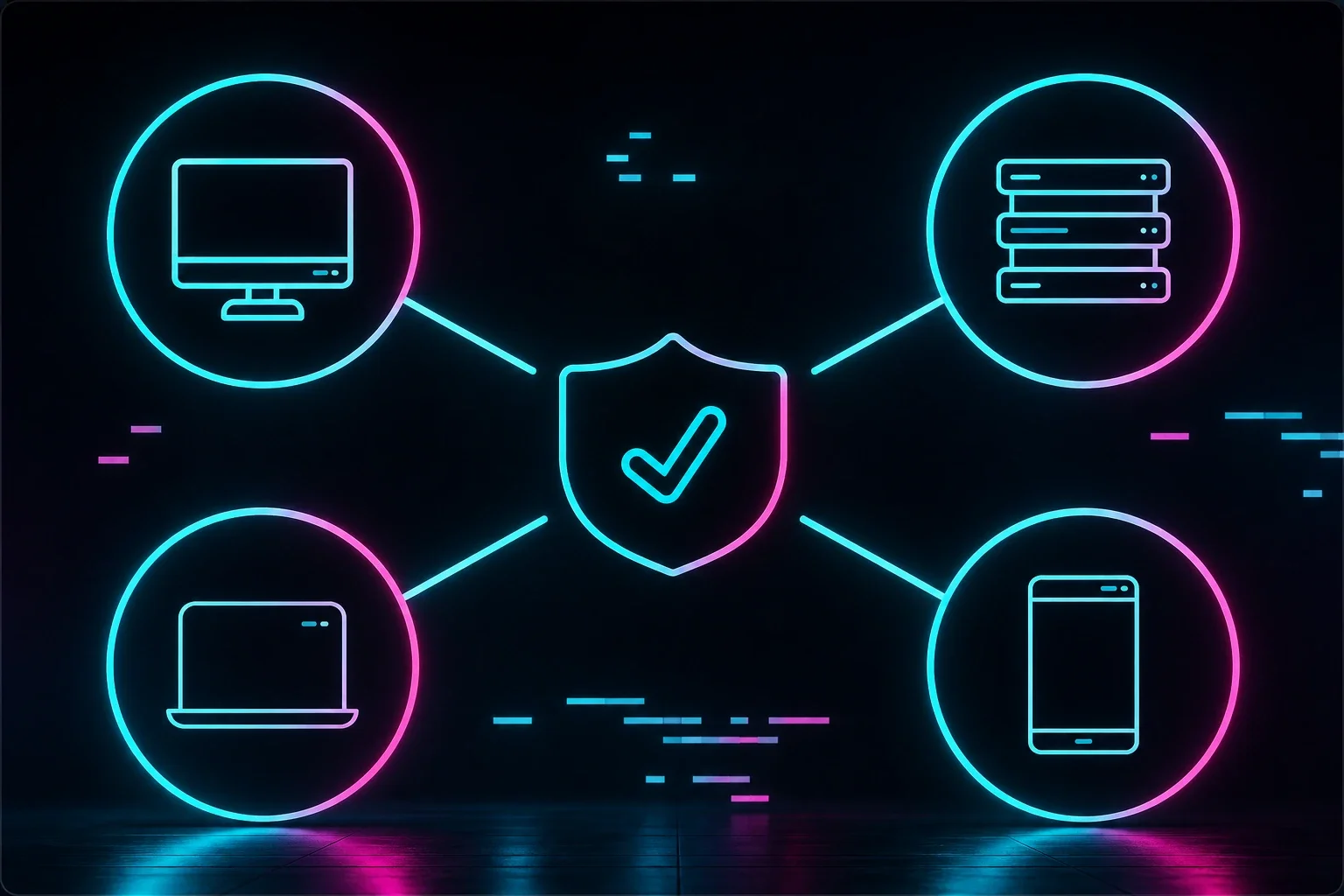
The old way of thinking was like a castle: once you cleared the moat and got past the front gate, you had the run of the place. But in a modern plant, that’s a massive risk. Zero Trust assumes that every connection—whether it’s a laptop, a vendor, or a sensor—could be a potential invader until proven otherwise.
It sounds intense, but for manufacturing, it’s about being practical. You aren't trying to make life harder for your team; you're just making sure that a breach in the breakroom doesn’t lead to a shutdown on the assembly line. That means having multiple moats and multiple gates to defend your castle.
“Zero Trust architecture can feel like a lot to ask of an organization and its employees,” says Brian Milbier, Senior Director, Security and IT, Deputy CISO at Huntress. “But, what it’s really about is ensuring that every system at every level is protected and that no one is able to gain unauthorized access.”
Here are a few clear-cut ways businesses are making Zero Trust happen right now:
- Tighter vendor access: Instead of giving OT manufacturers wide-open access to systems via VPN, you give them access only to the specific systems they need to fix and only for the time they need to fix it.
- Segmenting the floor: You wouldn't put your office printer and your $5M CNC machine on the same segment. Creating digital walls between these areas keeps a small problem from becoming a plant-wide disaster.
- Verifying every time: Using multi-factor authentication (MFA) for every login, such as at VPN gateways—especially for remote workers or people accessing control systems—is a simple way to stop stolen passwords in their tracks.
- Checking device health: Before a device is allowed to talk to your ICS, Network Access Controls (NACs) or Zero Trust gateways check to see if it has the latest security patches or if it’s showing signs of being compromised.
- Continuous network monitoring: Look for anomalous behavior by first creating a baseline of network traffic and then monitoring for things like unexpected network connections after hours, spikes in traffic, etc.
Trend #4: Legacy systems are still the soft underbelly
While legacy systems are the backbone of many plants, they’re also a massive target. Whether it's an old HMI running Windows 7 (or even XP!) or a PLC that hasn't seen an update in a decade, these devices are often the easiest way for an attacker to access your operation.
The main problem is that you often can’t patch them. Sometimes the original manufacturer is out of business, or a simple software update might break the very thing that keeps the machine running. This leaves you with outdated systems that are essentially open doors for anyone who knows how to knock.
Legacy systems are threat actors’ favorite endpoint vulnerabilities for a few simple reasons:
- They’re predictable: Old software has well-known vulnerabilities that have been documented for years. Attackers don’t have to guess how to get in—they can just Google it.
- They’re dark assets: Because these machines are so old, they often don't play nice with modern security tools. This means a threat actor could be hanging out on an execution system for weeks without anyone noticing.
- Shared passwords: Back in the day, common passwords like “password” or “1234” were the standard. Many of these systems still use those hard-coded credentials that are used across the devices on the entire floor.
- Unnecessary open services: Legacy PLCs and HMIs often have “set-and-forget” management ports active by default. Keeping insecure services like Telnet, unencrypted HTTP, or FTP open allows threat actors to intercept credentials or move laterally between machines without hitting a single security hurdle.
Trend #5: Cloud and AI create bigger attack surfaces
While great for streamlining operations, every new cloud dashboard or remote management tool also adds another endpoint for an attacker to get into your environment. When you move your data and controls to the cloud, you’re essentially trading a locked door at your facility for a digital one that’s being knocked on 24/7.
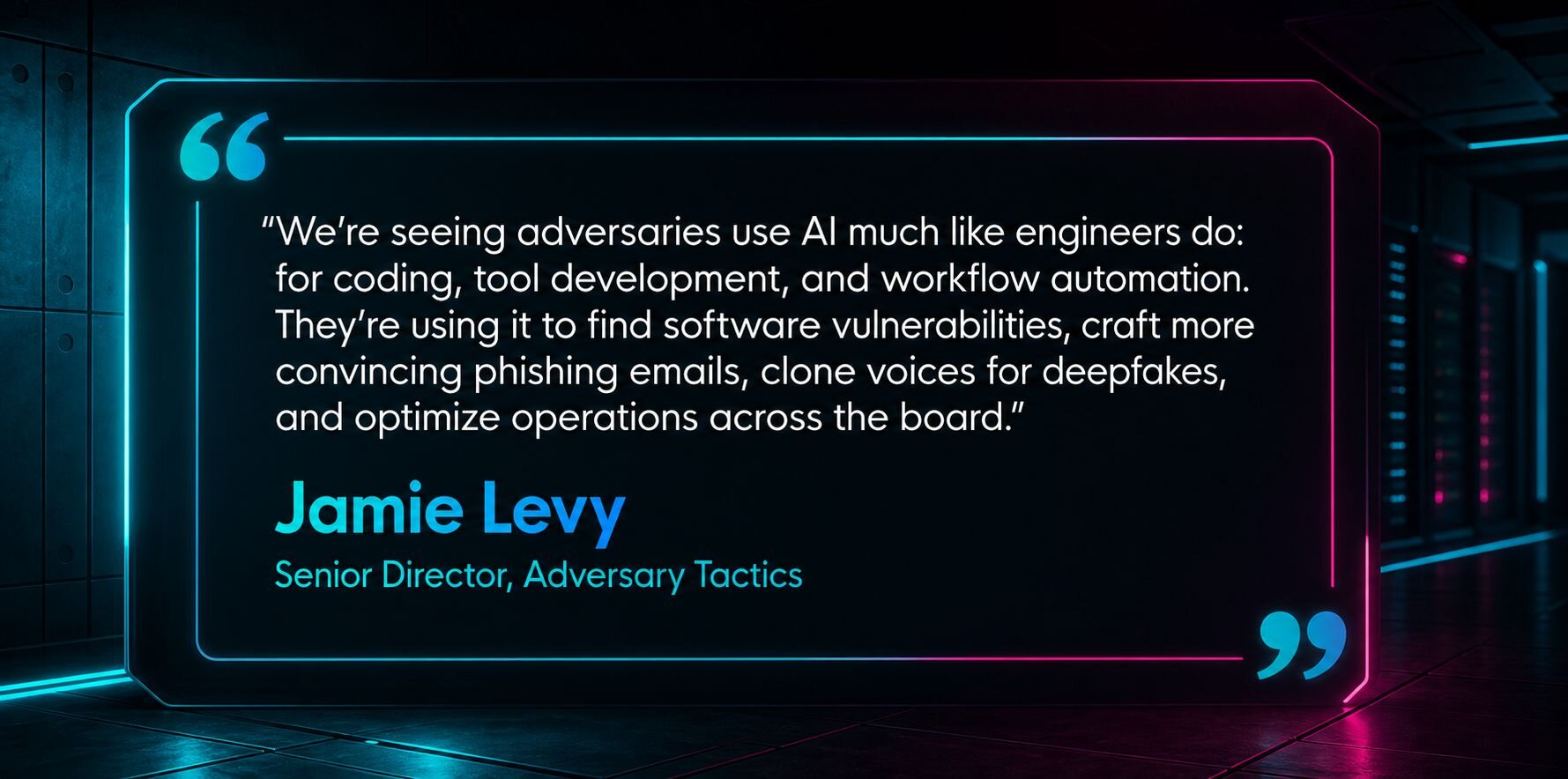
The same AI tools that help you speed up the line are also helping threat actors. They use AI to write better phishing emails and find holes in your network faster than any person could. The good news is that those same technologies, partnered with a human expert, can help keep you safe. Here’s how Huntress does it:
- Weeding out the noise: Our AI-assisted human-led SOC uses automation to sift through millions of events, instantly clearing out the false positives that usually bury IT teams in alerts.
- Catching quiet threats: While AI is great at spotting big spikes in data, our SOC analysts look for the subtle tradecraft—like a persistent foothold—that automated tools often miss.
- Practical response: When a real threat is found, we don't just send you a generic notification. You get clear, step-by-step instructions from a real person on how to fix the problem and get back to work.
Trend #6: Supply chain and third-party access are weak links
Just like no man is an island, no plant is an island, either. You rely on a chain of vendors, equipment integrators, and partners to keep your machines calibrated and your software updated.
To do their jobs, these third parties often have total access to your network through remote management tools or permanent VPN tunnels. The problem is that while your security might be tight, you can’t always vouch for theirs. Here’s how these supply chain attacks happen:
- The soft target: An attacker breaches a small HVAC contractor (like with the 2014 Target breach) or a specialized machine integrator who has a remote connection to your floor.
- The stolen key: They find the saved credentials or the “always-on” VPN link the partner uses to monitor your equipment.
- The silent entry: The attacker logs into your network. To your system, it looks like a routine maintenance check from a trusted friend.
- The payload: Once inside, they use that high-level access to deploy ransomware across your servers or directly manipulate the control systems the partner was hired to manage.
This is why practical security means keeping a close eye on who is coming and going. You don't have to stop working with partners; you just need to make sure their access is limited to exactly what they need, exactly when they need it.
Trend #7: Controls and governance lead to rising regulatory pressure
Between government programs and directives like CMMC 2.0 and NIS2, and big customers demanding proof of security before they sign a contract, the pressure is on.
Governance is about making sure that cybersecurity programs are fit-for-purpose, well-managed, and compliant, so that if a threat actor does find a way in, you have a practical plan to stop them. Regulators and partners want to see that you aren’t just guessing—they want to see that you have a handle on who has access to your systems, apps, and data, and what’s running on your floor.
To stay compliant and keep your contracts, you’ll likely need to show:
- Documented policies, procedures, and responsibilities: Clear documentation needs to show how cybersecurity is governed, operated, and who is in charge of security tasks, so nothing falls through the cracks during a crisis.
- Asset inventories: You can't protect what you don't know you have. You need a live list of every laptop, PLC, and IIoT sensor on your network.
- Access reviews: Regularly checking who has the "keys" to your systems—and kicking out former employees or vendors who don't need access anymore.
- Incident response plans: A written, tested playbook that tells everyone exactly what to do (and who to call) the second a machine starts acting weird.
What these trends really mean for manufacturers
Cybersecurity in manufacturing directly impacts your ability to do work. A system failure often triggers a production stoppage that hits your revenue, your reputation, and your delivery dates. Viewing security as production continuity helps you see it as a necessary part of keeping the lights on.
Safety also plays a massive role here. A breach on the shop floor can lead to physical consequences for your equipment and your people. Implementing these manufacturing cybersecurity trends creates a practical safety net to ensure your machines—and the team running them—stay out of harm's way.
Make security a normal part of your operations with Huntress
Staying ahead of these shifts in manufacturing cybersecurity trends helps you do more than just check a compliance box. You’re building a business resilient enough to handle a bad day without it becoming a business-ending event.
Huntress aims to bring this level of protection to businesses of all sizes so you can keep the line moving. Threats can seem overwhelming, but with our in-depth understanding of how threat actors think, we know what to look for.
Huntress gives you fully Managed Endpoint Detection and Response (EDR), so you've got 24/7 support from security experts ready to respond to threats.
FAQs
Why are bad threat actors so focused on manufacturing now?
Threat actors attack manufacturing because they know that manufacturers have a very low tolerance for downtime. Because a stalled assembly line costs so much every hour, threat actors have more leverage to demand a quick payout. They’re also taking advantage of the fact that many plants are currently connecting old, unprotected machinery to the internet for the first time.
How is ransomware in manufacturing different from other industries?
In manufacturing, ransomware is about physical disruption. Attackers now use double extortion, where they both steal your proprietary designs and shut down your operational technology (OT). This puts your intellectual property and your physical production at risk at the same time.
How should smaller manufacturers prioritize cybersecurity investments?
Smaller manufacturers can invest in cybersecurity by reducing access to only critical systems, implementing MFA wherever possible, and making sure that they have a clear inventory of assets to keep track of what they have.
Is it realistic to prevent every cyber incident in manufacturing?
Unfortunately, it’s not realistic in any industry to prevent 100% of cyber incidents, let alone in manufacturing. The focus should be on quick threat detection, identification, and containment.