



The June 2026 proposed FAR CUI rule requires Revision 3 of NIST Special Publication 800-171 for contractors safeguarding Controlled Unclassified Information. However, the current requirements for defense contractors, found in DFARS 252.204-7012 and 252.204-7021, stipulate Revision 2. This creates a transition period between the two revisions, where defense contractors may need documentation for both revisions, until multi-year contracts with Rev 2 fade out.
What differs in Rev 3
Rev 3 is a restructured set of requirements, sourced from the federal catalog of security and privacy controls (NIST SP 800-53 Revision 5). Three major changes stand out:
More families. Rev 3 organizes requirements into 17 families, versus the 14 used in Rev 2. Planning, System and Services Acquisition, and Supply Chain Risk Management are new.
Merged and withdrawn requirements. Many Rev 2 requirements are folded into other Rev 3 requirements, forming structured lists instead of single-sentence requirements.
Organization-defined parameters. Rev 3 leaves blank variables, such as event types, frequencies, and time periods, to be defined by you or a government customer.
The overall effect is larger, more detailed requirements with more assessment objectives, leading to more documentation that forms more complete processes.
The four-step transition
The good news is that moving from Rev 2 to Rev 3 does not mean starting over. If we walk through the steps to transition an organization from Revision 2 to Revision 3, we can see how this works.
Step 1: Relocate Rev 2 requirements
Rev 3 uses an expanded format. A Rev 2 requirement often becomes a list item inside a different Rev 3 requirement. Build a map from each Rev 2 objective to its new home before anything else.
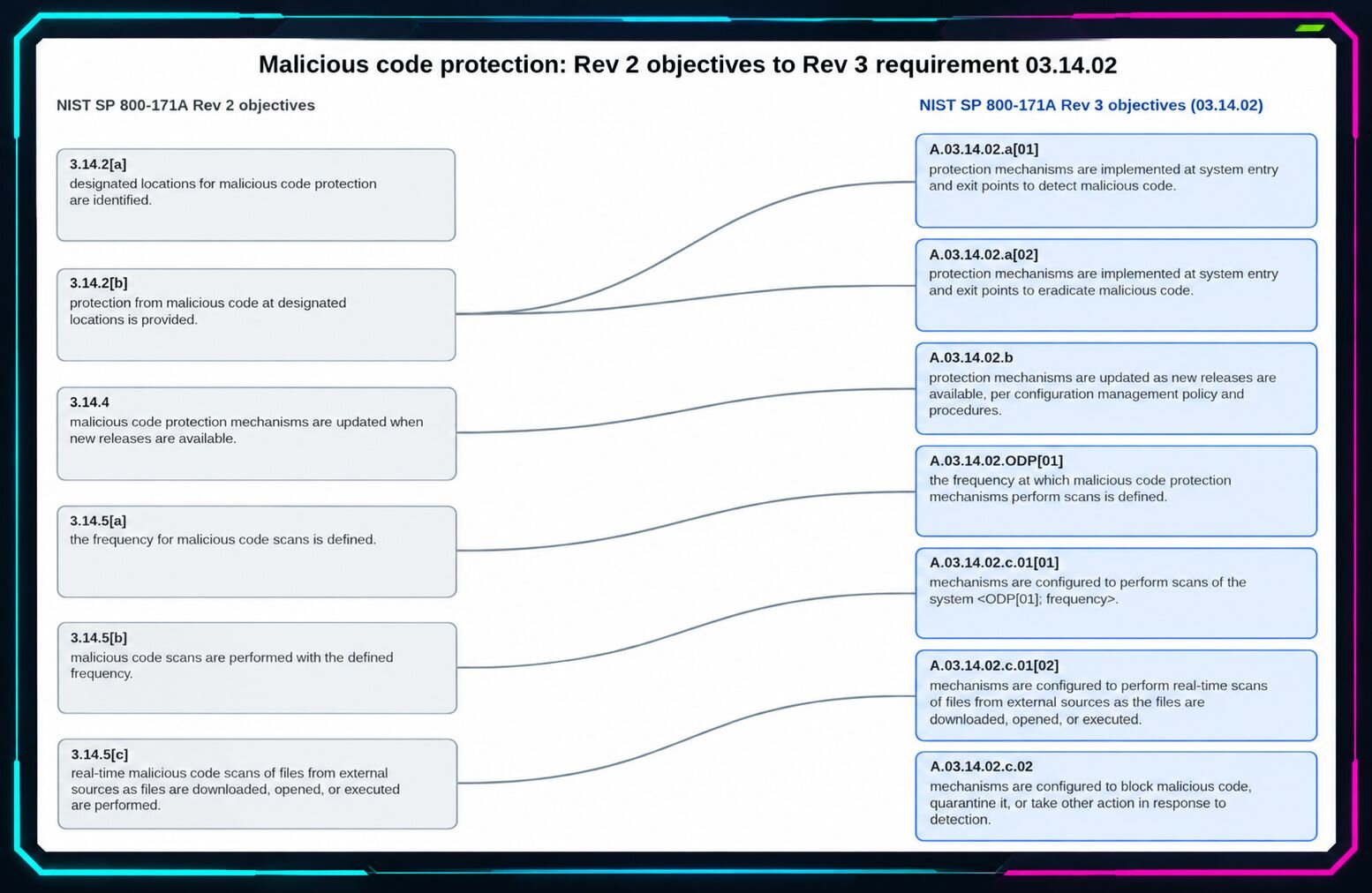
Rev 2 spread the topic of malicious code protection across three requirements: 3.14.2 (protect at designated locations), 3.14.4 (update the mechanisms), and 3.14.5 (periodic and real-time scans). Rev 3 collects all three into one requirement: 03.14.02. The image above shows where each Rev 2 objective lands. Objective 3.14.2[a], which identifies the designated locations, has no Rev 3 match.
Step 2: Take credit for previous work
Some Rev 2 assessment objectives don't directly satisfy Rev 3 assessment objectives, but some small adjustments will often get us there. The assessment language changed, but actions from a Rev 2 Huntress resource may still meet Rev 3 requirements.
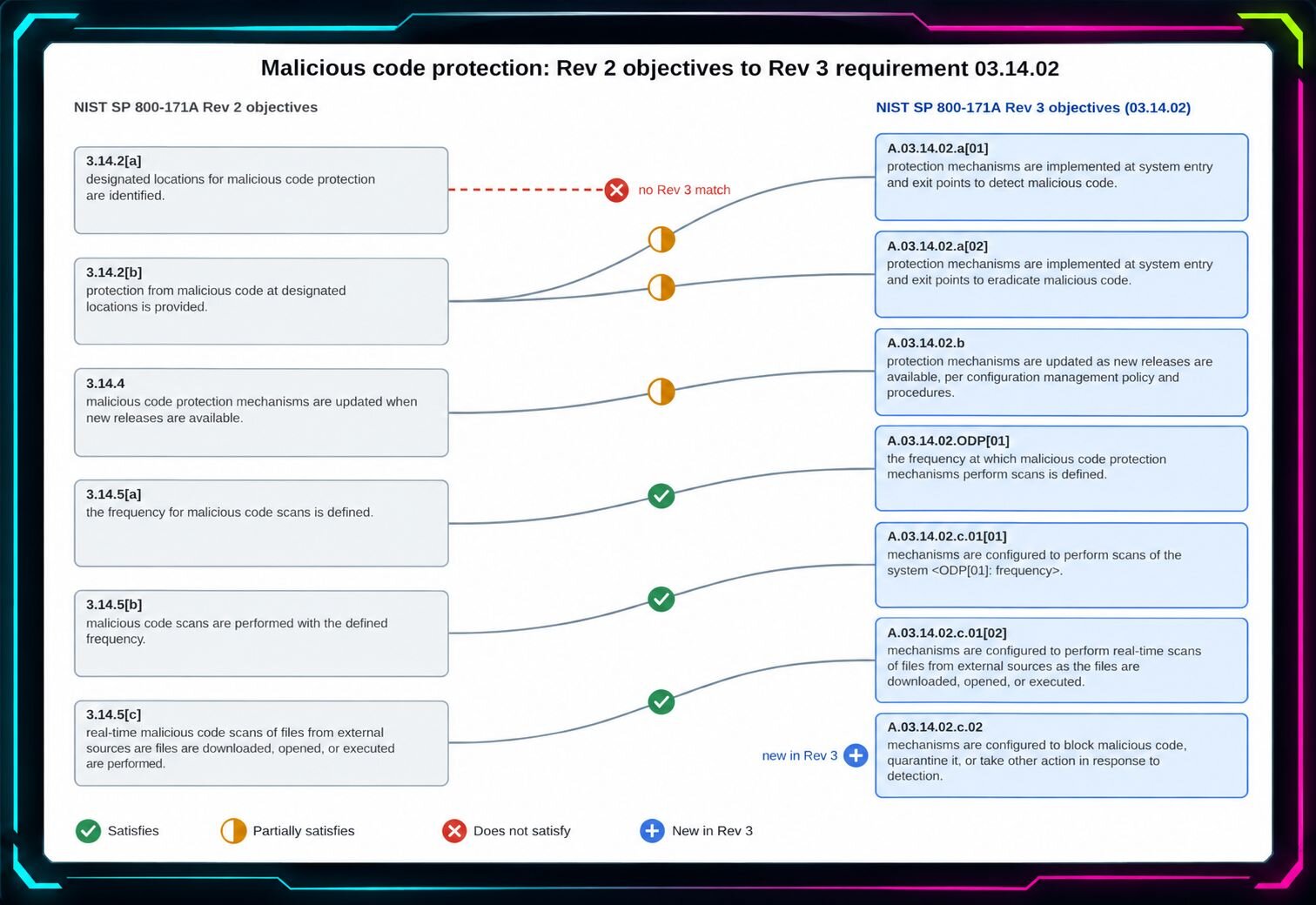
In the 03.14.02 example above, you'll see that some of your Rev 2 efforts require fact-checking to see if they line up with the new language:
Rev 3 gets more specific about where malicious code protections must be implemented. If you identified designated locations for malware protection during your Rev 2 implementation and didn't cover all "system entry and exit points," you might have a gap.
Rev 3 also points to "configuration management policy and procedures" as the documents governing malware updates. If policies and procedures don't describe updating malicious code protections when new releases are available, you may have some edits to make.
The malware scanning objectives (3.14.5[a] through [c]) from Rev 2 should satisfy their Rev 3 counterparts. Take credit for work you've already completed!
Step 3: Apply the DoD ODPs
Some Revision 3 requirements provide blank values so an organization can define frequencies, time periods, and other parameters. After 800-171 Rev 3 was published, the Department of Defense published a set of their own parameters for contractors to use in nonfederal systems.
03.14.02 has one blank parameter: how often the malicious code protection mechanisms scan the system.
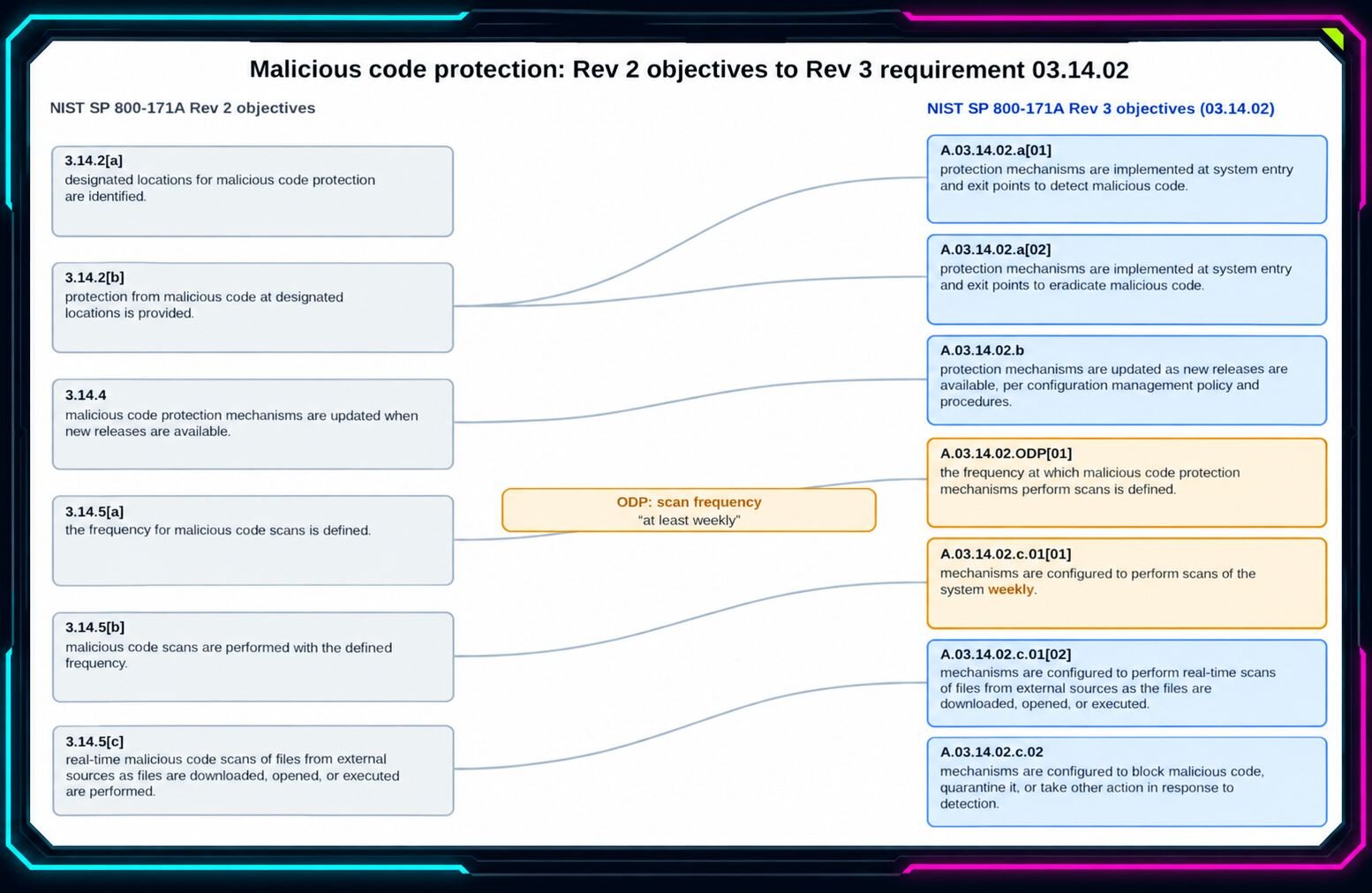
A value that is stricter than your current practice means a configuration change. In the case above, Managed Antivirus settings can supplement real-time protection with scheduled weekly scans. This frequency is already specified in the Huntress Baseline Configuration created to meet Revision 2 requirements.
Step 4: Attack the gaps
Rev 3 adds requirements and objectives with no Rev 2 equivalent. Backfill them last, once steps 1 through 3 show what is actually missing.
03.14.02 has one new item: configure the mechanisms to block, quarantine, or otherwise mitigate detected malicious code. While Huntress Managed EDR and Microsoft Defender work together to block malicious code, automatic host isolation could easily be one of your "other actions." Existing actions we already include in Huntress CMMC resources address this, and so the "gap" is really documenting how your Revision 2 implementation meets this new requirement.
How Huntress is handling the transition
Huntress has partnered with DEFCERT to chart an upgrade path to 800-171 Revision 3. This includes an updated Shared Responsibility Matrix, Operations Plan, SSP statements, and evidence. Since Revision 2 remains important for existing contracts, any new documentation will map back to Rev 2.
Learn more about how Huntress helps you achieve and maintain CMMC compliance.