
Don’t let overlooked obligations become incidents. Learn how.
Utility navigation bar redirect icon
Portal LoginSupportBlogContact
Search
Close search
Huntress Logo in Teal
  • Platform Overview
    Managed EDR

    Get full endpoint visibility, detection, and response.

    Managed EDR

    Get full endpoint visibility, detection, and response.

    Managed ITDR

    Protect your Microsoft 365 and Google Workspace identities and email environments.

    Managed ITDR

    Protect your Microsoft 365 and Google Workspace identities and email environments.

    Managed SIEM

    Managed threat response and robust compliance support at a predictable price.

    Managed SIEM

    Managed threat response and robust compliance support at a predictable price.

    Managed Security Awareness Training

    Empower your teams with science-backed security awareness training.

    Managed Security Awareness Training

    Empower your teams with science-backed security awareness training.

    Managed ISPM

    Continuous Microsoft 365 and identity hardening, managed and enforced by Huntress experts.

    Managed ISPM

    Continuous Microsoft 365 and identity hardening, managed and enforced by Huntress experts.

    Managed ESPM

    Proactively secure endpoints against attacks.

    Managed ESPM

    Proactively secure endpoints against attacks.

    Integrations
    Integrations
    Support Documentation
    Support Documentation
    See Huntress in Action

    Quickly deploy and manage real-time protection for endpoints, email, and employees - all from a single dashboard.

    Huntress Cybersecurity
    See Huntress in Action

    Quickly deploy and manage real-time protection for endpoints, email, and employees - all from a single dashboard.

    Huntress Cybersecurity
  • Threats We Stop
    Phishing
    Phishing
    Business Email Compromise
    Business Email Compromise
    Ransomware
    Ransomware
    Infostealers
    Infostealers
    View Allright arrowView Allright arrow
    Industries We Serve
    Education
    Education
    Financial Services
    Financial Services
    State and Local Government
    State and Local Government
    Healthcare
    Healthcare
    Law Firms
    Law Firms
    Manufacturing
    Manufacturing
    Utilities
    Utilities
    View Allright arrowView Allright arrow
    Tailored Solutions
    MSPs
    MSPs
    Resellers
    Resellers
    SMBs
    SMBs
    Compliance
    Compliance
    What Gets Overlooked Gets Exploited

    Most days, nothing happens. But one day, something will.

    Huntress Cybersecurity
    Cybercriminals Have Evolved

    Get the intel on today’s cybercriminal groups and learn how to protect yourself.

    Huntress Cybersecurity
  • Pricing
  • Community Series
    The Product Lab

    Shape the next big thing in cybersecurity together.

    The Product Lab

    Shape the next big thing in cybersecurity together.

    Fireside Chat

    Real people. Real perspectives. Better conversations.

    Fireside Chat

    Real people. Real perspectives. Better conversations.

    Tradecraft Tuesday

    No products, no pitches – just tradecraft.

    Tradecraft Tuesday

    No products, no pitches – just tradecraft.

    _declassified

    Exposing hidden truths in the world of cybersecurity.

    _declassified

    Exposing hidden truths in the world of cybersecurity.

    Resources
    Upcoming Events
    Upcoming Events
    Ebooks
    Ebooks
    On-Demand Webinars
    On-Demand Webinars
    Videos
    Videos
    Whitepapers
    Whitepapers
    Datasheets
    Datasheets
    Cybersecurity Education
    Cybersecurity 101
    Cybersecurity 101
    Cybersecurity Guides
    Cybersecurity Guides
    Threat Library
    Threat Library
    Real Tradecraft, Real Results
    Real Tradecraft, Real Results
    2026 Cyber Threat Report
    2026 Cyber Threat Report
    The Huntress Blog
    Huntress Lands on the Microsoft Marketplace
    Huntress Cybersecurity
    Huntress Lands on the Microsoft Marketplace
    Huntress Cybersecurity
    How Huntress & DEFCERT Are Streamlining CMMC Assessment Prep
    Huntress Cybersecurity
    How Huntress & DEFCERT Are Streamlining CMMC Assessment Prep
    Huntress Cybersecurity
    Live Hacking Into Microsoft 365 with Kyle Hanslovan
    Huntress Cybersecurity
    Live Hacking Into Microsoft 365 with Kyle Hanslovan
    Huntress Cybersecurity
  • Why Huntress

    Go beyond AI in the fight against today’s hackers with Huntress Managed EDR purpose-built for your needs

    Huntress Cybersecurity
    Why Huntress

    Go beyond AI in the fight against today’s hackers with Huntress Managed EDR purpose-built for your needs

    Huntress Cybersecurity
    The Huntress SOC

    24/7 Security Operations Center

    The Huntress SOC

    24/7 Security Operations Center

    Reviews

    Why businesses of all sizes trust Huntress to defend their assets

    Reviews

    Why businesses of all sizes trust Huntress to defend their assets

    Case Studies

    Learn directly from our partners how Huntress has helped them

    Case Studies

    Learn directly from our partners how Huntress has helped them

    Community

    Get in touch with the Huntress Community team

    Community

    Get in touch with the Huntress Community team

    Compare Huntress
    Bitdefender
    Bitdefender
    Blackpoint
    Blackpoint
    Breach Secure Now!
    Breach Secure Now!
    Crowdstrike
    Crowdstrike
    Datto
    Datto
    SentinelOne
    SentinelOne
    Sophos
    Sophos
    Compare Allright arrowCompare Allright arrow
  • HUNTRESS HUB

    Login to access top-notch marketing resources, tools, and training.

    Huntress Cybersecurity
    HUNTRESS HUB

    Login to access top-notch marketing resources, tools, and training.

    Huntress Cybersecurity
    Partners
    MSPs

    Join our partner community to deliver expert-led managed security.

    MSPs

    Join our partner community to deliver expert-led managed security.

    Resellers

    Partner program designed to grow your cybersecurity business.

    Resellers

    Partner program designed to grow your cybersecurity business.

    Tech Alliances

    Driving innovation through global technology Partnerships

    Tech Alliances

    Driving innovation through global technology Partnerships

    Microsoft Partnership

    A Level-Up for Your Business Security

    Microsoft Partnership

    A Level-Up for Your Business Security

  • Press Release
    Huntress Announces Collaboration with Microsoft to Strengthen Cybersecurity for Businesses of All Sizes
    Huntress Cybersecurity
    Press Release
    Huntress Announces Collaboration with Microsoft to Strengthen Cybersecurity for Businesses of All Sizes
    Huntress Cybersecurity
    Our Story

    We're on a mission to shatter the barriers to enterprise-level security.

    Our Story

    We're on a mission to shatter the barriers to enterprise-level security.

    Newsroom

    Explore press releases, news articles, media interviews and more.

    Newsroom

    Explore press releases, news articles, media interviews and more.

    Meet the Team

    Founded by former NSA Cyber Operators. Backed by security researchers.

    Meet the Team

    Founded by former NSA Cyber Operators. Backed by security researchers.

    Careers

    Ready to shake up the cybersecurity world? Join the hunt.

    Careers

    Ready to shake up the cybersecurity world? Join the hunt.

    Awards
    Awards
    Contact Us
    Contact Us
  • Portal Login
  • Support
  • Blog
  • Contact
  • Search
  • Get a Demo
  • Start for Free
Portal LoginSupportBlogContact
Search
Close search
Get a Demo
Start for Free
HomeBlog
From Code to Coverage (Part 5B): Event 5156 Correlation: Proving Source IP Attribution Is Possible
Published:
April 9, 2026

From Code to Coverage (Part 5B): Event 5156 Correlation: Proving Source IP Attribution Is Possible

By:
Andrew Schwartz
Share icon
Glitch effectGlitch effectGlitch effect

The BloodHound Slack challenge

Coincidentally, as I was drafting my post on the ADWS blind spot (originally scoped to be part 6, but now Part 5A), I observed an interesting conversation take place in the BloodHound Slack #red-team channel. The conversation that followed set the stage for this research, and ended up leading me to decide to split Part 6 into two separate posts. 

The original exchange

It started when User 1 asked about ADWS detection:

"Hi guys, what's your preferred way of opsec safe AD enum? ADSI vs ADWS? And what's your experience with detection of adws on the dc side? Eg when using soapy? ADSi has been very reliable for us, also in very mature environments. I would love to hear more about adws enum."

User 2 responded with his preference for ADWS and explained the detection challenges:

"My preferred way is using ADWS for AD collection but I'm a bit biased lol 😅
But the name of the game when performing stealthy collection of any type is all about using constrained and unique queries. Specifically doing collection through ADWS has a large number of opsec benefits which depending on how detections are written can completely bypass some LDAP oriented detections.
As for the best way of detecting ADWS, probably SACL canaries."

User 2 then explained the core attribution problem:

"The main thing differentiating the two protocols is with common LDAP diagnostic logging the host/device the collection appears to be coming from in the logs is always the DC the ADWS query is executed on due to the ADWS services interaction with the LDAP service on loopback, and detailed logging for the ADWS service is very lacking and usually not enabled."

Charlie Clark asked if correlation was possible with more logs:

"absolutely, but it's still possible to determine for adws requests, right? it's just it requires correlating more logs?"

User 2's response:

"Nope, not really. I've not found a way to correlate the originating host whatsoever. The only way to derive the originating host is through netsession enumeration, but its even harder with SOAPy because you can proxy in the traffic from a non-windows session."

Charlie pushed back:

"surely you could with a network event? 5156?"

User 2's full response outlined the challenges:

"Yeah you could theoretically identify the originating host with 5156 but thats just a basic network connection and usually tuned down due to the large amount of those events generated. Big identity solutions like MDI usually don't alert for collection on those types of events to my understanding due to the amount of normal traffic.
You could detect it with traffic to 9389 (ADWS) but there's an even bigger problem there, all of RSAT uses ADWS. So sysadmins doing normal operations would trigger false positives.

So you could figure it out during triage but it would be tough 
but alerting is very difficult"


Why Event 5156 wasn't a random suggestion

When I saw Charlie suggest Event 5156, I knew immediately that he was onto something. This wasn't a shot in the dark; Charlie, Jonathan Johnson, and I had collaborated on Event 5156 correlation before.

Prior work:

  1. Jonathan Johnson's RPC Research - Jonny's SpecterOps 2022 paper, "RPC for Detection Engineers", had demonstrated the power of Event 5156 for correlating network connections with service activity.

  2. Our Collaborative Post - Charlie, Jonny, and I had published "The Client Server Relationship - A Match Made in Heaven", where we showed exactly how to use Event 5156 for client-server correlation and attribution.

So when User 2 said 5156 correlation was “theoretically” possible but impractical, I knew the technique worked. The question was whether it would work specifically for ADWS.

Challenge accepted.


The hypothesis

User 2 raised valid concerns:

  1. Event 5156 generates high volume

  2. RSAT tools create false positives

  3. Correlation is difficult

But I hypothesized that:

  1. Event 5156 is already being collected by most enterprise SIEMs

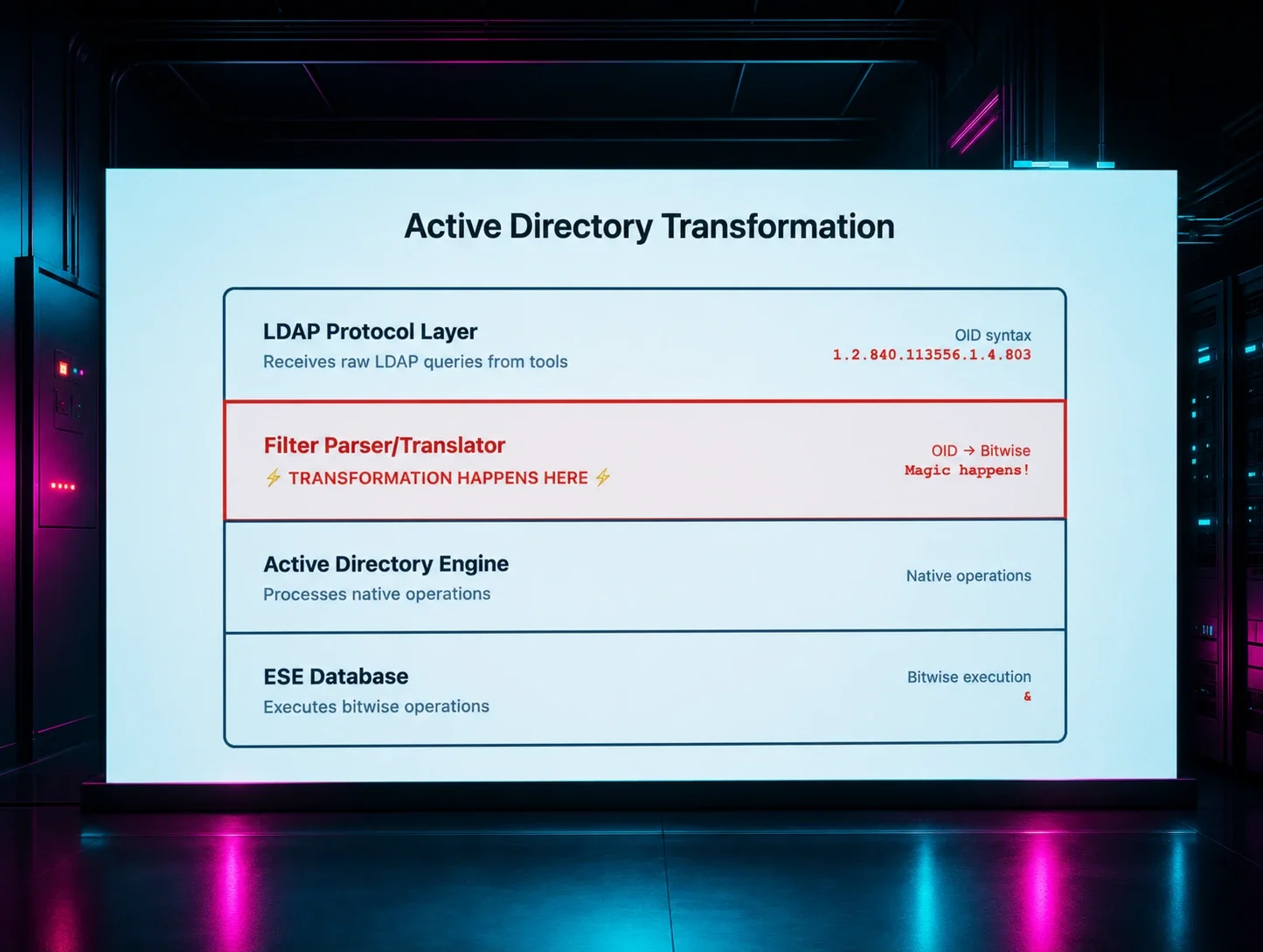
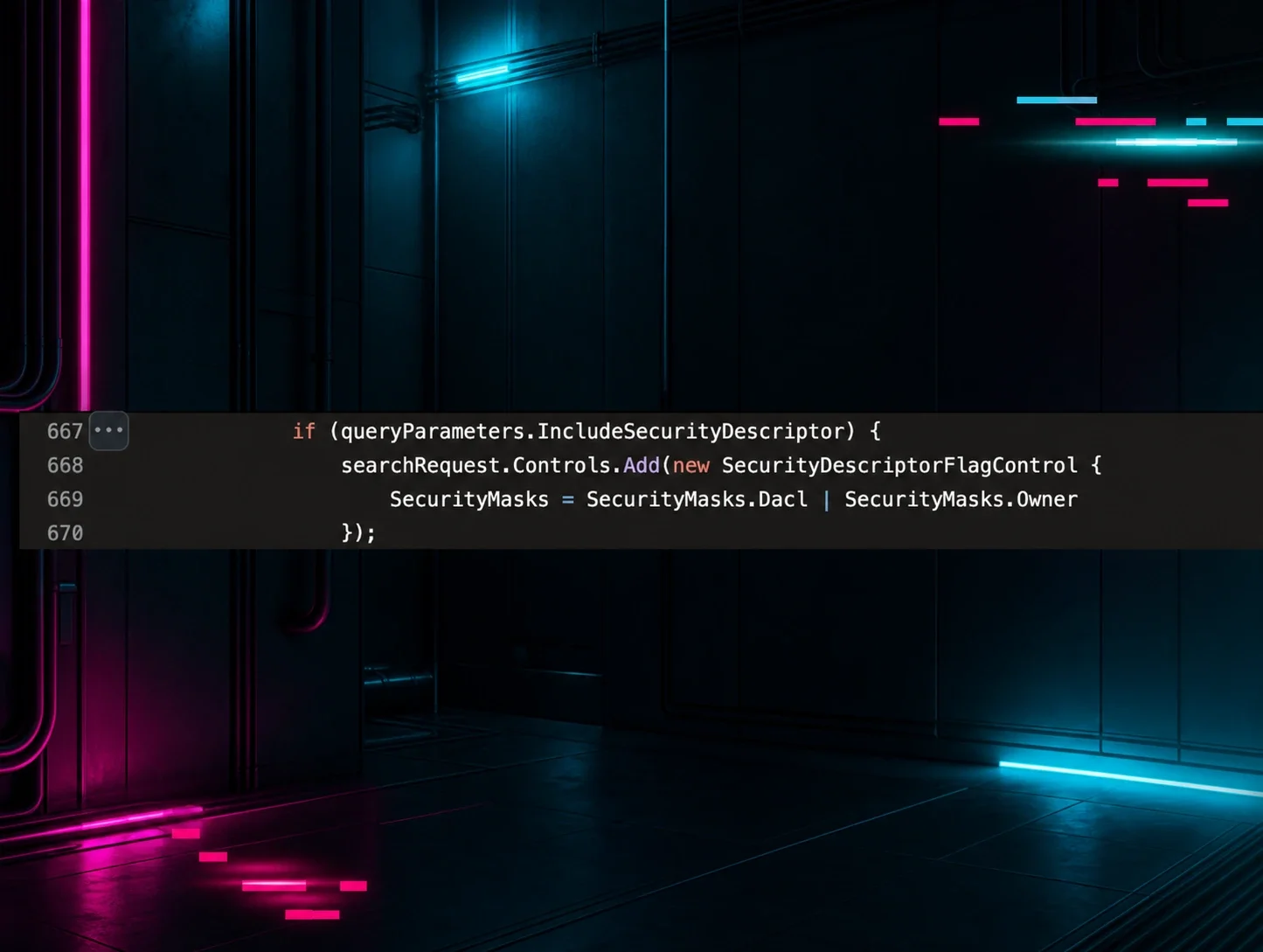
  2. Pattern detection in 1644 (like [all_with_list], SDflags:0x7, (!(FALSE))) solves the false positive problem

  3. Timestamp correlation with a tight window could work

Phase 1: Understanding the event flow

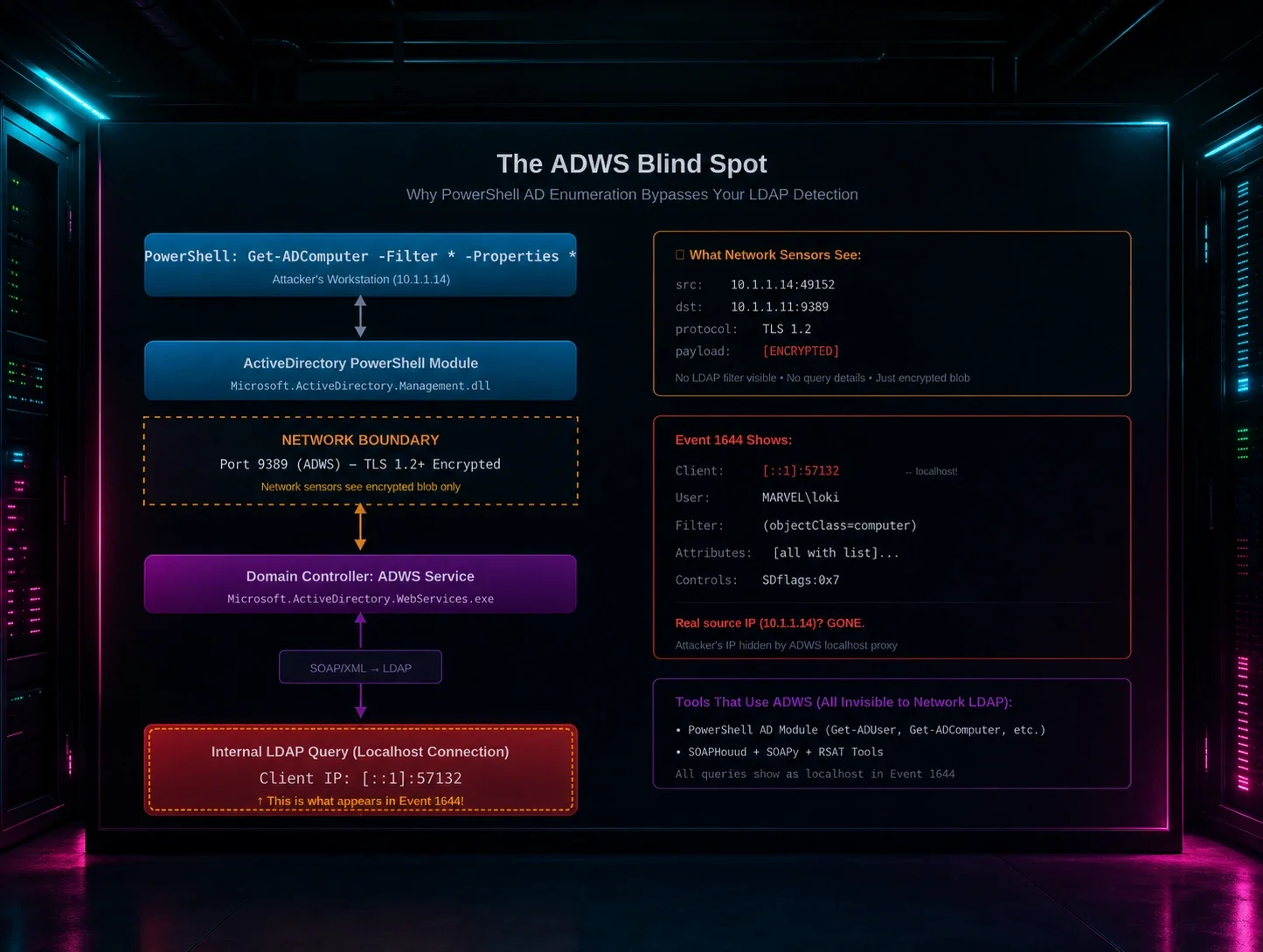
In Part 5A we showed how ADWS hides the attacker’s IP from network sensors and Event 1644—the network sees only an encrypted blob on port 9389, and the LDAP log shows [::1] as the client. Here’s the full event sequence that makes attribution possible anyway.

Event 5156 is the missing piece. It comes from the Windows Filtering Platform (WFP) and hits the Security event log every time a network connection is permitted. It’s become one of my favorite events for correlation work because it records the application that owns the connection, not just the port. So instead of seeing generic svchost.exe, you see microsoft.activedirectory.webservices.exe. It’s on by default under the Filtering Platform Connection audit subcategory, so no extra configuration is needed.

When a remote host connects to ADWS on port 9389, Event 5156 captures the inbound connection with the real source IP. That happens before ADWS translates the request into an internal LDAP call, which is the step that swaps the real IP for localhost.
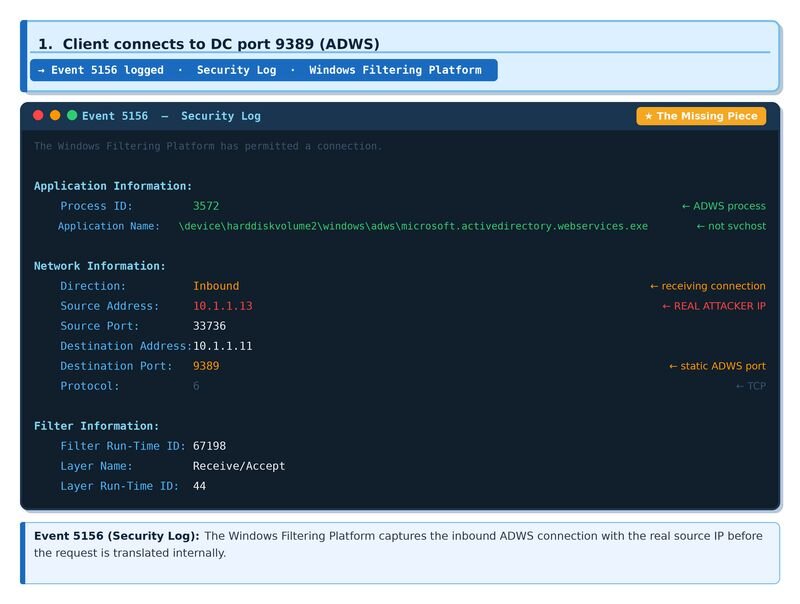

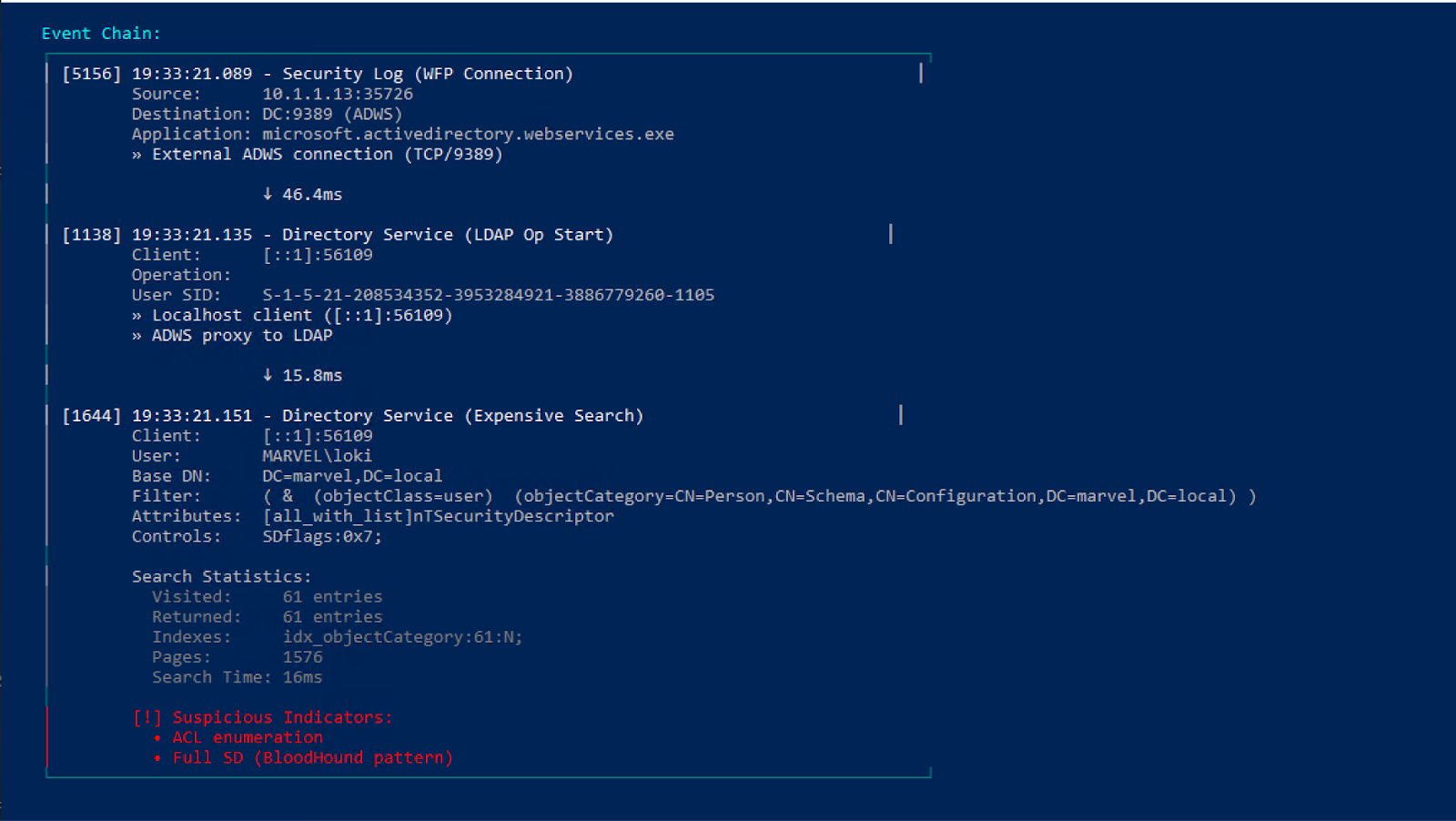
Figure 1: Event 5156 (Security Log): The Windows Filtering Platform captures the inbound ADWS connection with the real source IP before the request is translated internally.
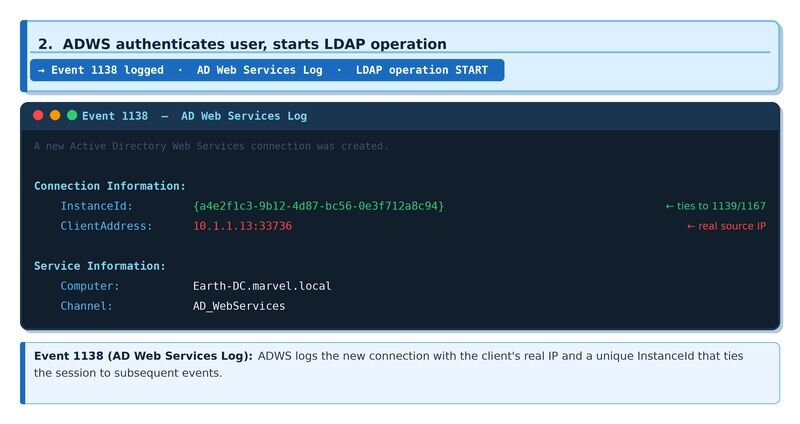


Figure 2: Event 1138 (AD Web Services Log): ADWS logs the new connection with the client's real IP and a unique InstanceId that ties the session to subsequent events.
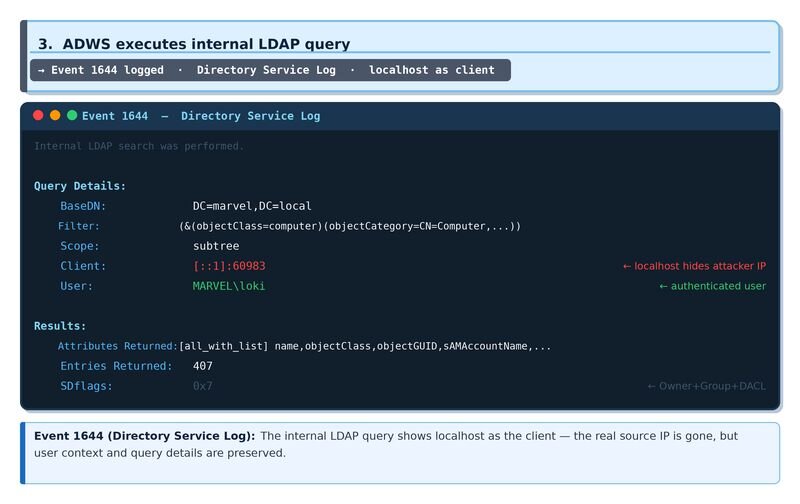

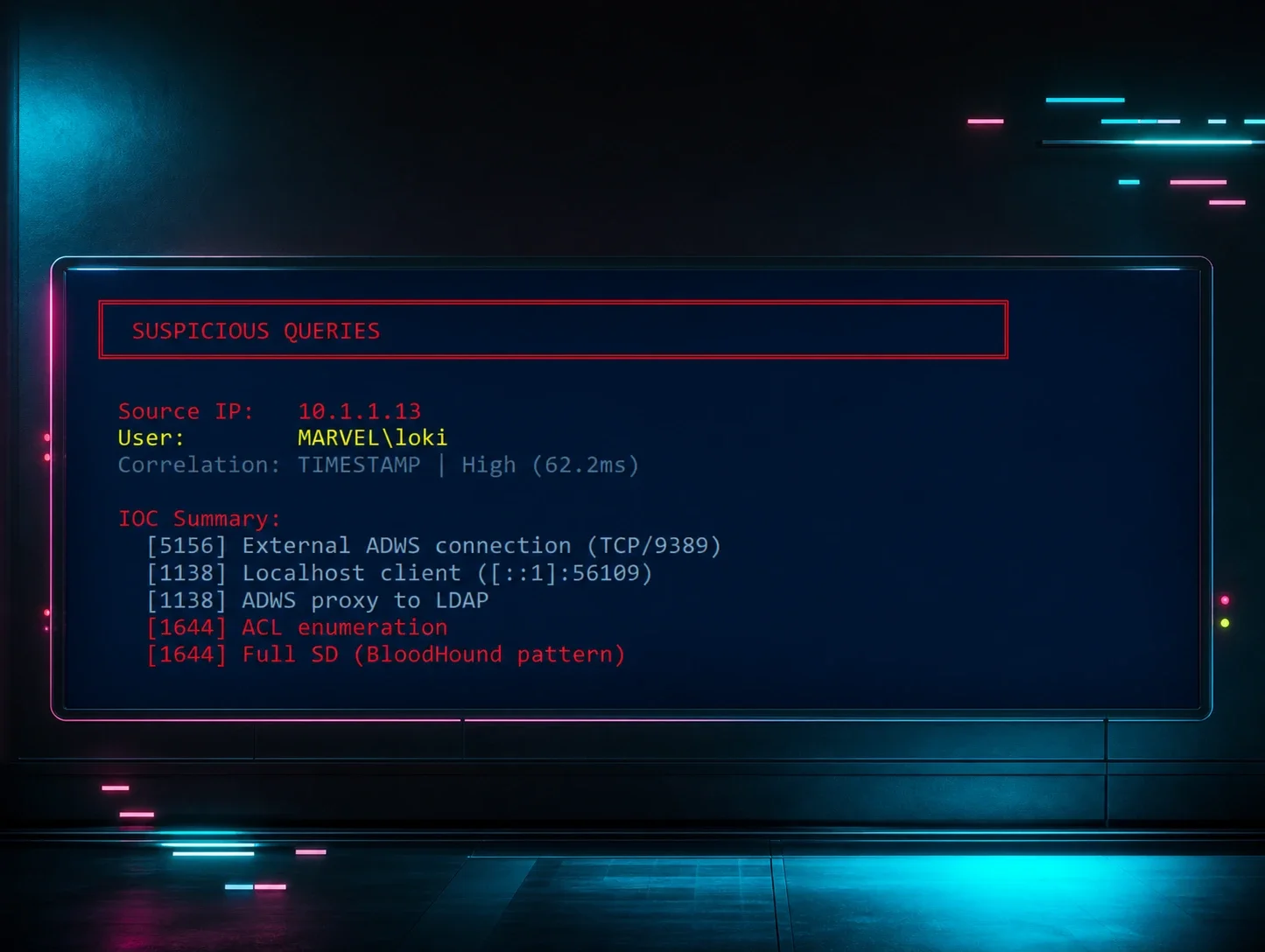
Figure 3: Event 1644 (Directory Service Log): The internal LDAP query shows localhost as the client—the real source IP is gone, but the user context and query details are preserved.


This is the external connection that provides source IP attribution.


Phase 2: Port-based correlation

Event 1644 shows the client as [::1]:60983 (localhost with ephemeral port). If we could find an internal Event 5156 showing ADWS connecting to LDAP on that same port, we could chain: 

External 5156 → Internal 5156 (matching port) → 1644.

Running SOAPy from the Linux box (10.1.1.13) and checking the logs:

Event 1644:

Client: [::1]:60983

User: MARVEL\loki

Filter: ( & (objectClass=user) ... )

Internal 5156 events found:

03:54:46.406 | ::1:61532

03:53:46.393 | ::1:61522

03:52:46.380 | ::1:61514

The ports don’t match. Event 1644 shows port 60983, but the internal 5156 events show 61532, 61522, and so on. Port 60983 is a persistent LDAP connection ADWS established long before the test. The original 5156 for that connection had already rolled out of the Security log. New queries reuse this existing connection — no new 5156 is created for each query.

Port-based correlation only works in a SIEM where the original 5156 (when the persistent connection was first established) is still retained. On a live DC query, it may have rolled out.


Phase 3: Timestamp-based correlation

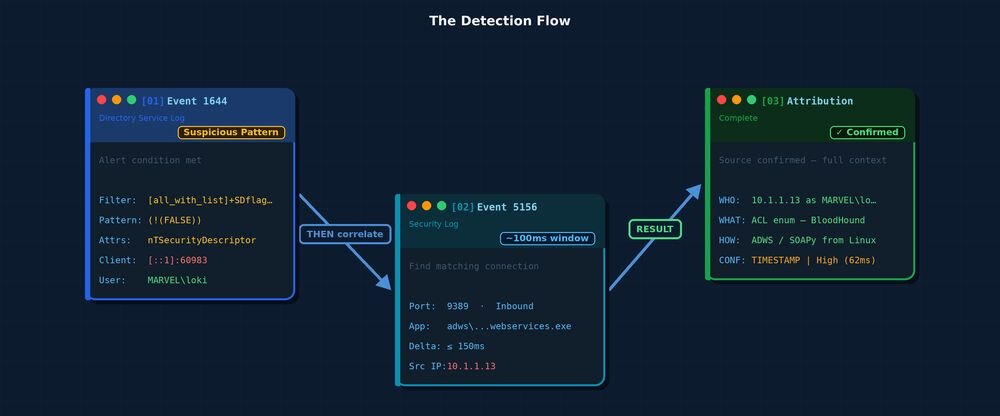
Port-based correlation failed, but the events still happen in sequence with predictable timing. Even if the persistent connection’s original 5156 has rolled out of the log, the external 5156 that fired for the current query is still there — timestamped within milliseconds of Event 1644.

The hypothesis: correlate by time window.

External 5156 → [ADWS processing] → Event 1644

    ~60–80ms

Same SOAPy attack, checking timestamps:

External 5156:

Time: 03:53:28.407

Source IP: 10.1.1.13

Dest Port: 9389

Application: microsoft.activedirectory.webservices.exe

Event 1644:

Time: 03:53:28.469

Client: [::1]:60983

User: MARVEL\loki

Filter: ( &  (objectClass=user)  (objectCategory=CN=Person,CN=Schema,CN=Configuration,DC=marvel,DC=local) )

Attributes: [all_with_list]nTSecurityDescriptor

Controls: SDflags:0x7;

Delta: 62ms

Repeated testing across three runs:


Test Run

External 5156

Event 1644

Delta

Run 1

03:52:22.256

03:52:22.339

83.2ms

Run 2

03:53:28.407

03:53:28.469

61.2ms

Run 3

03:55:25.275

03:55:25.341

65.8ms

Consistent ~60-80ms window across all three runs. The processing delay between external connection and LDAP query execution is stable enough to correlate events.


Phase 4: Building the detection script

With timestamp correlation confirmed as reliable, the next step was building a script that could do this automatically — collecting the relevant events, attempting port-based correlation first, then falling back to the timing window.

Running Get-ADWSAttribution.ps1 during active SOAPy enumeration:


Figure 4: Get-ADWSAttribution.ps1 correlating Event 5156 → 1644 to attribute LDAP queries back to their source IP, catching MARVEL\loki mid-BloodHound enumeration.
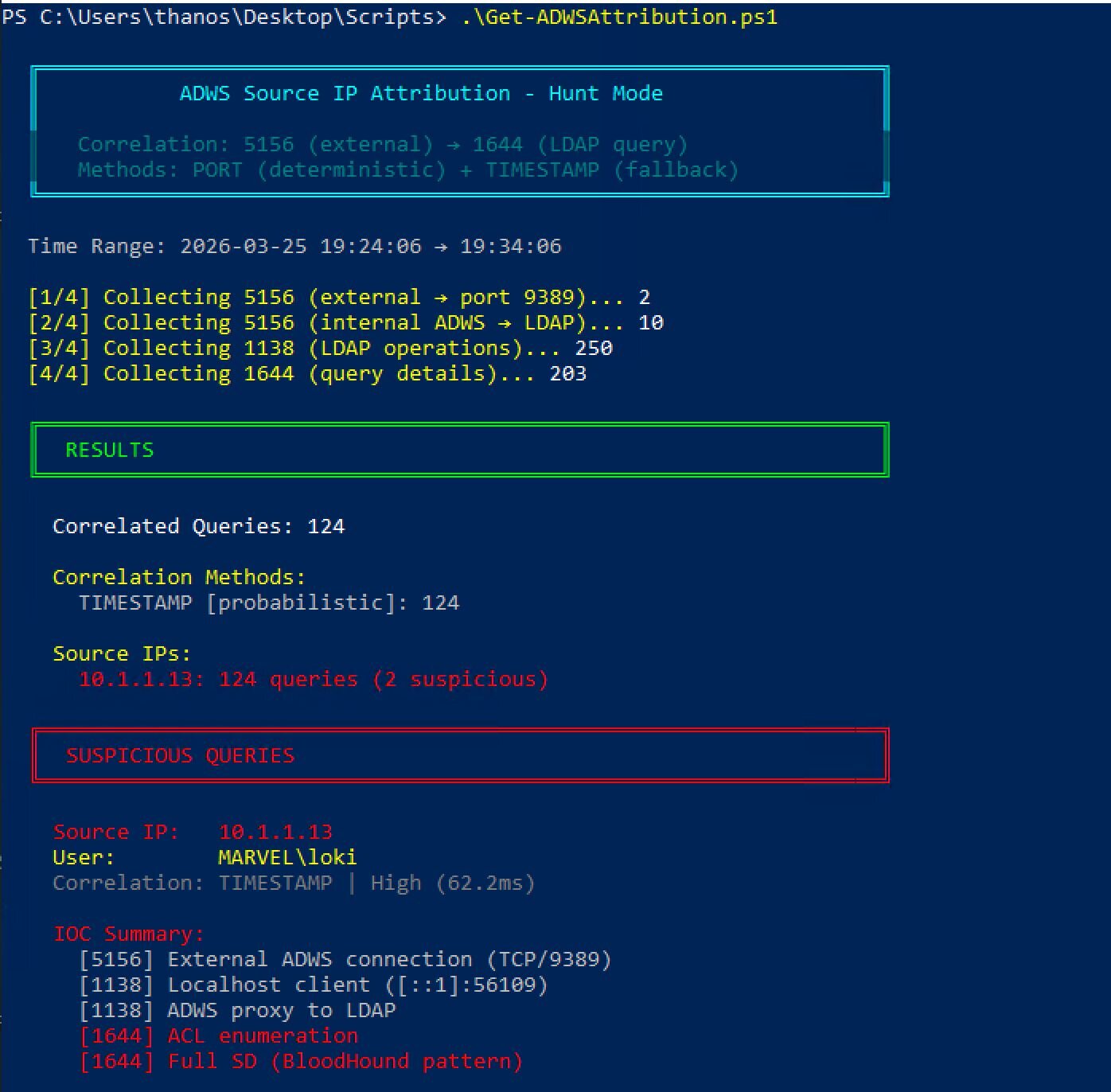
Source IP 10.1.1.13 correctly attributed to all three queries. The real-time monitor mode catches it as it happens:


Figure 5: Three events. One attacker. Event 5156 tells you who connected. Event 1138 tells you ADWS proxied it. Event 1644 tells you what they were after.

Phase 5: The 5156 reality check

The first objection to any 5156-based detection is volume, the concern that it’s tuned down or disabled in most environments. Let's check:

auditpol /get /subcategory:      "Filtering Platform Connection"

Filtering Platform Connection    Success

Event 5156 is on by default. It’s part of Windows Filtering Platform auditing that ships enabled out of the box. The volume concern is real, but it’s about retention, not availability. Every network connection generates a 5156, so on a busy DC, the Security log fills fast, and old events get overwritten.

The fix is SIEM. Most enterprise environments already forward Security logs to a SIEM, which means the data is retained for days or weeks.


Environment

5156 Availability

Correlation Method

Live DC query

May have rolled out

TIMESTAMP (probabilistic)

SIEM (Splunk/Sentinel)

Retained for days/weeks

PORT (deterministic) or TIMESTAMP

Forensic EVTX backup

If captured in time

Either method


Phase 6: Addressing the false positive problem

User 2's concern: "All of RSAT uses ADWS."

True. Sysadmins using PowerShell AD cmdlets generate identical 5156 traffic to port 9389. The solution is pattern detection in Event 1644. You don’t alert on every ADWS connection—only on connections that correlate with suspicious LDAP patterns.


Pattern

Meaning

Legitimate Use?

[all_with_list]

PowerShell -Properties *

Rare for admins

SDflags:0x7

Full security descriptor request

Very rare

(!(FALSE))

SOAPHound signature

Never

High volume localhost queries

Bulk enumeration

Suspicious

nTSecurityDescriptor in attributes

ACL enumeration

BloodHound pattern


The detection flow

Figure 6: The Detection Flow: spot the suspicious pattern in Event 1644, correlate it to a matching Event 5156 within ~100ms, walk away with a confirmed source IP, authenticated user, query details, and tool signature—all from logs that were already there.


Where this leaves the debate

User 2 was right about several things: LDAP events show localhost, 5156 generates high volume, RSAT creates false positives, and real-time DC-local detection is harder when the original 5156 has already rolled out of the Security log.

But his conclusion that the originating host “cannot be determined” doesn’t hold for SIEM-based detection. The data has been there all along in most enterprise environments. Timestamp correlation works even when port-based correlation doesn’t. And pattern detection in Event 1644 handles the false positive problem he identified.

The gap was never technical. It was that nobody had published the correlation method.


Summary: The complete attribution chain
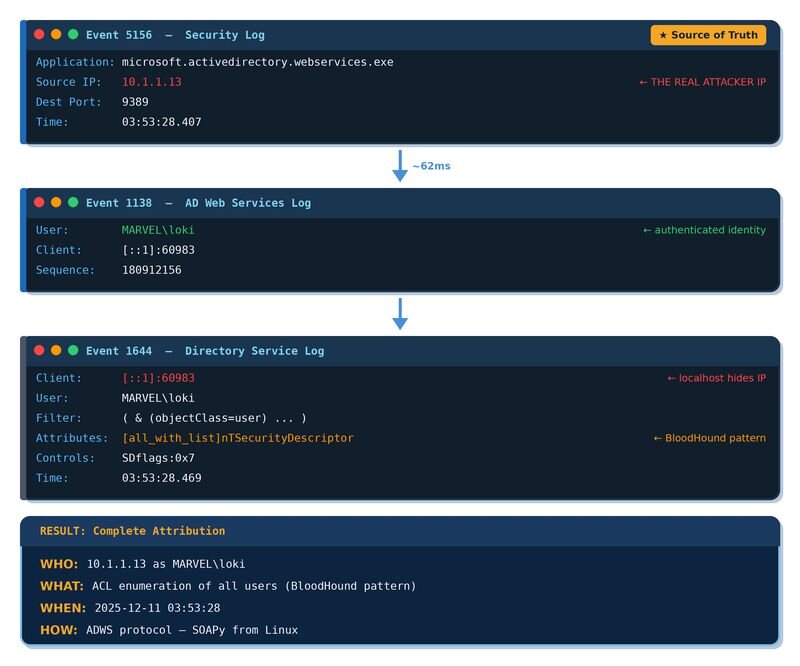
Figure 7: Complete attribution chain: Event 5156 captures the real source IP at the network boundary; Event 1138 ties the ADWS session to the authenticated user; Event 1644 reveals the query—correlate all three, and the attacker has nowhere to hide.


Conclusion

"Can you identify who's querying AD via ADWS?"

Yes. Event 5156 correlation with a ~60–80ms timing window gives you the source IP that Event 1644 hides behind localhost. Port-based correlation works when your SIEM retains the original connection event. Timestamp-based correlation works even when it doesn't.

The data was always there. Nobody was correlating it.


Acknowledgments

  • User 1 - For asking the original question in #red-team

  • User 2 - For explaining the ADWS/LDAP loopback problem and the challenges

  • Charlie Clark - For suggesting Event 5156 correlation as a potential solution

  • BloodHound Slack #red-team - Where the conversation happened


Thanks to Jonathan Johnson, Anton Ovrutsky, Matt Anderson, Tyler Bohlmann, Michael Haag, Nasreddine Bencherchali, and Adam Bienvenu for their help in reviewing this post.


Categories
Cybersecurity Education
ChatGPT logoChatGPTOpens in new tabClaude logoClaudeOpens in new tabPerplexity logoPerplexityOpens in new tabGoogle Gemini logoGoogle AIOpens in new tab
AI sparkle iconSummarize This Page
ChatGPT logoChatGPTOpens in new tabClaude logoClaudeOpens in new tabPerplexity logoPerplexityOpens in new tabGoogle Gemini logoGoogle AIOpens in new tab

Don't let "later" cost you

Join us on May 20 (12pm EST) for _declassified, for an unfiltered look from Truman Kain at the overlooked security obligations that hit hard later.
Register now
Share
Facebook iconTwitter X iconLinkedin iconDownload icon
Glitch effect

You Might Also Like

  • Should MSPs Turn Off Google Gemini?

    Hackers are using Google Gemini's email summaries to sneak in phishing attacks without links or attachments.
  • I Have a Lot to be Thankful for in 2020

    Huntress CEO Kyle Hanslovan has a lot to be thankful for in 2020 — and it starts with the MSP community.
  • When Trust Becomes a Trap: How Huntress Foiled a Medical Software Update Hack

    Hackers cloned a legitimate medical image viewer site to distribute malware, but thanks to Huntress, the threat was detected in time. Dive into the incident and see how we uncovered the deception and averted disaster.
  • Deep Dive: Kaseya VSA Mining Payload

    For many of us in the Managed Services Provider market, we were rocked with news of a vulnerability in Kaseya’s VSA product. The purpose of this blog is to shine technical light on what the Huntress ThreatOps team observed and analyzed thus far.
  • Triangulation

    This blog dives into triangulation as a guiding concept during investigations and reporting.
  • “Advanced” Intrusion Targeting Executive at Critical Marketing Research Company

    An intrusion at a market research company used living-off-the-land techniques, but Huntress detected and mitigated the threat, uncovering tactics like service creation and registry manipulation. Learn more and get detection guidance and mitigation strategies.
  • GWS and Business Email Compromise: Why BEC Is Now an Identity Problem

    Modern BEC attacks now abuse Google Workspace identities. Discover why BEC is an identity problem, and learn how to secure your organization against these threats.
  • A Parent's Guide to Securing Children's Tech Gifts

    Safeguard holiday tech gifts for kids this season—secure their devices, protect privacy, and build lifelong safety habits. Feat. resources from our exclusive Fireside Chat.

Sign Up for Huntress Updates

Get insider access to Huntress tradecraft, killer events, and the freshest blog updates.
Privacy • Terms
By submitting this form, you accept our Terms of Service & Privacy Policy
Huntress Managed Security PlatformManaged EDRManaged EDR for macOSManaged EDR for LinuxManaged ITDRManaged SIEMManaged Security Awareness TrainingManaged ISPMManaged ESPMBook a Demo
PhishingComplianceBusiness Email CompromiseEducationFinanceHealthcareManufacturingState & Local Government
Managed Service ProvidersResellersIT & Security Teams24/7 SOCCase Studies
BlogResource CenterCybersecurity 101Upcoming EventsSupport Documentation
Our CompanyLeadershipNews & PressCareersContact Us
Huntress white logo

Protecting 242k+ customers like you with enterprise-grade protection.

Privacy PolicyCookie PolicyTerms of UseCookie Consent
Linkedin iconTwitter X iconYouTube iconInstagram icon
© 2025 Huntress All Rights Reserved.

Join the Hunt

Get insider access to Huntress tradecraft, killer events, and the freshest blog updates.

By submitting this form, you accept our Terms of Service & Privacy Policy