What’s IASM? Identity Attack Surface Management Explained

Key Takeaways:

  • Stolen passwords and other identity-based attacks are now among the most common entry points for data breaches.
  • Identity and access management (IAM) helps strengthen your security posture, but it leaves gaps like accounts with too much access, old forgotten accounts, and passwords that are hard to track and control.
  • Identity attack surface management (IASM) helps close these gaps by automatically finding hidden risks, flagging the most urgent ones, and helping your team resolve them fast, using automated fixes where possible and clear guidance where human decisions are needed.
  • IT managers can rely on security partners like Huntress to get round-the-clock coverage without hiring more staff.

When you think of the biggest breaches in the news, zero-day exploits (attacks that abuse unknown software flaws) or sophisticated ransomware probably come to mind. But the truth is that most breaches start with a stolen password, an over-permissioned profile, or a forgotten service account that nobody’s touched for years.

That makes the identity attack surface—the sum total of all the user accounts and permissions threat actors can exploit—one of the most overlooked gaps in modern security. The problem gets even harder to manage when you consider problems like staff shortages, high labor costs, and burned out teams. So, what can you do to fix it?

This guide defines IASM, explaining why it matters and how your team can put IASM best practices to work without increasing headcount or labor costs.

What’s IASM? Identity Attack Surface Management Explained

Key Takeaways:

  • Stolen passwords and other identity-based attacks are now among the most common entry points for data breaches.
  • Identity and access management (IAM) helps strengthen your security posture, but it leaves gaps like accounts with too much access, old forgotten accounts, and passwords that are hard to track and control.
  • Identity attack surface management (IASM) helps close these gaps by automatically finding hidden risks, flagging the most urgent ones, and helping your team resolve them fast, using automated fixes where possible and clear guidance where human decisions are needed.
  • IT managers can rely on security partners like Huntress to get round-the-clock coverage without hiring more staff.

When you think of the biggest breaches in the news, zero-day exploits (attacks that abuse unknown software flaws) or sophisticated ransomware probably come to mind. But the truth is that most breaches start with a stolen password, an over-permissioned profile, or a forgotten service account that nobody’s touched for years.

That makes the identity attack surface—the sum total of all the user accounts and permissions threat actors can exploit—one of the most overlooked gaps in modern security. The problem gets even harder to manage when you consider problems like staff shortages, high labor costs, and burned out teams. So, what can you do to fix it?

This guide defines IASM, explaining why it matters and how your team can put IASM best practices to work without increasing headcount or labor costs.

What’s identity attack surface management (IASM)?

IASM is a form of proactive security posture management that helps teams continuously discover, analyze and reduce identity-related risks. It focuses specifically on securing digital identities—the unique credentials and access permissions assigned to both people and systems. User accounts and access permissions let your team log into daily apps and share files instantly, but they’re also potential entry points for threat actors. The goal of IASM is to cut off the common routes that threat actors take to get into your systems and spread across your environment.


How IASM works: Discovery, risk prioritization, & threat mitigation

There are a few core IASM functions that explain how the practice protects your organization:

  • Discovery: Uncovers every identity in your environment, including dormant accounts, service accounts, and shadow IT that slipped through the cracks
  • Risk prioritization: Highlights the accounts that pose the biggest risk, such as over-privileged users or accounts with weak authentication
  • Threat mitigation: Fixes identity misconfigurations and risky accounts before threat actors can exploit them, automatically wherever possible, and feeds high-risk findings into your detection and response workflows so live attacks are contained quickly.

Why identity attack surface management matters (& why traditional IAM isn't enough)

Identity and access management (IAM) tools control who gets access to which resources and enforce core policies like SSO and MFA. But they weren’t built to continuously surface the risks hiding inside that access. Issues like excessive permissions, dormant accounts, misconfigured conditional access, and weak or inconsistent MFA enforcement can linger for months or even years. IASM closes that gap by continuously assessing your identity environment for those blind spots and prioritizing what to fix first.

Common identity vulnerabilities attackers exploit

Identity-based attacks often follow the same well-worn paths. Threat actors can get creative, and some increasingly use generative AI to find new ways in. Still, these are the security gaps they rely on most often:

  • Over-privileged accounts: When a login has more access than it actually needs, it becomes a powerful tool if someone gets hold of it. Threat actors use these accounts to reach sensitive systems and spread further into your network.
  • Dormant accounts: Old logins that IT never deactivated are easy targets. Nobody’s watching them, and they still work. Some may even belong to former employees who had high levels of access, like a CTO or IT admin.
  • Service accounts without credential rotation: Service accounts and other non‑human identities without regular credential rotation. Their passwords are rarely changed or monitored, which makes them valuable targets after a breach.
  • Weak, inconsistent, or missing MFA: MFA requires users to verify their identity in more than one way, like entering a password and then a code sent to their phone. It isn’t foolproof, but accounts without it are much easier to compromise. Ideally, MFA is required for all accounts, especially high-risk ones.
  • Shadow IT identities & unmanaged SaaS accounts: Apps and tools set up outside of IT's knowledge create logins that nobody tracks. When threat actors exploit these, it’s even harder for IT teams to spot the breach.

How to scale identity attack surface management without adding headcount

Lean security teams don’t have time to manually audit every user permission or configure every module for complex new software platforms. Most teams are already dealing with too many alerts, disconnected tools, and everyday threats. That’s why effective IASM relies on tools that automate the heavy lifting.

Automated discovery

You can’t secure what you don’t know exists. Automated discovery continuously scans your systems to find and map every user account and profile. Manual audits only capture a snapshot of active or forgotten accounts at a specific point in time. Automated scanning keeps that picture current across the entire organization.

Risk prioritization

Not every identity risk needs your immediate attention. Good attack surface management tools analyze, score, and rank findings by potential impact, so your team can address higher-risk accounts first. This prioritization matters most for teams that don’t have the capacity to review every alert.

Identity hardening

Once you know what’s at risk, the next step is locking it down. Identity hardening strategies depend on the risks you find and their underlying causes, but common fixes include:

  • Enforcing least privilege so each account can only reach what it actually needs
  • Regularly changing service account passwords
  • Revoking account access after employees leave
  • Setting expiration dates on temporary access
  • Switching to just-in-time (JIT) access for high-risk requests, like admin controls or sensitive personally identifiable information (SPII)

Continuous monitoring

Your identity attack surface changes constantly as people join your organization, leave, or change roles. Continuous monitoring tools keep a watch on those changes. Ideally, your IASM tool also triggers an automatic response when it spots an unsecured account or other risk. This is also a key component of identity security posture management (ISPM), the ongoing work of cleaning up your identity security to harden attack paths and eliminate blind spots.

Secure your identity attack surface with Huntress

Understanding how IASM works is only the first step; the real hurdle is finding the people to manage your identity attack surface. Many security leaders face a tough choice: get a budget for more in‑house specialists, or pile even more identity work onto an already stretched team.

Huntress solves this by offering a unified approach. Managed identity security posture management (ISPM) hardens your environment to prevent attacks before they start. Managed identity threat detection and response (ITDR) provides a 24/7 security operations center (SOC) to spot threats across your organization and quickly respond to shut down identity attacks.

Our human analysts continuously monitor your environment for identity-based attacks, validating every single threat before taking action to protect the identity. We then guide your team through remediating the issue.

For the IT department, this eliminates alert fatigue, puts an end to chasing false positives, and prevents waking up to overnight security disasters. For leadership, it means IASM doesn’t have to be a separate line item in the budget.


Get started today

Identity-based attacks aren’t slowing down, and traditional IAM alone isn’t enough to stop them. IASM closes critical security gaps, but it only works as well as the resources behind it. With the right tools and SOC support, you can get around-the-clock security coverage without building a team from scratch.

Ready to see how Huntress Managed ITDR can help secure your organization? Get started for free.

Frequently Asked Questions

Traditional IAM controls who has access to various resources across your organization. IASM goes a step further by helping teams analyze the risks associated with that access. It looks for things like dormant accounts, excessive permissions, and weak authentication—gaps that IAM tools weren’t built to catch. Both play a crucial role in ISPM.

User accounts are the most obvious access points, but IASM tools also scan for and monitor the following:

  • Service accounts
  • Machine identities
  • Third-party app integrations
  • Shadow IT profiles

Yes—by partnering with a managed security provider that takes on that role for you. IASM best practices don’t require a huge in‑house identity team, but they do require continuous monitoring and fast response. A managed SOC like Huntress can deliver that coverage as part of Managed ITDR, while Managed ISPM handles the day‑to‑day hardening work in Microsoft 365, so your internal team doesn’t have to.

Zero trust is a security model that treats every user and device as a potential risk until proven otherwise. No one gets automatic access just because they’re already in the network. IASM supports this by continuously checking identities and reducing unnecessary access. It’s a natural fit for teams enforcing least privilege or JIT access as part of their zero trust model.


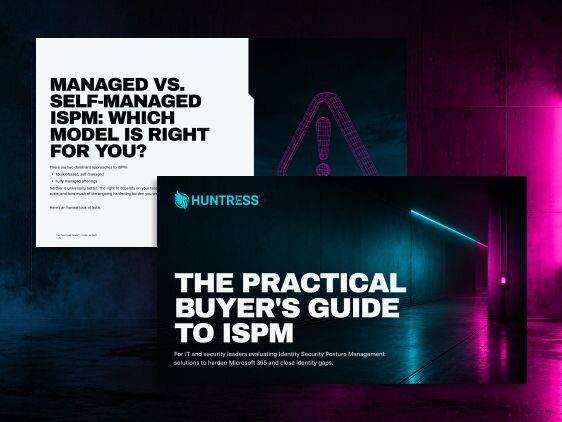
Choosing an ISPM Solution? Get the Playbook.

Not every ISPM tool actually hardens your posture, some just give you another dashboard to monitor. The Practical Buyer's Guide to ISPM breaks down the capabilities that matter, the questions to ask vendors, and whether a managed or self-managed model fits your team.

Get Your ISPM Buyers Guide