

Shadow AI is already taking root across financial services and many firms are discovering it only after the fact. Employees are turning to AI tools to work faster and more efficiently, but in a highly regulated industry, unsanctioned AI use can introduce serious security, privacy, and compliance risks. Adoption is spreading at the edge of the organisation, moving faster than governance, visibility, and controls can keep pace.
What is Shadow IT and Shadow AI? The same or different
Shadow IT refers to technology, applications, devices or cloud services being used within an organisation without the approval or governance of the IT function. Here is an example: an employee integrates their work calendar with an external calendar management tool for productivity purposes. The IT department has not approved this external integration and they have no monitoring capabilities, making it difficult to manage the potential risk.
Shadow AI occurs when AI tools or models are used in an organisation without approval or governance. Unauthorised data exposure into public AI models carries a huge unaccounted risk. Here is an example: an employee needs to review a vast amount of spreadsheets with customer data and so they decide to upload this data into a public Generative AI model like ChatGPT. They prompt ChatGPT to analyse the data. Now your organisation's customer data has found itself into a public model and there are no data controls to prevent that data being used and shared on the internet by other people who are not associated with your business.
How big is the Shadow AI problem and why is financial services especially exposed?
Let's be realistic, most financial services organisations have some visibility into which AI tools are being used, however like every other company, shadow AI exists. Meaning unsanctioned AI tools exist within the business that haven't been vetted by IT, security or legal teams therefore the risks are unknown. The sector is particularly exposed because of the combination of highly sensitive data, complex regulatory obligations, and competitive pressure to move quickly. For the leadership team it's hard to direct resources to investigate shadow AI when there's no clear evidence for it. There's more direct ROI for leadership to put their resources on other tasks which deliver something back to the business.
Which AI tools are employees using, and how are they using them?
The usual obvious tools are out there: ChatGPT, Microsoft Copilot. But we've moved past just prompt tools over the last few years to a huge number of AI meeting and writing tools amongst other virtual assistants and automation tasks. Thankfully, I have approved access to summarisation tools which help reduce a number of administrative tasks. But I can see how employees would very quickly pivot to use these tools without approval, sometimes even on their own personal devices. Tools that can help draft client communications, summarise client calls, analyse financial data, generate reports and more. To use these tools you have to share the data, which brings into question what data is being given to these unapproved tools. This is when data leakage becomes a tangible risk factor for many businesses.
What risks does Shadow AI create and how is it different from Shadow IT?
Shadow IT focuses on unmanaged software and applications and how that creates a security hole in the business. The recent N-able vulnerability affecting N-central is a good example of dangers posed by Shadow IT. In many environments, Huntress found large numbers of N-central deployments were still present without partners or end customers being aware of them, often remnants of previous Managed Service Provider (MSP) relationships or abandoned trials.
This shows how limited visibility into unsanctioned or forgotten tools can create a serious security gap. When a widely deployed platform is affected by a major vulnerability, the combination of hidden exposure and supply-chain risk can enable attacks to spread quickly, with potentially devastating consequences.
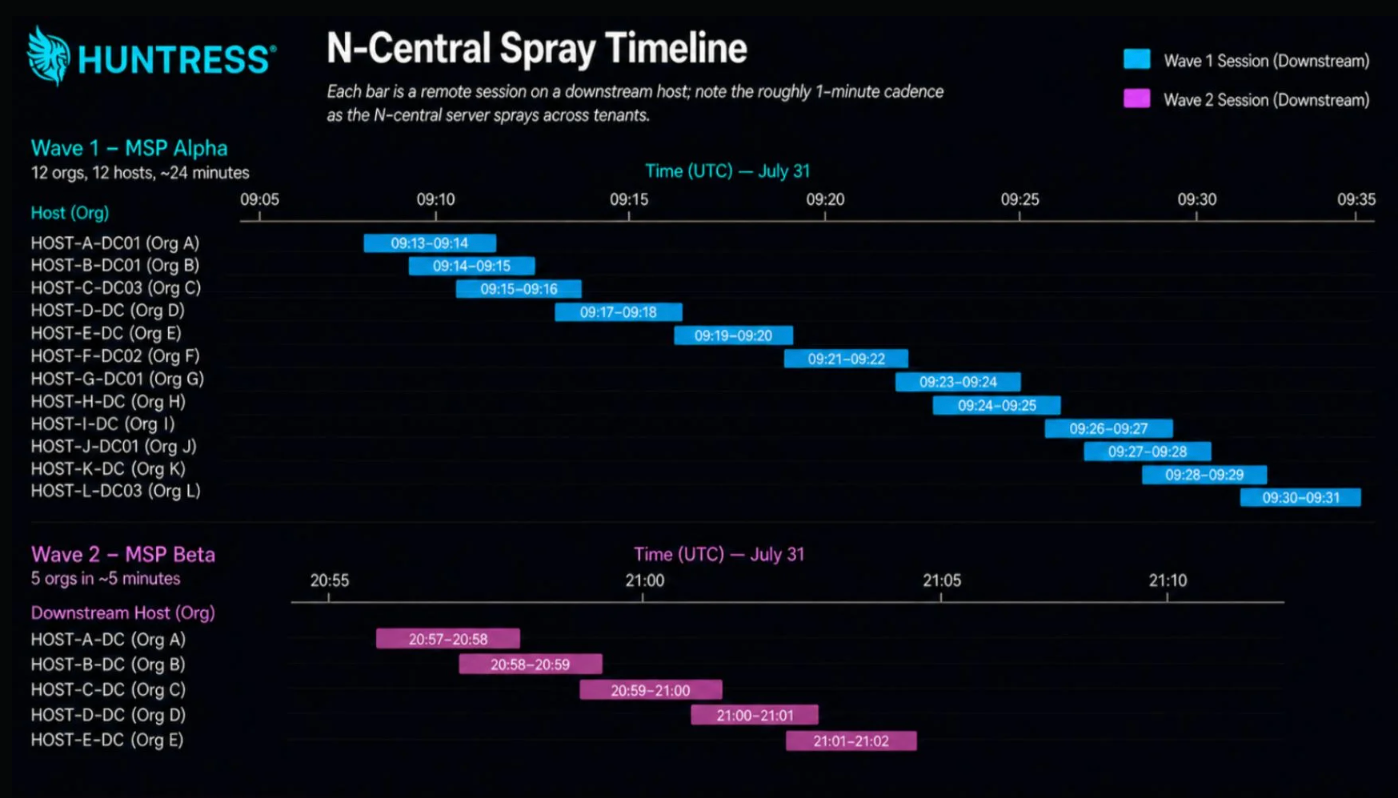
Figure 1: Timeline of threat actors tearing through downstream hosts on two impacted organizations
/
Fundamentally, shadow AI is a different problem. While there is a risk of an insecure AI tool for the financial sector, the bigger risk is data. When data lands in a tool that is not controlled or governed by the business, it's a potential breach of client confidentiality, data protection regulation, and in some cases, market conduct rules.
Why isn't completely blocking AI an effective strategy?
Blocking AI tools completely actually does more harm. As the risk to the business increases, there is now a higher chance that employees will start finding ways to circumvent these blocked tools and could resort to using personal devices. At the same time, it puts the employees and the business in a disadvantaged situation against their competitors, who are most definitely adopting AI and bringing efficiencies to their customers.
How to get ahead of Shadow AI risk
The risks we covered above are exactly why organisations need to get ahead of the curve, evaluating AI tools and approving their use for the business. When IT sanctions and secures the right tools with clear policy guidelines, employee adoption becomes safer.
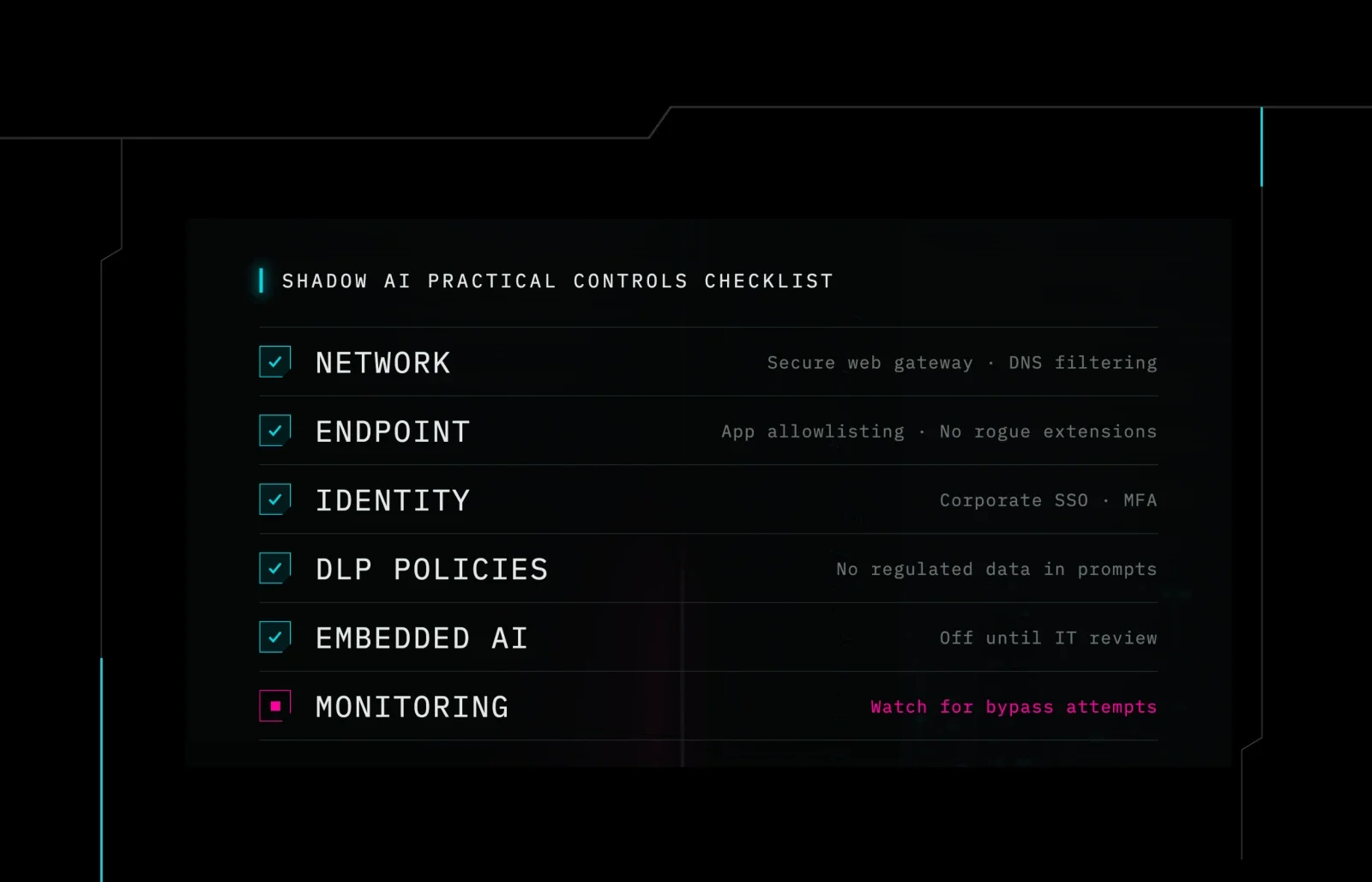
Your practical controls checklist for managing Shadow AI
At the network level, use secure web gateways, DNS filtering, to identify and block access to unapproved AI services.
When it comes to endpoint and browsers, enforce application allowlisting and restrict the installation of unsanctioned browser extensions and desktop AI clients.
From an identity perspective, require approved AI tools to use corporate SSO, MFA, rather than personal logins.
Apply data loss prevention (DLP) policies to prevent sensitive, regulated, or customer data from being submitted into a prompt or uploaded to unauthorised AI platforms.
Turn off default, embedded generative AI options in approved enterprise software. This should only be enabled after review from the IT department.
Monitor AI-related traffic and endpoint activity for new services, unusual activity, or attempts to bypass controls.
How to build a safer, more structured approach to AI adoption
A combination of things can help employees and the business adopt AI in a more controlled manner:
Provide employees with some of the leading AI tools. Invest time and money into vetting and approving these tools because this stops employees from looking elsewhere.
Have a clear, unambiguous AI acceptable use policy that provides clarity with specific tools mentioned in the policy.
Create a culture that allows your employees to bring feedback and suggestions on new AI tools for review.
Educate employees with on going awareness training on AI across the business, not only on the risks of AI and data leakage, but provide education on how to maximise the value of these AI tools and how to better use them.
Good AI governance: actionable advice for security and compliance leaders
Gather an inventory or survey your employees to understand what AI tools are being used. Be very clear this isn't a reprimand exercise but actually an opportunity to influence what the business could adopt more widely.
Create an AI council or review board that will evaluate new tools and be the voice of authority on AI topics for employees and the leadership team. The AI council should not be formed of leaders only, it needs a broad mix of people to balance and provide feedback.
Create a culture that allows employees to learn AI use cases from one another. This will help AI adoption but also improve AI literacy in the business. Establish a Q&A channel to remove any ambiguity and allow employees to ask those specific questions about what they can and cannot do.
AI is moving fast so AI governance is not a one-time thing. The business cannot be rigid in processes and will need to be dynamic and move quickly.