

Don’t let overlooked obligations become incidents. Learn how.
Utility navigation bar redirect icon
Portal LoginSupportContact
Search
Close search
Huntress Logo in Teal
  • Platform Overview
    Managed EDR

    Get full endpoint visibility, detection, and response.

    Managed EDR

    Get full endpoint visibility, detection, and response.

    Managed ITDR

    Protect your Microsoft 365 identities and email environments.

    Managed ITDR

    Protect your Microsoft 365 identities and email environments.

    Managed SIEM

    Managed threat response and robust compliance support at a predictable price.

    Managed SIEM

    Managed threat response and robust compliance support at a predictable price.

    Managed Security Awareness Training

    Empower your teams with science-backed security awareness training.

    Managed Security Awareness Training

    Empower your teams with science-backed security awareness training.

    Managed ISPM

    Continuous Microsoft 365 and identity hardening, managed and enforced by Huntress experts.

    Managed ISPM

    Continuous Microsoft 365 and identity hardening, managed and enforced by Huntress experts.

    Managed ESPM

    Proactively secure endpoints against attacks.

    Managed ESPM

    Proactively secure endpoints against attacks.

    Integrations
    Integrations
    Support Documentation
    Support Documentation
    See Huntress in Action

    Quickly deploy and manage real-time protection for endpoints, email, and employees - all from a single dashboard.

    Huntress Cybersecurity
    See Huntress in Action

    Quickly deploy and manage real-time protection for endpoints, email, and employees - all from a single dashboard.

    Huntress Cybersecurity
  • Threats We Stop
    Phishing
    Phishing
    Business Email Compromise
    Business Email Compromise
    Ransomware
    Ransomware
    Infostealers
    Infostealers
    View Allright arrowView Allright arrow
    Industries We Serve
    Education
    Education
    Financial Services
    Financial Services
    State and Local Government
    State and Local Government
    Healthcare
    Healthcare
    Law Firms
    Law Firms
    Manufacturing
    Manufacturing
    Utilities
    Utilities
    View Allright arrowView Allright arrow
    Tailored Solutions
    MSPs
    MSPs
    Resellers
    Resellers
    SMBs
    SMBs
    Compliance
    Compliance
    What Gets Overlooked Gets Exploited

    Most days, nothing happens. But one day, something will.

    Huntress Cybersecurity
    Cybercriminals Have Evolved

    Get the intel on today’s cybercriminal groups and learn how to protect yourself.

    Huntress Cybersecurity
  • Pricing
  • Community Series
    The Product Lab

    Shape the next big thing in cybersecurity together.

    The Product Lab

    Shape the next big thing in cybersecurity together.

    Fireside Chat

    Real people. Real perspectives. Better conversations.

    Fireside Chat

    Real people. Real perspectives. Better conversations.

    Tradecraft Tuesday

    No products, no pitches – just tradecraft.

    Tradecraft Tuesday

    No products, no pitches – just tradecraft.

    _declassified

    Exposing hidden truths in the world of cybersecurity.

    _declassified

    Exposing hidden truths in the world of cybersecurity.

    Resources
    Upcoming Events
    Upcoming Events
    Ebooks
    Ebooks
    On-Demand Webinars
    On-Demand Webinars
    Videos
    Videos
    Whitepapers
    Whitepapers
    Datasheets
    Datasheets
    Cybersecurity Education
    Cybersecurity 101
    Cybersecurity 101
    Cybersecurity Guides
    Cybersecurity Guides
    Threat Library
    Threat Library
    Real Tradecraft, Real Results
    Real Tradecraft, Real Results
    2026 Cyber Threat Report
    2026 Cyber Threat Report
    The Huntress Blog
    Huntress Lands on the Microsoft Marketplace
    Huntress Cybersecurity
    Huntress Lands on the Microsoft Marketplace
    Huntress Cybersecurity
    How Huntress & DEFCERT Are Streamlining CMMC Assessment Prep
    Huntress Cybersecurity
    How Huntress & DEFCERT Are Streamlining CMMC Assessment Prep
    Huntress Cybersecurity
    Live Hacking Into Microsoft 365 with Kyle Hanslovan
    Huntress Cybersecurity
    Live Hacking Into Microsoft 365 with Kyle Hanslovan
    Huntress Cybersecurity
  • Why Huntress

    Go beyond AI in the fight against today’s hackers with Huntress Managed EDR purpose-built for your needs

    Huntress Cybersecurity
    Why Huntress

    Go beyond AI in the fight against today’s hackers with Huntress Managed EDR purpose-built for your needs

    Huntress Cybersecurity
    The Huntress SOC

    24/7 Security Operations Center

    The Huntress SOC

    24/7 Security Operations Center

    Reviews

    Why businesses of all sizes trust Huntress to defend their assets

    Reviews

    Why businesses of all sizes trust Huntress to defend their assets

    Case Studies

    Learn directly from our partners how Huntress has helped them

    Case Studies

    Learn directly from our partners how Huntress has helped them

    Community

    Get in touch with the Huntress Community team

    Community

    Get in touch with the Huntress Community team

    Compare Huntress
    Bitdefender
    Bitdefender
    Blackpoint
    Blackpoint
    Breach Secure Now!
    Breach Secure Now!
    Crowdstrike
    Crowdstrike
    Datto
    Datto
    SentinelOne
    SentinelOne
    Sophos
    Sophos
    Compare Allright arrowCompare Allright arrow
  • HUNTRESS HUB

    Login to access top-notch marketing resources, tools, and training.

    Huntress Cybersecurity
    HUNTRESS HUB

    Login to access top-notch marketing resources, tools, and training.

    Huntress Cybersecurity
    Partners
    MSPs

    Join our partner community to deliver expert-led managed security.

    MSPs

    Join our partner community to deliver expert-led managed security.

    Resellers

    Partner program designed to grow your cybersecurity business.

    Resellers

    Partner program designed to grow your cybersecurity business.

    Tech Alliances

    Driving innovation through global technology Partnerships

    Tech Alliances

    Driving innovation through global technology Partnerships

    Microsoft Partnership

    A Level-Up for Your Business Security

    Microsoft Partnership

    A Level-Up for Your Business Security

  • Press Release
    Huntress Announces Collaboration with Microsoft to Strengthen Cybersecurity for Businesses of All Sizes
    Huntress Cybersecurity
    Press Release
    Huntress Announces Collaboration with Microsoft to Strengthen Cybersecurity for Businesses of All Sizes
    Huntress Cybersecurity
    Our Story

    We're on a mission to shatter the barriers to enterprise-level security.

    Our Story

    We're on a mission to shatter the barriers to enterprise-level security.

    Newsroom

    Explore press releases, news articles, media interviews and more.

    Newsroom

    Explore press releases, news articles, media interviews and more.

    Meet the Team

    Founded by former NSA Cyber Operators. Backed by security researchers.

    Meet the Team

    Founded by former NSA Cyber Operators. Backed by security researchers.

    Careers

    Ready to shake up the cybersecurity world? Join the hunt.

    Careers

    Ready to shake up the cybersecurity world? Join the hunt.

    Awards
    Awards
    Contact Us
    Contact Us
  • Portal Login
  • Support
  • Contact
  • Search
  • Get a Demo
  • Start for Free
Portal LoginSupportContact
Search
Close search
Get a Demo
Start for Free
HomeCybersecurity GuidesInsider Threats Guide
Insider threat hunting

Proactive Techniques to Identify Insider Risks

Published:
February 10, 2026

When you think of cybersecurity threats, you’re probably tapping into visions of shadowy figures in hoodies, hunched over keyboards in dark rooms. The reality, though, is often way less dramatic and closer to home. The biggest risks often tiptoe inside your organization as authorized, legitimate users. 

That’s right: we’re talking about insider threats. These are risks that come from the people you trust (and probably spend a lot of time with), like your employees, contractors, and partners. It sounds scary, and it can be, but don't panic. 

This guide breaks down what insider threats are, how to spot them, and how you can use threat hunting as a proactive strategy to find them in your environment. 


Try Huntress for Free
Get a Free Demo
Topics
Proactive Techniques to Identify Insider Risks
Down arrow
Topics
  1. Types of Insider Threats: Malicious, Negligent, and Compromised Employees
  2. Insider Risk Management: Strategies to Detect and Minimize Insider Risks
  3. Warning Signs of Potential Insider Attacks
  4. Proactive Techniques to Identify Insider Risks
    • What are insider threats?
    • What's an example of an insider threat?
    • What is threat hunting?
    • What is an example of threat hunting?
    • What are the three types of cyber threat hunting?
    • Put on your detective hat, hunt for insider threats
  5. How to Prepare for and Mitigate Insider Attacks
Share
Facebook iconTwitter X iconLinkedin iconDownload icon

Proactive Techniques to Identify Insider Risks

Published:
February 10, 2026

When you think of cybersecurity threats, you’re probably tapping into visions of shadowy figures in hoodies, hunched over keyboards in dark rooms. The reality, though, is often way less dramatic and closer to home. The biggest risks often tiptoe inside your organization as authorized, legitimate users. 

That’s right: we’re talking about insider threats. These are risks that come from the people you trust (and probably spend a lot of time with), like your employees, contractors, and partners. It sounds scary, and it can be, but don't panic. 

This guide breaks down what insider threats are, how to spot them, and how you can use threat hunting as a proactive strategy to find them in your environment. 


Try Huntress for Free
Get a Free Demo

What are insider threats?

Insider threats are risks from people within an organization who use their authorized access or organizational knowledge to cause damage. According to the Cybersecurity and Infrastructure Security Agency (CISA), an insider is any person who has or had authorized access or knowledge of an organization’s resources, including personnel, facilities, information, equipment, networks, and systems. 

That’s a lot of potential people who can unleash chaos on your attack surface. But it's not always a case of a pissed off employee trying to sabotage the company on their way out. More often than not, it's completely unintentional and accidental. 

Here’s how insider threats are categorized:

1. The malicious insider

A malicious insider intentionally misuses their authorized access to steal data, disrupt business operations, or otherwise harm the organization. Their motives can range from financial gain, like selling company secrets, to settling a score for perceived wrongdoing. The bottom line is they know the rules of the game the organization plays by, and they’re willing to break them for personal gain. 

2. The compromised insider

A compromised insider is an employee whose credentials have been stolen by an external attacker, often through phishing scams, malware, or stolen credentials. The attacker then uses these credentials to access accounts, systems, and networks as a legitimate user in the organization. The scammed employee has no idea their account is being used for malicious activities, making this type of threat especially sneaky and tough to spot with traditional security measures. 

3. The negligent insider

Negligent insiders aren’t trying to cause harm, but following security policies isn’t always at the top of their to-do list. Their ignorance, mishaps, and mistakes, like clicking on sketchy phishing links, reusing weak passwords across multiple accounts, or connecting to different public wifi networks every time they leave the house, cause security blunders. They’re not trying to stir up a data breach, but unfortunately, their habits can have the same devastating consequences as a malicious attack. 


What's an example of an insider threat?

Let’s break down a classic example of a malicious insider threat. Imagine a sales executive who has been with a company for a few years. She has heaps of organizational knowledge and full access to all the databases with customer information. But she’s hopping to a new job at a top competitor in just a few weeks. In her last week, she logs into the company's CRM like normal, but this time she downloads the entire customer list and stores it on a thumb drive, complete with contact details and sales history. She plans to bring this list directly to the competitor on her first day for an easy competitive edge. 

The employee had legitimate access to the data as part of her job, but she intentionally misused that access for personal gain, regardless of the potential damage she might bring to the company. 

The good news? When insider threat monitoring is part of the security strategy, it flags shady activity like this and alerts the security team.


What is threat hunting?

Threat hunting is a proactive approach that combines intelligence, data logs, and alerts to create and define hypotheses. By testing the hypotheses, defenders find unknown threats, security gaps, and potential zero-day vulnerabilities. 

In other words, instead of waiting for an alarm to go off, threat hunters assume that attackers (in some cases, insider threats) are already inside the network and actively look for signs of shady activity.

Here’s another way to think about threat hunting:

  • Traditional security is like having a burglar alarm on your house. It only goes off after someone has broken in. 

  • Threat hunting is like having a security guard who patrols the property, checks for unlocked windows, and looks for footprints in the garden. 

Threat hunting vibes are all about being proactive, not reactive.


What is an example of threat hunting?


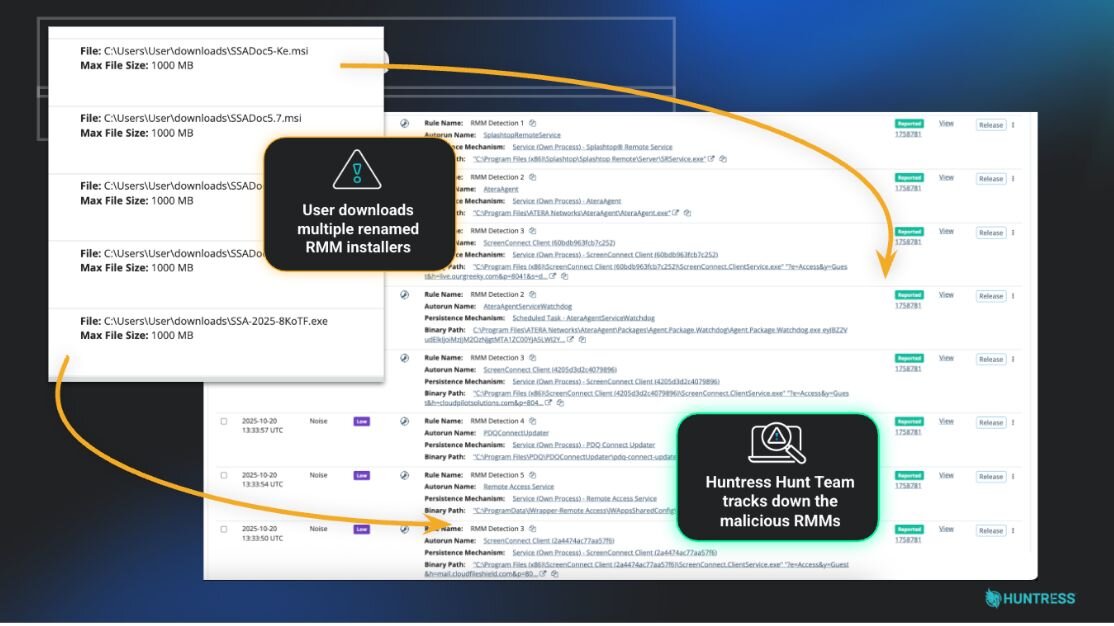
Let’s say a threat hunter is looking for signs of malicious Remote Monitoring and Management (RMM) installation. RMMs are legitimate tools used by threat actors to gain remote access to endpoints. The threat hunters start with a hypothesis, like "An attacker is installing malicious RMM software on endpoints in targeted environments to gain persistence."

Here’s how they test the hypothesis:

  1. Trigger: Something like an alert, abnormal network behavior, or threat intelligence kicks off the hunt. 

  2. Investigation: This involves investigation and analysis of data from tools like Managed Security Information and Event Management (SIEM) and Managed Endpoint Detection and Response (EDR). Analytics and machine learning tools help with pattern recognition and anomaly detection. 

  3. Resolution: Get rid of the problem and kick out the threat actor! Patch vulnerabilities, update security policies, or remove malicious artifacts. 

In this case, the 24/7 Huntress SOC found overwhelming evidence that an attacker tricked a victim into downloading renamed malicious RMM installers disguised as legitimate-looking government documents—a compromised insider. This activity happened over several months. Our SOC analysts used the IoCs on the compromised host to pivot and investigate additional endpoints, quickly spotting evenmore instances of nasty RMMs on different hosts and ultimately kicking the threat actor to the curb. 


Example of a Huntress SOC threat hunt for malicious RMMs

Example of a Huntress SOC threat hunt for malicious RMMs

Threat hunting is a proactive way to spot this type of activity, whether insiders are malicious or unwitting, and shut down the attackers who hide in the noise.  

Want to dig deeper into the world of threat hunting? Check out our video series, Behind the Hunt, to get a backstage pass to threat hunting and security research.


What are the three types of cyber threat hunting?

Threat hunting isn't a one-size-fits-all activity. It’s broken down into three categories, each with a different starting point.

1. Intelligence-Driven Hunting

This type of hunt is based on specific threat intelligence, like an alert from a government agency about a new malware strain, a security vendor report about new threat actor tactics, or SIEM or EDR alerts. The threat hunter uses the intelligence to look for specific indicators of compromise (IOCs) within their own environment.

Check out this example of intelligence-driven threat hunting from our SOC:


2. Hypothesis-Driven Hunting

The hunter uses their knowledge of attacker techniques and their own company's environment to form a hypothesis about a potential threat. For example, they might hypothesize, "An attacker is using PowerShell to run malicious scripts that are disguised as normal administrative tasks." They then actively search for evidence to prove or disprove that hypothesis. This is where a deep understanding of insider threat behavior comes in handy.

3. Anomaly-Driven Hunting (Analytics)

This approach uses machine learning and data analytics to spot outliers and anomalies in user and system behavior. The idea is to establish a baseline of what "normal" looks like for your network. Then, the system automatically flags any activity that strays significantly from that baseline. For example, if an employee who normally works a normal Monday-to-Friday schedule during the day suddenly starts accessing sensitive files at 3 am over the weekend, that's an anomaly worth investigating. This is a powerful tool for insider threat monitoring.

More resources to learn more about proactive threat hunting:

  • Information to Insights: Intrusion Analysis Methodology

  • Utilizing ASNs for Hunting & Response

  • Brute Force or Something More? Ransomware Initial Access Brokers Exposed


Put on your detective hat, hunt for insider threats

Building an insider threat hunting program is a journey, but you can start with a few key steps:

  • Know Your Environment: Understanding what "normal" looks like in your network helps you spot the anomalies that signal insider threats

  • Use threat intelligence: Bring in data from threat intelligence feeds to deepen your understanding of current threat landscapes

  • Encourage continuous learning: Threat landscapes never stop changing—regular training and knowledge updates for your threat hunting team are key

Insider threats are here whether you’re prepared or not. By building a security strategy with proactive threat hunting, you can turn the tables on would-be attackers and protect your organization from the inside out.


Continue Reading

How to Prepare for and Mitigate Insider Attacks

Right arrow

Protect What Matters

Secure endpoints, email, and employees with the power of our 24/7 SOC. Try Huntress for free and deploy in minutes to start fighting threats.
Try Huntress for Free
Huntress Managed Security PlatformManaged EDRManaged EDR for macOSManaged EDR for LinuxManaged ITDRManaged SIEMManaged Security Awareness TrainingManaged ISPMManaged ESPMBook a Demo
PhishingComplianceBusiness Email CompromiseEducationFinanceHealthcareManufacturingState & Local Government
Managed Service ProvidersResellersIT & Security Teams24/7 SOCCase Studies
BlogResource CenterCybersecurity 101Upcoming EventsSupport Documentation
Our CompanyLeadershipNews & PressCareersContact Us
Huntress white logo

Protecting 215k+ customers like you with enterprise-grade protection.

Privacy PolicyCookie PolicyTerms of UseCookie Consent
Linkedin iconTwitter X iconYouTube iconInstagram icon
© 2025 Huntress All Rights Reserved.

Join the Hunt

Get insider access to Huntress tradecraft, killer events, and the freshest blog updates.

By submitting this form, you accept our Terms of Service & Privacy Policy