Enterprise Cybersecurity Guide

Enterprise cybersecurity is what it takes to protect a modern organization when attackers never stop looking for the easiest way in. And in enterprise environments, there are a lot of endpoints to check.

Cloud infrastructure. Remote endpoints. Hybrid networks. SaaS sprawl. Third-party access. Misconfigurations. Unpatched vulnerabilities. Overprivileged accounts. The bigger and more distributed the environment, the easier it is for risk to hide in plain sight.

That’s what makes enterprise cybersecurity so hard. It’s not just the volume of threats. It’s the chaos that comes with trying to manage them all.

Effective enterprise cybersecurity needs a layered, always-on approach across four core areas:

  • Endpoint security
    Every device is a potential foothold for an attacker. Enterprise endpoint security has to go beyond legacy antivirus and basic prevention. It should help security teams continuously monitor activity, detect suspicious behavior, and respond fast before a small problem turns into a major incident.
  • Identity and access management
    Attackers don’t always break in. More often, they log in. Stolen credentials, weak policies, and over-permissioned accounts give threat actors exactly what they need to blend in and move quietly. Strong identity security means enforcing least privilege, tightening access controls, and detecting identity-based threats before they become business-wide problems.
  • Network security
    In a distributed environment, trust can’t be automatic. Network segmentation, zero trust principles, and continuous traffic monitoring help contain threats and limit lateral movement when an attacker gets inside. The goal is simple: make it harder for attackers to move, escalate, and do damage.
  • Threat detection and response
    This is where a lot of teams feel the pressure. Logs pile up. Alerts pile up. Security teams get buried. The right approach isn’t more noise. It’s better signal, faster context, and real response. SIEM, detection, and 24/7 monitoring only matter if they help teams find real threats and act on them quickly.

Underneath all of this should be a clear cybersecurity framework, whether that’s NIST CSF, ISO 27001, or CIS Controls. Frameworks help organizations assess risk, prioritize investments, support compliance, and build a security program that can actually scale.

And today’s threat landscape isn’t getting any easier.

Ransomware has evolved from smash-and-grab malware into targeted, hands-on-keyboard operations. Business email compromise continues to cost organizations billions. Supply chain attacks let adversaries compromise trusted software to reach victims downstream. And AI is helping threat actors move faster, scale faster, and create more convincing attacks across nearly every vector.

But the hardest part of enterprise cybersecurity still isn’t any one tactic. It’s managing protection at scale.

Thousands of endpoints. Dozens of apps. Remote users. Hybrid infrastructure. Vendors with privileged access. Security teams are expected to defend all of it while moving fast, proving value, and keeping the business running.

That’s why enterprise cybersecurity can’t be reactive. It has to be continuous.

Organizations need ongoing vulnerability assessment, attack surface visibility, identity protection, and security operations that reduce manual lift instead of adding to it. Because when teams are stretched thin, complexity becomes its own risk.

The organizations that do this well don’t treat cybersecurity like a box to check or a function to isolate in IT. They treat it like an always-on business priority tied directly to resilience, uptime, and trust.

This guide breaks down how enterprise cybersecurity works, the biggest challenges organizations face right now, and the strategies that help security teams protect more without adding more chaos.


Glow effect

Explore the Enterprise Cybersecurity Guide

1

What is Enterprise Endpoint Management? A Complete Guide

Understand enterprise endpoint management, why it matters, and how to protect every device in your network with centralized, scalable security tools.

2

What is Endpoint Security as a Service (ESS)?

Cybersecurity threats are evolving fast. Every laptop, server, or mobile device connected to your network can become a gateway for attackers. Securing these endpoints is a full-time job, but not every MSP has the in-house resources to do it right.

Endpoint security as a service (ESS) flips the script. Learn more now.


3

Enterprise Security Monitoring Guide

Continuous visibility is the backbone of modern cybersecurity, with information security monitoring making sure organizations can detect, respond to, and recover from threats in real time.

This is where enterprise security monitoring steps in—the 24/7 ICU for your digital infrastructure. It catches silent infections, tracks vital signs, and responds in real time before a minor issue turns into a major incident.

4

Best Enterprise Endpoint Protection Solutions Compared

Get an unbiased look at leading EPP tools, their strengths, limitations, and what enterprises should prioritize when evaluating solutions.


5

How to Build a Strong Enterprise Endpoint Security Strategy

Discover the layered defenses enterprises need, from EDR to IAM, to counter modern threats that slip right past legacy antivirus.


6

Best Enterprise SIEM Solutions for Threat Detection and Compliance

Explore the SIEM landscape and see which solutions balance compliance needs with real threat detection.

7

How to Choose the Right Enterprise Cybersecurity Solution for Your Business?

Cut through the noise with criteria that actually matter: scalability, visibility, integration, and cost.


8

Top Enterprise Security Trends to Watch

From AI-powered threats to supply-chain attacks, get the trends you need on your radar to plan ahead.


9

Enterprise Security Automation for Advanced Cyber Defense

See how automation trims response times, reduces alert fatigue, and frees up human expertise for the real battles.


10

Why Enterprises Need Attack Surface Management to Prevent Cyber Threats?

Your attack surface is bigger than you think. Learn how to continuously map, monitor, and shrink it.


11

A Guide to Implementing an Effective Enterprise Security Framework

Get a roadmap for rolling out a framework that aligns with your business goals while reducing risk.

12

The Biggest Enterprise Network Security Threats and How to Mitigate Them

Unpack the most common network-level threats and practical ways to stop them in their tracks.


13

Enterprise Network Security Best Practices

From segmentation to zero trust, these best practices will keep your network resilient against evolving attackers.


14

How to Conduct a Comprehensive Enterprise Vulnerability Assessment?

Step through how to identify, prioritize, and remediate vulnerabilities before adversaries exploit them.


15

Building a Strong Enterprise Cyber Risk Management Strategy

Learn how to translate technical risk into business impact—and build a strategy leadership will actually back

16

Best Practices for Securing Mobile Devices in Enterprise Environments

With BYOD and remote work here to stay, learn how to lock down mobile endpoints without stifling flexibility.


17

Best Ransomware Protection Solutions and Strategies for Enterprise Organizations

Uncover top enterprise ransomware protection solutions to shield your organization from attacks. Explore key features and benefits to stay secure.


Enterprise cybersecurity refers to the strategies, technologies, processes, and practices that organizations implement to protect their digital assets, systems, networks, and data from cyber threats.

It is a comprehensive approach to safeguarding an enterprise's IT infrastructure and sensitive information against unauthorized access, data breaches, malware, ransomware, phishing attacks, and other cyber risks.

In today's digital landscape, enterprise cybersecurity is not just a technical necessity but a critical business priority to ensure resilience and long-term success.


Additional Resources

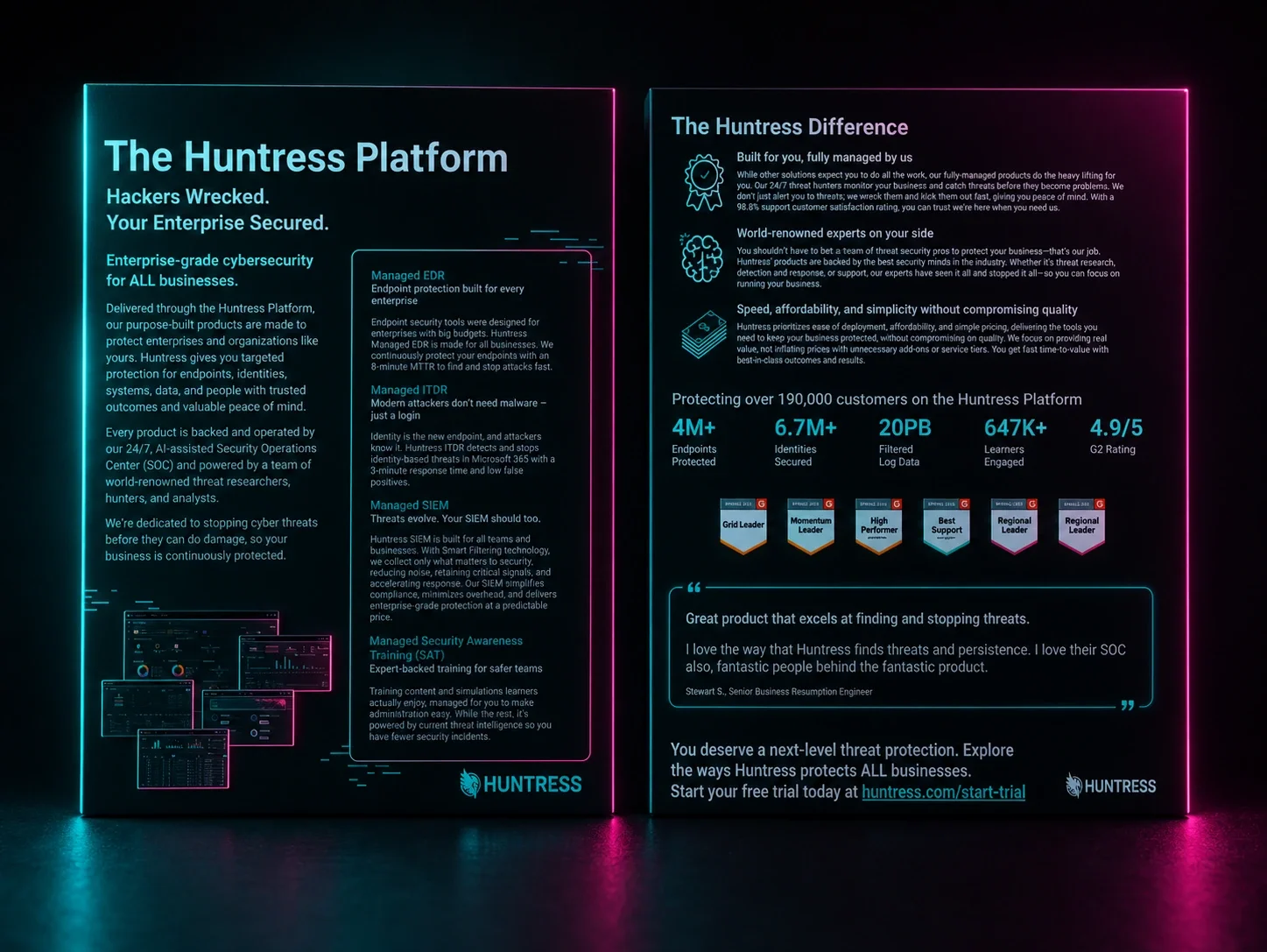
Read more about The Huntress Security Platform Overview Datasheet
The Huntress Security Platform Overview Datasheet
Datasheet

Explore The Huntress Security Platform, included services and key features.

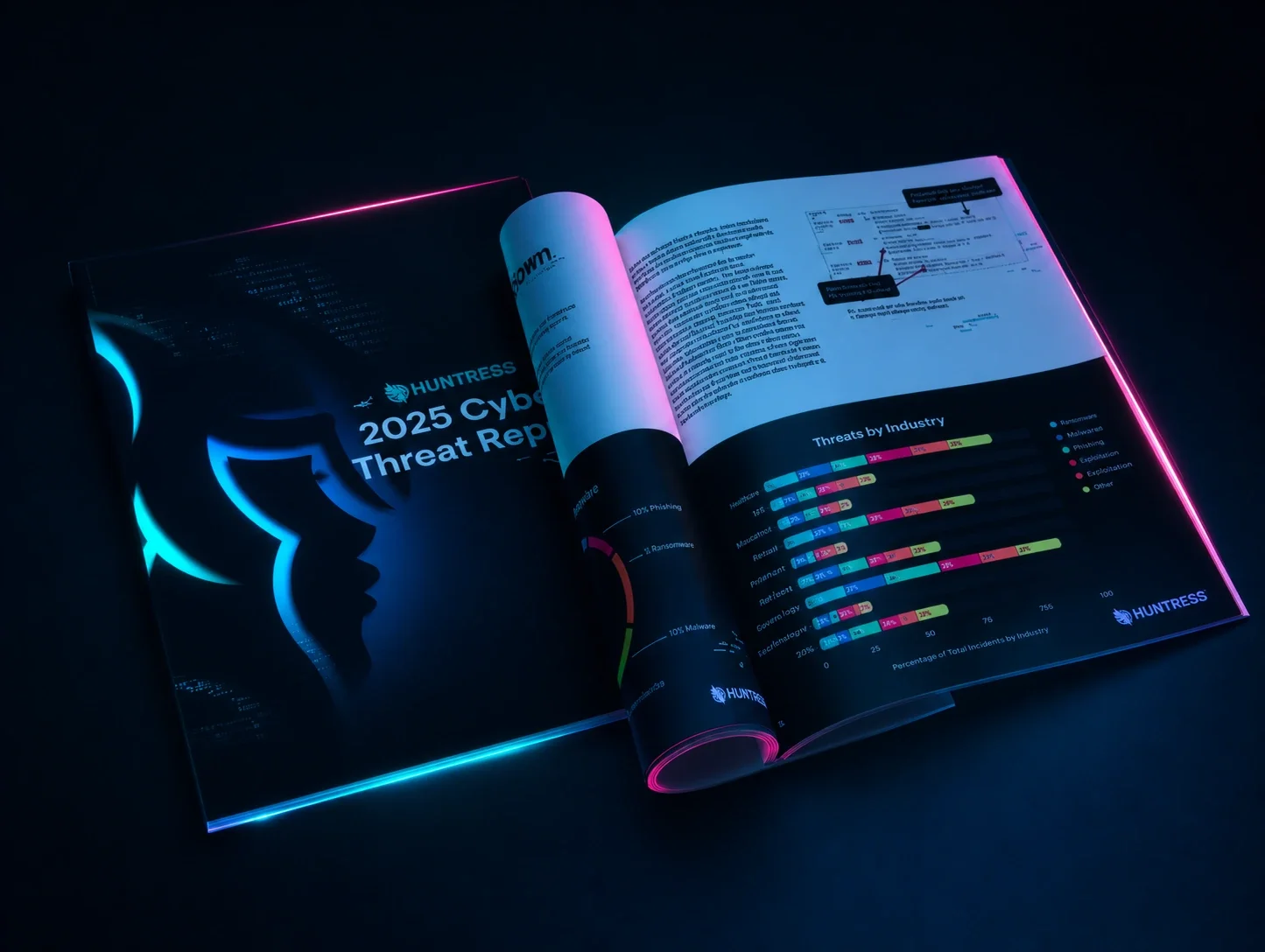
Read more about Huntress 2025 Cyber Threat Report: Proliferating RATs, Evolving Ransomware, and Other Findings
Huntress 2025 Cyber Threat Report: Proliferating RATs, Evolving Ransomware, and Other Findings
Blog Post
RATs proliferating. Ransomware evolving. Attackers getting quieter. The Huntress 2025 Cyber Threat Report is out. Check out the key findings from a year of tracking threats across millions of endpoints.
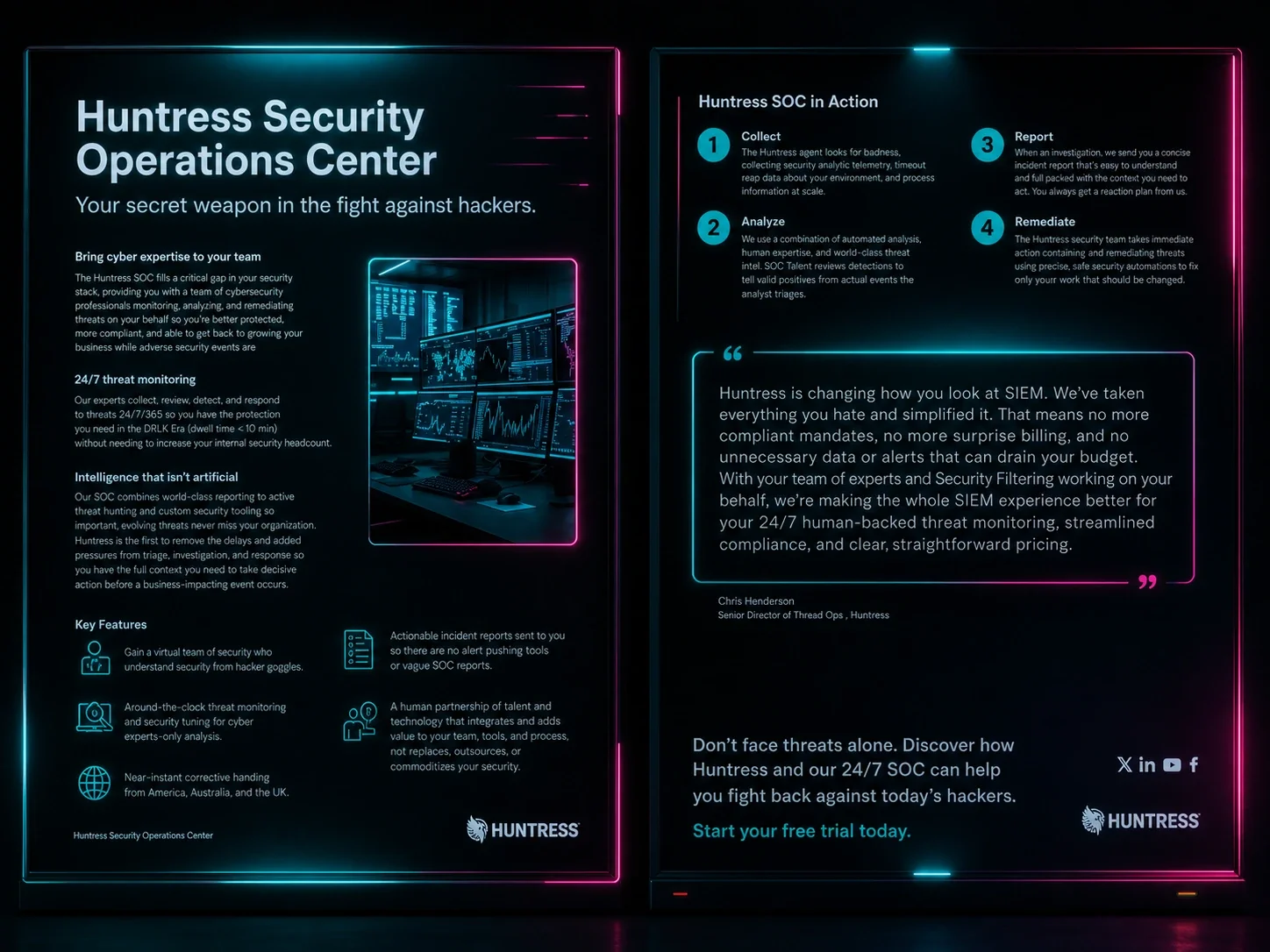
Read more about Huntress SOC Datasheet
Huntress SOC Datasheet
Datasheet

Learn about our 24/7 Security Operations Center (SOC), how our team operates, and the value they deliver to our partners.

What Our Customers Have to Say

Green arrow left
Green arrow right
Related Blog Glitch Top RightGlitch effect

Your Enterprise Secured.

Start a free trial of Huntress Managed EDR and experience round‑the‑clock monitoring plus human‑led detection and response that keeps threats from slipping through the cracks.

Try Huntress for Free