

Enterprise Network Security: Core Components and How to Mitigate Threats

Key Takeaways:

  • Enterprise network security is both an architecture (firewalls, segmentation, zero trust) and an ongoing practice—not a single tool you install once.

  • Threats like DDoS, ransomware, and phishing are only part of the picture. Most breaches trace back to gaps in access control, segmentation, or monitoring rather than one missing product.

  • Huntress Managed EDR, Managed SIEM, and Managed ITDR work together to provide managed detection, investigation, and response across endpoints, identities, and logs—the layers network architecture alone can't cover.

Network security is at the core of most organizations' IT architecture, and for good reason. Many businesses move sensitive data across networks constantly. Threats to networks include rogue internet of things (IoT) devices (not quite as scary as in the 80s' movie Maximum Overdrive, but still quite harmful to business), ransomware attacks, DNS tunneling, and more.

Ignoring threats to intellectual property or clients' personally identifiable information (PII) would be foolish at best, and legally actionable more often than not. That's why you need to adopt the right architecture, practices, and protocols to deal with enterprise network security threats quickly and effectively. For many businesses, that means bringing in a remote security operations center (SOC).

Enterprise Network Security: Core Components and How to Mitigate Threats

Key Takeaways:

  • Enterprise network security is both an architecture (firewalls, segmentation, zero trust) and an ongoing practice—not a single tool you install once.

  • Threats like DDoS, ransomware, and phishing are only part of the picture. Most breaches trace back to gaps in access control, segmentation, or monitoring rather than one missing product.

  • Huntress Managed EDR, Managed SIEM, and Managed ITDR work together to provide managed detection, investigation, and response across endpoints, identities, and logs—the layers network architecture alone can't cover.

Network security is at the core of most organizations' IT architecture, and for good reason. Many businesses move sensitive data across networks constantly. Threats to networks include rogue internet of things (IoT) devices (not quite as scary as in the 80s' movie Maximum Overdrive, but still quite harmful to business), ransomware attacks, DNS tunneling, and more.

Ignoring threats to intellectual property or clients' personally identifiable information (PII) would be foolish at best, and legally actionable more often than not. That's why you need to adopt the right architecture, practices, and protocols to deal with enterprise network security threats quickly and effectively. For many businesses, that means bringing in a remote security operations center (SOC).

What’s enterprise network security?

Enterprise network security is the combination of technology, policy, and people that protects the data and resources moving across a business's network, from the physical hardware and software controls down to the rules your team follows to use them correctly. Done right, it protects the three components of the CIA triad: confidentiality (only the right people see your data), integrity (your data isn't altered without authorization), and availability (your systems stay up and reachable for the people who need them).

For an enterprise specifically, that means security solutions, procedures, and infrastructure sized for a large, often distributed environment: multiple offices, remote employees, cloud workloads, and a mix of managed and unmanaged devices all touching the same network. Bring in a solution to address a specific enterprise threat, and it becomes part of your enterprise network security, for better or worse. The catch: every new control becomes another dependency, and if it doesn't integrate cleanly with your existing identity, endpoint, and logging stack, it can introduce as many blind spots as it closes.


Core components of enterprise network security architecture

Before you can mitigate a threat, you need the underlying architecture in place to see it and stop it. Here's what that architecture typically includes:

  • Firewalls and next-gen firewalls (NGFWs): the baseline control that inspects and filters traffic entering and leaving your network, with NGFWs adding application-level awareness on top of basic packet filtering

  • Intrusion detection and prevention (IDS/IPS): systems that watch network traffic for known attack signatures and anomalous behavior, and can block malicious traffic automatically

  • VPN and secure remote access: encrypted tunnels that protect data in transit for remote and distributed employees. Read more on VPN vs. Remote Desktop for how these approaches compare

  • Network segmentation and micro-segmentation: divides your network into smaller zones so a compromised device or account can't move freely across the whole environment

  • Network access control (NAC): enforces which devices are allowed onto the network in the first place, based on identity rules

  • Zero trust architecture (ZTNA): verifies every user and device on every request instead of trusting anything by default just because it's already inside the network

  • Secure access service edge (SASE): a cloud-delivered approach that bundles networking and security functions (SD-WAN, secure web gateway, ZTNA, CASB) into a single service, popular with distributed enterprises that don't want to manage each piece separately

  • Cloud access security brokers (CASB) and data loss prevention (DLP): controls purpose-built for enterprises running data through SaaS platforms like Microsoft 365 and Google Workspace

  • SIEM: aggregating and correlating logs across all of the above so your team (or your SOC) can actually see what's happening across the whole environment, not just at one layer

No enterprise needs every one of these on day one, and buying all of them doesn't guarantee security. Architecture without monitoring just gives an attacker more places to hide quietly. That's the gap most of the mitigations in the section below are meant to close.


What are the common threats to network security?

The list of enterprise network security threats is always changing, and always will be. There's no one solid answer to "What are the most common types of attacks that threaten enterprise data security?" At the time of this writing, the top five threats to network security for most types of businesses include:

DDoS attacks

Distributed denial-of-service (DDoS) attacks are becoming ever more sophisticated, now typically using multi-vector attacks via botnets and incorporating surprisingly effective anti-mitigation strategies.

Ransomware

We continue to observe attackers encrypting  either a networked storage asset or system endpoints, demanding money to make it usable again. 

Malware

An oldie-but-baddie: malicious software designed to infiltrate a network and harm it is as old as computer networks themselves. Spyware, worms, Trojans, and viruses still pose a huge threat to enterprises.

Phishing attempts

More social engineering than hacking, phishing consistently ranks among the most common and costly attack methods, especially in fintech and online banking. 

Zero-day exploits

All too often, cybercriminals find out about the vulnerabilities of your  hardware or software before the developers do. That means organizations are sometimes unknowingly running  systems vulnerable to exploitation.

Trusted tool and RMM abuse

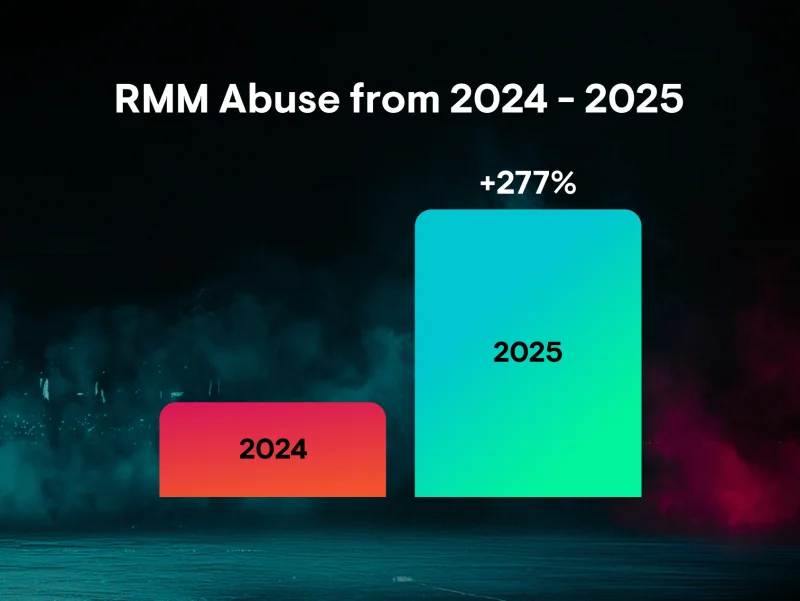
Attackers increasingly don't need to bring their own malware at all. According to the Huntress 2026 Cyber Threat Report, abuse of remote monitoring and management (RMM) tools software, often already approved and running on enterprise networks, jumped 277% year over year and showed up in nearly a quarter of the incidents Huntress investigated. 

Other still-common enterprise network security threats include:

  • Network protocol attacks

  • API exploits

  • Brute-force and other password attacks

  • Cryptojacking (using your computing power to mine cryptocurrency for the attacker)

  • XSS (cross-site scripting) code-insertion

  • SQL injection

  • Misuse by authorized users

  • Adversary-in-the-middle (AitM) attacks


What are the four types of enterprise network security threats?

All of the above threats fall within four broad categories based on the attacker's intent:

1. Exploitation of a perceived weakness

This category includes social engineering, some kinds of malware, and most types of unauthorized access.

2. Disrupting integrity

This encompasses various attempts to "mess with" your data, with ransomware being the most common example.

3. Stealing data

Attackers  use malware, social engineering, or physical penetration to access and collect your data.

4. Disrupting availability

Attackers may  prevent authorized users from accessing your systems or data with DDoS attacks or  sabotaging infrastructure.


Enterprise network security threat mitigation

So, how do you stop these threats?

  • Micro-segmentation: Limit traffic on a very granular scale to reduce your attack surface.

  • Encrypted DNS: Encrypt unprotected DNS queries.

  • Continuous network monitoring: Keep an eye on your attack surface even as it changes from day to day.

  • Device quarantine: Prevent a compromised device from infecting or communicating with the rest of the network.

  • Continuous endpoint monitoring: Ensure constant oversight of devices that connect to and disconnect from your networks.

  • Identity monitoring: Track access patterns and user behavior to spot misappropriated identities and suspicious activity.

  • [NEW] Zero trust access controls: Verify every connection instead of assuming anything inside the perimeter is automatically safe.


Enterprise network security and compliance

Network security architecture isn't optional in regulated industries;it's usually a documented requirement. Healthcare organizations need to satisfy HIPAA, businesses handling card payments need PCI DSS, EU-facing companies need GDPR, and many enterprises benchmark their overall program against NIST CSF or ISO 27001. None of these frameworks are satisfied by a single tool. They typically require a combination of access control, segmentation, encryption, logging, and demonstrable monitoring—which is exactly why the architecture described above should be viewed as a package, not a shopping list. See our enterprise cybersecurity compliance guide for how these frameworks map to specific controls.


Protect your network before it's too late

Huntress Managed EDR works with Managed SIEM and Managed ITDR to detect pivots and anomalous traffic, keeping you safe from known and emerging enterprise network security threats. For how to implement this architecture day to day, see Enterprise Network Security Best Practices and Why Enterprises Need Attack Surface Management. Book a demo today to see what we can do to protect your business.


FAQs

It's the combination of architecture—firewalls, segmentation, VPNs, zero trust controls, and the ongoing monitoring and policy that protects data and systems across a large or distributed business network. It's a practice, not a single product.

Network security protects data and traffic moving across your whole environment: firewalls, segmentation, and VPNs. Endpoint security protects the individual devices themselves. Enterprises need both, since an attacker who compromises an endpoint will try to move across the network from there.

These solutions cover the monitoring and response layer that network architecture alone can't address. Huntress Managed EDR watches individual endpoints for persistence, malicious behavior, and ransomware precursors; Managed SIEM centralizes and correlates security-relevant logs across firewalls, VPNs, servers, and cloud platforms for threat detection and compliance; and Managed ITDR focuses on identity-based abuse in Microsoft 365 and Google Workspace, like suspicious logins, session hijacking, and business email compromise.


Protect What Matters

Secure endpoints, email, and employees with the power of our 24/7 SOC. Try Huntress for free and deploy in minutes to start fighting threats.
Try Huntress for Free