



TL;DR: Huntress and Acrisure are partnering to help eligible businesses turn stronger cybersecurity into better cyber insurance outcomes. Through the Huntress × Acrisure Cyber Insurance Program, eligible organizations using Huntress Managed EDR and Managed ITDR can access streamlined Cyber Insurance or Tech E&O coverage through Acrisure, including a simplified application, transparent pricing, and a $0 deductible on covered losses. Huntress focuses on 24/7 managed endpoint and identity protection, while Acrisure handles the insurance side. The goal is to give businesses and MSPs a clearer, easier way to connect security investments to real financial resilience.
Go to huntress.com/hac to learn more.
The promise of "Security + Insurance," and where it's fallen short
Cybersecurity and cyber insurance keep getting louder, more complex, and more intertwined. Yet for the 50–2500 employee organizations doing their best to stay afloat, the way these two worlds come together still doesn’t feel as simple or effective as it should.
Insurance companies are being asked to interpret security telemetry. Technology partners are being asked to fill out insurance questionnaires. Owners, or legal and finance leaders, are stuck in the middle, trying to make sense of it all while running their businesses.
Huntress and Acrisure are partnering to change that.
Before we talk about what we’re doing together, it’s worth looking honestly at how cybersecurity vendors and cyber insurers have tried to partner in the past. And why those approaches haven’t quite gotten it right for all businesses.
Over the last decade, cyber insurers, carriers, managing general agents (MGAs), brokers, and security vendors have experimented with a lot of ways to work together. On paper, the goal is straightforward: combine better security with smarter risk transfer so fewer bad things happen, and when they do, the right coverage is there.
In practice, many of the models that have emerged leave companies with more portals and paperwork than real-world outcomes.
1. External scans
One common pattern is to use external cyber-rating platforms and scan-based underwriting. Insurers and MGAs lean on services that scan an organization’s internet-facing assets, blend in some data science, and generate a score that feeds into pricing and eligibility decisions.
That’s better than nothing, but it has real limitations:
- It’s often point-in-time. A clean scan in January doesn’t say much about your exposure in June.
- It misses the human element. External scans and long forms miss how controls actually get operated day to day
- It’s hard to act on. Letter grades and generic remediation advice don’t equate to the 24/7 expert security help they actually need.
- There’s still little transparent evidence that “more scanning at bind time” alone is driving better loss ratios; it often just weeds out the worst risks.
2. Continuous monitoring and score-based discounts
To move beyond one-and-done underwriting, some carriers have adopted continuous monitoring platforms and “cyber health ratings,” sometimes tied to premium discounts for keeping scores high.
That’s better, but it’s still imperfect. Here’s why:
- Integration = work. The tech integrators aren’t the insurance buyers, creating a catch-22 that often kills the process.
- Blunt incentives. Discounts are usually tied to abstract scores, not to clear, observable reductions in incidents or claim severity.
- Alert fatigue. Continuous alerts and “at-risk” notifications create more noise for IT teams and their partners who are already stretched thin.
- Limited data sharing. Privacy, regulation, and culture often limit the sharing of data that would actually move the needle.
3. Bundled “security + insurance” stacks
We’ve also seen insurers, MGAs, and security vendors offer unified “security plus insurance” packages. In these models, the same ecosystem provides a managed detection and response (MDR) service and the insurance that pays when things go wrong.
These programs promise simplicity—one partner to handle detection, response, and the financial backstop—but they come with tradeoffs:
- Shaky security DNA. Many bundled offerings are born from the insurance space, adding on security services. Creating a first-class Security Operations Center (SOC) is harder than they think. Top-tier security talent gravitates toward awesome security companies rather than insurance providers.
- Bias towards historical data. The insurance industry measures risk largely based on historical data. This works very well in cases like home and auto, but cybersecurity changes too fast to base your security investments on yesterday's attacks.
- Enterprise tools don’t work without security teams. Many bundles are built around heavyweight enterprise tools that don’t come with the security services baked in. Just because you deploy a good brand-name tool doesn’t mean you’ll see good security outcomes if you don’t have the resources to properly run it.
4. Preferred vendor panels and program lists
Carriers and industry groups also maintain “preferred cybersecurity provider” lists and panels. The idea is to make it easier for insureds to find vetted vendors for MDR, incident response, security audits, and more.
In reality:
- Selection criteria are opaque. From the outside, it’s not always clear whether a vendor is “preferred” because of superior outcomes or simply because of commercials and personal relationships.
- Brokers get workflow drag. Every preferred vendor has its own quoting, terms, and portal. Brokers end up herding cats across security and insurance ecosystems, usually without extra compensation.
- Tech partners feel sucker punched. When a carrier panel recommends security services into an account, it often creates a lot of unnecessary friction with the embedded IT teams, partners, and their existing stack and relationships.
What’s really been missing
Across all of these models, the core problem isn’t that cyber insurers and security vendors haven’t tried to work together. It’s that the collaboration too often stops at checkboxes and marketing claims instead of delivering shared outcomes for real-world businesses.
A better approach needs to:
- Reward actual security outcomes, not just paperwork. Carriers and brokers care about fewer ransomware and business email compromise (BEC) incidents, faster containment, and lower claims, not just whether a form says endpoint detection and response (EDR) is deployed.
- Be designed for businesses of all sizes and the tech partners who serve them. That means fast deployment, security best practices enabled by default, and expert security help from humans, not a pile of dashboards that assume in-house IT will be operating the tools.
- Make life easier for brokers and agents. Security shouldn’t turn brokers into unpaid CISOs. They need simple eligibility rules, clear stories to tell, and a fast path to quotes and coverage.
- Clarify roles. Customers deserve to know who prevents, who detects, who responds, and who pays. As insurers build their own MDR offerings and vendor panels, those lines can easily blur.
That’s the gap Huntress and Acrisure set out to close together.
Introducing the Huntress × Acrisure Cyber Insurance Program
Huntress is purpose-built to protect ALL businesses. Acrisure is one of the largest brokerages in the world, insuring around 3 million businesses. Roughly one out of every five businesses in America works with Acrisure in some capacity.
Together, and at launch with Dual North America—one of the largest independent underwriting organizations in the US—we’re bringing a new kind of cyber insurance program to organizations that rely on Huntress Managed EDR and Managed Identity Threat Detection and Response (ITDR).
At the center of the program are two streamlined, highly aligned policies, available to eligible Huntress customers:
- Cyber Insurance for end customers
- Tech Errors & Omissions (Tech E&O) for MSPs and technology companies
Both policies are designed specifically for organizations using Huntress Managed EDR and Managed ITDR. When those controls are in place, eligible buyers get:
- A radically simplified application: basic firmographics plus a short Statement of Fact attesting to Huntress deployment, instead of pages of technical questionnaires.
- Preferential pricing and broad coverage, tailored for sub-$100M revenue bands and common claim scenarios like ransomware, BEC, and data breaches.
- A $0 deductible on covered losses—real primary insurance coverage with a tangible financial benefit.
The goal is to make sure that when you invest in 24/7 managed endpoint and identity protection, the insurance market recognizes that effort in a way your CFO, owner, or board can easily see.
Important roles and responsibilities:
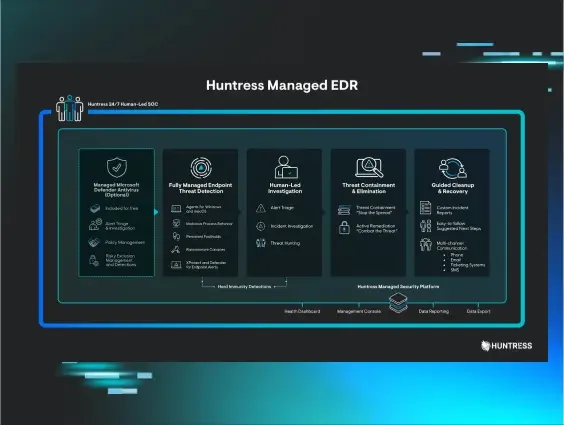
- Huntress is not selling insurance. Huntress provides the managed EDR and ITDR services that include global 24/7 SOC management to help reduce risk. All insurance conversations, quotes, and policies are handled by Acrisure and its insurance producer affiliates.
- Acrisure places the insurance policies, with coverage underwritten-at-launch by Dual North America.

We’re also being deliberate about how we don’t talk about this program. Because this isn’t a regulatory gray area “bundle” where software and insurance are fused into a single product. It’s a clearly separated program where:
- Huntress focuses on detecting and stopping attacks (especially ransomware and BEC) across endpoints and identities.
- Acrisure places real cyber and Tech E&O coverage.
The two sides are tightly coordinated, but still play distinct, well-defined roles.
Why this model is different
When we started working with Acrisure on this program, we anchored on a few guiding principals.
Real primary insurance, intended to help ALL businesses
For years, competitive “ransomware guarantees” and product warranties have influenced buying decisions, even though, in practice, they’re often narrow, difficult to claim on, or secondary to other insurance policies.
The Huntress x Acrisure program is designed around primary cyber insurance policies, placed by a top-tier broker and underwritten on A-rated/A-plus paper. It’s not a product warranty that’s legally watered-down with configuration gotchas and fine print.
Outcomes that matter to both security and insurance
The program rewards organizations for deploying both Huntress Managed EDR and Managed ITDR, a dynamic duo that meaningfully reduces today’s most painful cyber risks:
- Ransomware-as-a-Service (RaaS) targeting organizations of all sizes.
- BEC and funds-transfer fraud, where compromised identities and mail rules lead to real-world wire fraud.
Those are exactly the areas where Acrisure and Dual need to see strong, sustained controls to confidently offer a $0 deductible and transparent pricing.
Why not the whole Huntress Security Platform?
We certainly could have, but we wanted this program to have the widest reach and lowest barrier to entry. Our mission is to wreck hackers and protect the organizations that don’t have the resources to properly protect themselves. Huntress and Acrisure built this program to align with that mission.
Clear swim lanes for MSPs, brokers, and sellers
This partnership was also designed around the real people in the middle of all this:
- MSPs, IT partners, and internal IT teams who are responsible for day-to-day security operations.
- Brokers and agents who are responsible for advising on coverage and placing policies.
- Huntress sellers, who need a “hold my beer” answer when competitors lead with warranties or insurer-provided MDR.
Instead of forcing MSPs to become insurance experts or brokers to become MDR experts, we’ve structured the program so everyone can stay in their lane:
- Huntress sellers use the program as an objection handler and value amplifier, not as something they have to quote or support directly.
- Acrisure specialists handle the applications, underwriting conversations, and claims, with a clear understanding of what Huntress is doing in the environment.
- MSPs and end customers get a single, simple path to request coverage (via Acrisure) that recognizes the protection Huntress is already delivering.
What this means for you
Whether you’re an MSP or an internal IT leader, the Huntress × Acrisure partnership is designed to make your life easier, not harder.
If you’re an eligible MSP or IT provider
You get:
- A better Tech E&O policy option that rewards your decision to partner with Huntress
- A credible, easily explained answer when a prospect asks, “What about those million-dollar ransomware warranties?”
- A way to strengthen your value proposition to business and risk owners by connecting strong controls (Huntress) with strong coverage (Acrisure and Dual).
- Clear enablement in Huntress Hub, one-pagers, and conversation guides to help you talk about the program without turning you into an insurance provider (let Acrisure handle that).
If you’re an internal IT or security leader at an eligible business
You get:
- A simplified path to real cyber insurance backed by a leading broker and underwriter, with coverage that actually reflects your security investments.
- A $0 deductible that can make the difference between “we survived that incident” and “we’re not sure the business will recover.”
- Confidence that your MSP and your insurer are working in alignment, not at cross-purposes.
Where we go from here
We believe this is the kind of partnership the cyber ecosystem has been missing:
- Real, primary insurance, not overly limited warranties.
- Real, human-led Managed EDR and Managed ITDR, not unmanaged required tools with poor outcomes.
- Really simple process, not a 20-page application or another portal nobody logs into.
This is only the beginning. As the program matures, we’ll continue to learn from real-world incidents, claims, and customer feedback. And we’ll keep refining it so all businesses can convert security investments into tangible operational and financial resilience.
If you’re already using Huntress and want to explore whether your organization could benefit from the Huntress × Acrisure program, go to huntress.com/hac to learn more, or talk with your Huntress account team or your Acrisure agent. If you’re just starting your journey and want to see how Huntress Managed EDR and Managed ITDR can improve both your security and your insurability, we’d love to show you.
Ready to turn better security into better insurance outcomes?
Book a Huntress demo and ask about our collaboration with Acrisure.
IMPORTANT NOTICE: The insurance policies described herein are placed by Acrisure, LLC and/or its insurance producer affiliates. The non-insurance cybersecurity and related cyber services described herein are provided by Huntress Labs, Inc. Huntress Labs is not an insurance carrier, broker, or agent and does not sell, solicit, or negotiate insurance. The products and services identified and described herein may not be available in all jurisdictions. The descriptions contained herein are not intended to be complete or exhaustive of all applicable terms, conditions, and exclusions of the policies described. Always refer to the actual insurance policy for the full and complete terms, conditions, exclusions, and other coverage details.







![The 36 Most Common Cyberattacks [2026]](https://cdn.builder.io/api/v1/image/assets%2F3eb6f92aedf74f109c7b4b0897ec39a8%2F36014deeb67545a0a0d94cdfa4b9b0db?height=10000)