Protect What Matters
Secure endpoints, email, and employees with the power of our 24/7 SOC. Try Huntress for free and deploy in minutes to start fighting threats.
What Is Security Information and Event Management (SIEM)?
Last Updated: 9/25/2026
Written by: Brenda Buckman
Quick answer: SIEM (security information and event management) is a cybersecurity solution that combines security information management (SIM) and security event management (SEM) into one platform, collecting and analyzing log data to detect and respond to potential threats.
Every login and file transfer leaves a trace.
Security information and event management (SIEM) exists to catch that trace before it can become a problem. As you’re probably aware, cybersecurity threats are becoming more sophisticated and harder to detect. Businesses need tools that provide real-time visibility into their systems and enable quick responses to potential threats.
That’s where SIEM comes into play. Let’s break down SIEM, how it works, and why it’s essential for protecting your organization against potential threats.
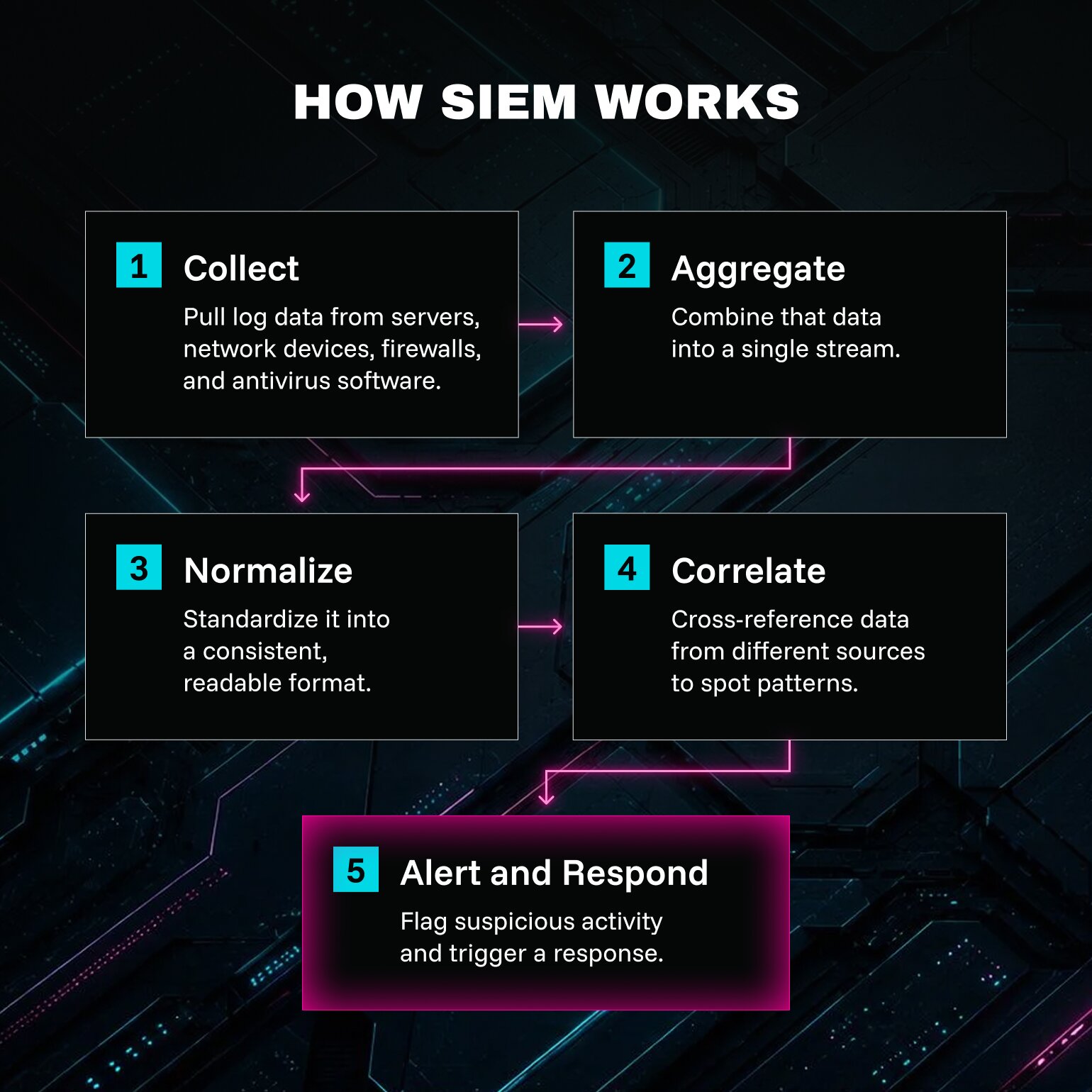
SIEM works by continuously collecting data from various sources within your IT infrastructure, like servers, network devices, firewalls, and antivirus software. This data is aggregated and normalized, making it easier to analyze.
The next step is correlation and analysis. SIEM uses predefined rules and threat intelligence feeds to correlate data from different sources and identify patterns that could indicate a security threat. For example, if an employee logs in from an unusual location or at an odd time, SIEM might flag this as suspicious and generate an alert.
Once a potential threat is detected, SIEM triggers an alert, allowing security teams to investigate and respond. Some SIEM systems also offer automated responses, such as blocking an IP address or isolating a compromised device, to mitigate threats quickly.
The primary purpose of SIEM is to provide organizations with real-time visibility into their security landscape. By centralizing log data and monitoring security events across the entire IT environment, SIEM helps businesses detect and respond to potential threats before they can cause major damage.
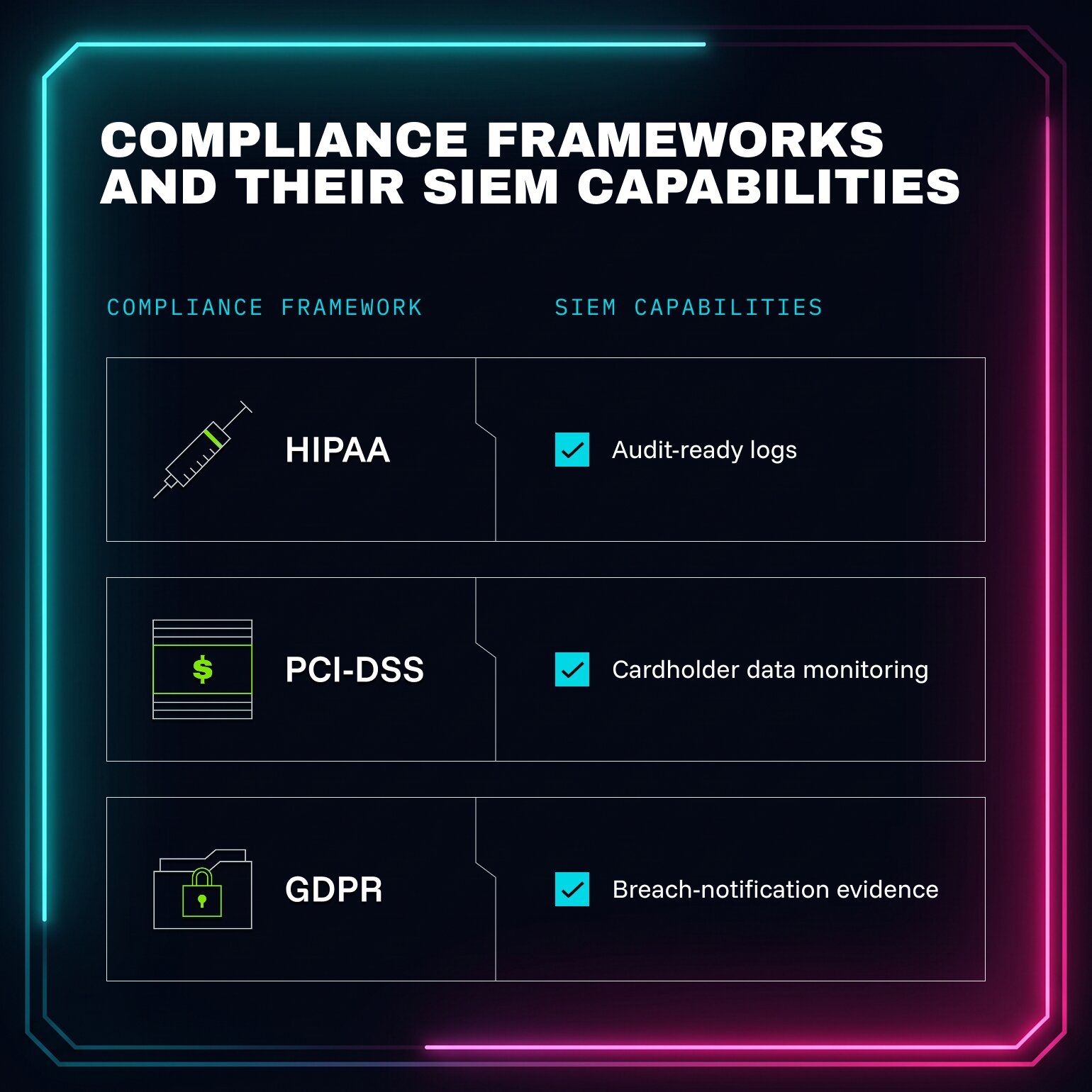
SIEM is also a valuable tool for compliance. Many industries have strict regulatory requirements for data protection and security, such as the General Data Protection Regulation (GDPR), the Health Insurance Portability and Accountability Act (HIPAA), or the Payment Card Industry Data Security Standard (PCI-DSS). SIEM systems can help businesses meet these requirements by providing detailed logs meeting the required security standards.
SIEM also aids in incident response and forensic investigations. If a security breach occurs, SIEM can provide a detailed timeline of events, helping security teams understand how the breach happened, what data was possibly compromised, and what steps must be taken to prevent future incidents.
SIEM and threat intelligence work closely together, but they’re not the same thing. SIEM is a security monitoring and event management platform, while a threat intelligence platform (TIP) is specifically designed to collect, aggregate, and analyze external threat data.
The key difference is focus: SIEM looks inward at your own environment, correlating logs and events to detect anomalies. A TIP looks outward, gathering intelligence about known threat actors, attack patterns, and emerging vulnerabilities.
That said, modern SIEM solutions like Huntress Managed SIEM incorporate threat intelligence feeds directly into their detection engine, so the line between the two has blurred significantly. Rather than choosing between SIEM and a threat intelligence platform, most organizations benefit from a SIEM solution with built-in threat intelligence.
SIEM provides several key benefits, like:
Without a SIEM, businesses risk missing critical security events, which could lead to costly breaches and compliance failures.
A SIEM tool is the software or platform organizations use to implement SIEM functions. These tools can vary widely in terms of features, complexity, and pricing, but they all help enhance an organization’s security by monitoring, analyzing, and reporting security events in real time.
The primary features of a SIEM tool can include:
GDPR, HIPAA, and PCI-DSS all require detailed logs and audit trails, and SIEM is built to produce exactly that. In healthcare specifically, the stakes are especially high, since breaches often go undetected for months, and by the time one surfaces, the damage compounds. That’s why it’s crucial that healthcare security leaders understand when and where SIEM will serve their best interests.
Historically, by the time a breach is discovered, malicious actors have been in healthcare and IT systems for weeks, months, or even years. With data pouring in and out of those systems so rapidly, threat actors have time to lurk, leveraging their unauthorized access and looking for golden nuggets of data that can be sold on the dark web or elsewhere.
SIEM ingests data. It’s a log collector that receives data across every device on the network while parsing, correlating, and analyzing that data. It’s also great for stepping back in time, providing the functionality to investigate events from months before. However, the strength of SIEM is also the inherent challenge: collecting and holding onto so much data is traditionally very expensive.
So yes, SIEM can potentially become cost-prohibitive for some organizations if it’s aimlessly ingesting all the data, all the time. That’s why healthcare systems and managed service providers (MSPs) should be looking for a SIEM solution that delivers that crucial, preventative care, while being smart and selective about how it stores data. Additionally, with so many healthcare systems still struggling with data storage, it’s important to understand where and why this solution can serve healthcare’s long-term security needs.
In so many healthcare IT considerations, Health Insurance Portability and Accountability Act (HIPAA) compliance drives the conversation, for myriad reasons. HIPAA requirements also tie into cyber insurance requirements for healthcare organizations, prompting customers to take proactive measures to build a more robust security stack now, rather than after a costly attack.
Additionally, mergers and acquisitions (M&A) have created consolidation across healthcare, expanding attack surfaces and imperiling more provider and patient data. Through the M&A process, more sophisticated organizations can inherit weak spots in technology, allowing criminals to slip through undetected.
Cyber insurers have realized they’re proverbially “behind the eight ball” in beating cybercriminals. Requirements for coverage are tightening, with more audits and proof points required during the underwriting process. Furthermore, cyber insurers are pushing customers to be more proactive and look at themselves through the lens of the attacker.
Healthcare organizations are already stretched thin from saving lives and serving patients. A SIEM earns its place in the stack only if it’s HIPAA-friendly, cyber insurer-approved, and realistic in cost and usability for MSPs and healthcare teams alike.
- Joe Goldstein, President & Founder of OCS IT
The old approach, some healthcare providers wrongly assumed they were simply “too small to matter” to threat actors. But every organization has something valuable to target, and malicious actors don’t have to work as hard to break into systems when leveraging legitimate business or operational tools.
Consider a healthcare software vendor that gets acquired; a previously trusted, valid tool can also suddenly inherit the acquiring company’s blind spots. Incidents like this can take services offline and require third-party cybersecurity support to resolve, even though the entry point was a tool nobody thought twice about.
Threat actors don’t have to break in if they can just open the front door. When it comes to healthcare software used across disparate systems and distributed provider footprints, there are untold places for criminals to hide and leverage their unauthorized access. SIEM is well-positioned to help mitigate that.
Healthcare systems and MSPs focused on SIEM should look for a streamlined approach that filters the chaotic “trauma bay” of data and alerts, whittling down to the most critical alerts. A forward-thinking, integrative approach, like the one great healthcare providers use, is the way to go with SIEM. Questions decision makers should ask when evaluating a SIEM:
Not all SIEM solutions are created equal, so choosing the right vendor is crucial. Here are some key factors to consider:
Consider whether a managed SIEM service would be more beneficial for your business. Cyber threats don’t keep office hours, and neither should your SIEM.
The best route is to choose a vendor that provides around-the-clock monitoring and expert support, so you’re never left in the dark. Managed SIEMs like Huntress Managed SIEM take the heavy lifting off your team, providing continuous monitoring, management, and threat response without requiring significant in-house expertise.
Traditional SIEMs were designed to simplify security, but they’ve become overly complex and costly for many businesses. That doesn’t have to be true of modern security information and event management.
Huntress Managed SIEM delivers a streamlined, effective solution that provides all the benefits of a SIEM without the hassle. With 24/7 monitoring, expert management, and straightforward pricing, Huntress Managed SIEM makes advanced cybersecurity simple and accessible to businesses of all sizes.
It’s time to move on from the SIEM technology of the past. Ready to see how Huntress can modernize your security strategy? Book a free demo so you can experience it yourself.
SIEM is the platform that collects and analyzes security data. A SOC (security operations center) is the team of people who use that platform, along with other tools, to monitor for threats and respond around the clock.
No. Splunk is one vendor’s SIEM product, alongside its broader data platform. SIEM is the general category of technology that Splunk, along with many other vendors, falls under.
SIEM isn’t being replaced by newer technology, but it’s evolving. Next-gen and managed SIEM models are built to solve the cost, complexity, and alert-fatigue problems that came with legacy SIEM, rather than abandoning the category altogether.
HIPAA doesn’t name SIEM specifically as a requirement. But its audit-trail and monitoring rules are hard to satisfy without one, and that same coverage ties directly into cyber insurance underwriting expectations, too.