


Ask most IT and security leaders how their organization handles compliance, and you'll get a confident answer. Audits are planned for, documentation is maintained, and the team knows what to do when a third-party assessor comes knocking.
The data backs that up, at least on the surface. The majority (91%) of IT and security leaders say their organization treats compliance documentation as an ongoing process rather than a last-minute scramble. And 70% say they are very confident that they'd pass a third-party security audit tomorrow with no additional prep time.
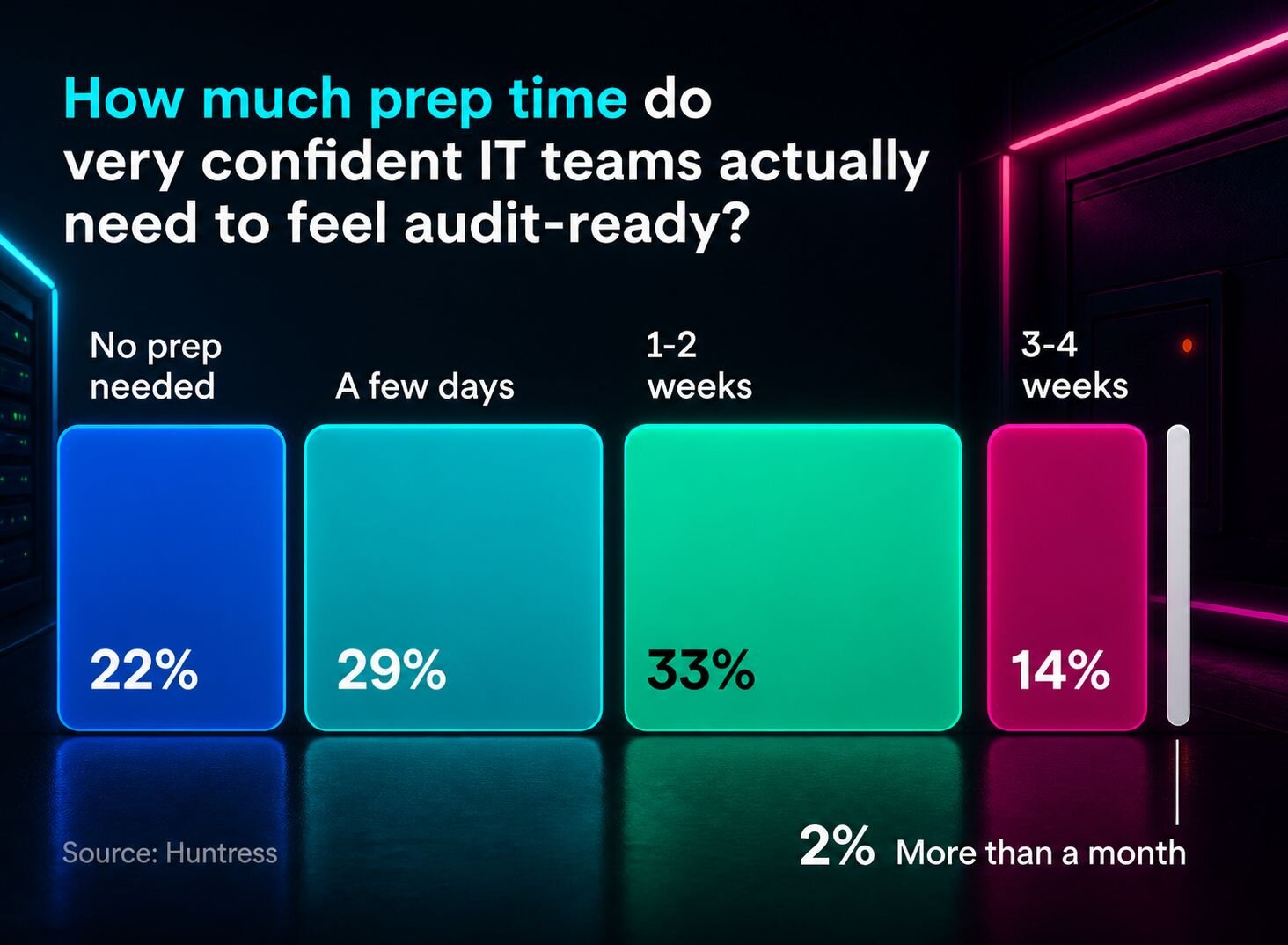
So we were surprised when we asked that same group how much notice they actually need to feel fully prepared. One in three said 1 to 2 weeks, while only 22% said they would need no additional prep time.
Confidence and actual readiness aren't the same thing. We surveyed more than 500 IT and security professionals to find out what it's costing teams that assume they're prepared—right up until the moment they have to prove it.
Key takeaways
78% of IT and security professionals who said their documentation and evidence were ready to go said they still need at least a few days of prep time to get there, and for nearly half (49%), that window is one week or more.
Compliance demands drove burnout or staff turnover in 37% of organizations over the past 12 months, and around one in five (21%) say they lost a contract or business opportunity as a direct result.
More than twice as many "very confident" IT teams are hiring extra staff to stay audit-ready compared to teams that are only moderately confident about their audit readiness (44% vs. 20%).
Shifting compliance requirements are the single most common reason organizations can't stay continuously audit-ready
Audit demands are burning out teams and hurting budgets
Compliance work has a way of expanding beyond what any organization initially budgets for it, in time, headcount, and business opportunity. When the documentation burden grows faster than the systems managing it, the people already stretched thin end up absorbing the difference.
Over the past twelve months, 37% of IT and security professionals say compliance and audit demands led to security team burnout or staff turnover. Another 37% hired additional headcount specifically to handle compliance work. Meanwhile, 34% delayed or deprioritized active security initiatives to keep up with documentation demands, and 21% report having lost a contract or business opportunity during that same period.
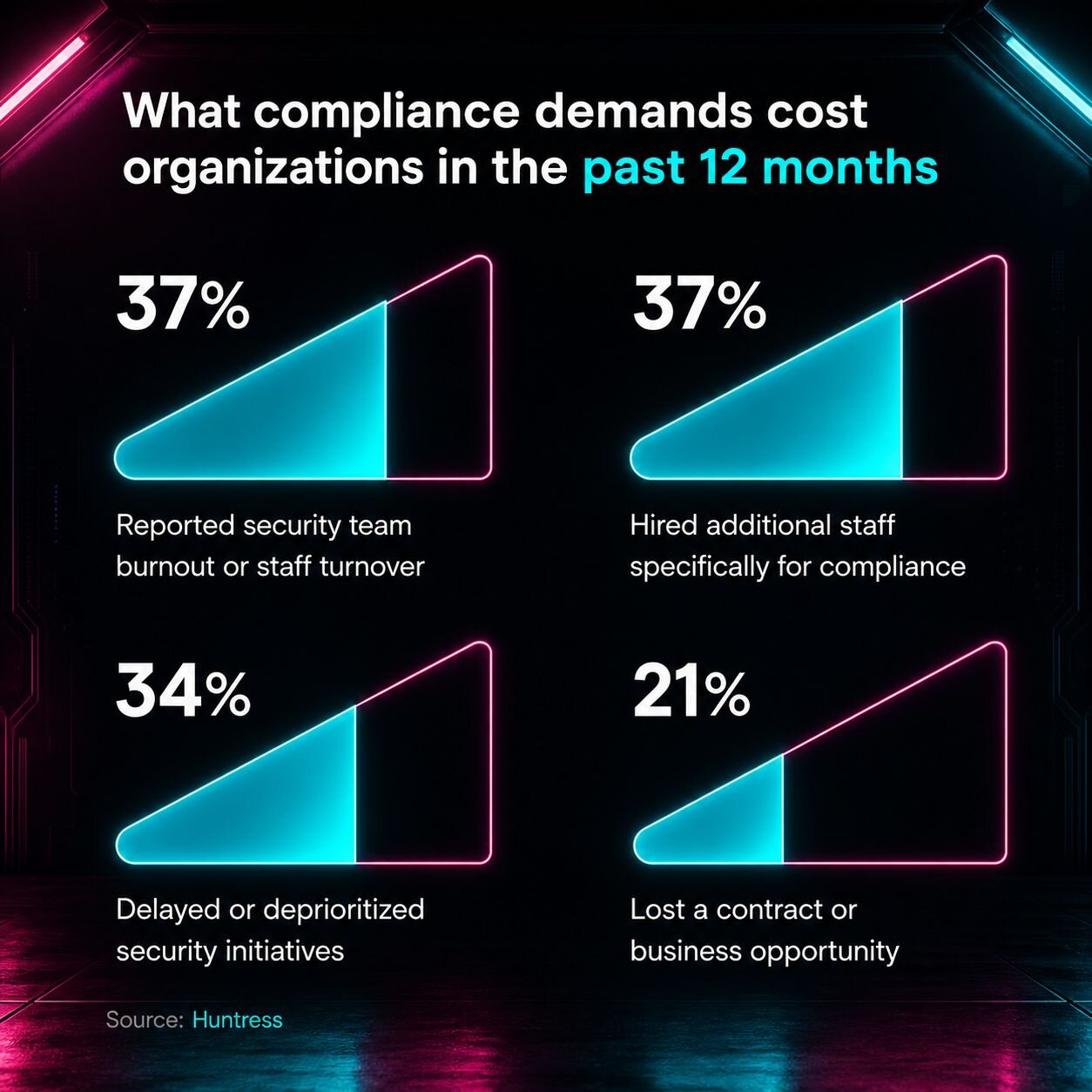
The picture that emerges is one of confidence propped up by effort rather than systems built to handle the load. Organizations reporting the highest audit readiness are also the ones hiring most aggressively to maintain it.
Among very confident teams, 44% brought on additional compliance staff in the past year, compared to 20% of moderately confident teams. Headcount can absorb the burden temporarily, but it comes at a real cost, and doesn't fix the underlying workload that made the hiring necessary in the first place.
That burden also has a direct effect on day-to-day security work. 65% of respondents say compliance documentation has a moderate or significant impact on their capacity for active security work, including threat monitoring, incident response, and keeping up with endpoint vulnerabilities. Time spent chasing down screenshots and formatting spreadsheets is time not spent on the work that actually keeps organizations defended.
The manual evidence problem
There's no dominant approach to how IT teams collect and manage evidence for security audits. Most teams that still lean heavily on manual processes are the ones that need the most prep time when an audit approaches.
Only 17% of all respondents said they're always audit-ready with no prep required. Among the group who said their documentation and evidence were ready to go, the most common answer for how much notice they'd still need was one to two weeks. Another 16% of that same group said they'd need three weeks or more.
Roughly a third of respondents run mostly or fully manual processes. Another third are evenly split between manual and automated methods, and the remaining third have moved mostly or fully to automation. A 50/50 split between manual and automated evidence collection suggests many organizations are mid-transition, still relying on older methods without a fully modern system in place to replace them.
Among mostly or fully manual teams, 40% say they need one to two weeks to feel audit-ready, the most common answer for that group. Add in those who need three weeks or more, and 64% of manual-heavy teams are looking at at least two weeks of prep time before they'd feel confident walking into an audit. Teams who are mostly or fully automated tell a different story: 22% say they need no prep time at all, compared to 15% among mostly or fully manual teams.
A failed or incomplete audit can lead to regulatory fines, loss of certification, contract termination, or being locked out of operating in certain industries altogether. And a data breach during that window only compounds the damage. For teams that need two weeks to pull everything together, advance notice doesn't always mean enough notice.
Changing requirements are the #1 barrier, ahead of both staffing and a lack of centralized tools
Even among organizations that feel prepared, maintaining that state is its own ongoing challenge. 79% of all respondents cited at least one barrier to staying continuously audit-ready. Audit readiness is a moving target, and most organizations feel that pressure regardless of how well-prepared they believe themselves to be.
Nearly a quarter (23%) named compliance requirements changing too frequently as their single biggest barrier. Another 18% cited security and compliance teams operating out of sync.
These two barriers share something in common: they're organizational and environmental challenges that better technology alone won't fix. A stronger evidence collection platform doesn't stabilize a regulatory framework that keeps shifting. And it doesn't close the communication divide between teams working toward the same goal from different directions.
The hours, the burnout, the delayed security work, the lost contracts — those are the symptoms of a readiness strategy that can't keep pace when the goalpost keeps moving. Building readiness into daily operations rather than treating it as something to assemble before each audit is what separates organizations that stay ahead from those that are playing a constant game of catch-up.
Why 88% of IT teams are rethinking how they handle audits and what they can do differently
Most IT and security leaders are trying to stay ahead of compliance demands, and many are managing it. But the prep windows, staffing costs, and hours diverted from active defense tell a more detailed story about what that effort actually costs.
88% of respondents are already using or actively evaluating tools designed to support compliance evidence collection and audit readiness. Manual processes are hitting a ceiling, and most teams seem to know it.
The teams furthest along in that shift toward continuous, automated evidence collection need less prep time, spend less on compliance-specific headcount, and report less drag on their security capacity.
Building toward continuous readiness is less about finding one perfect tool and more about changing how compliance work fits into daily operations. A few places to start:
Automate evidence collection so it runs in the background rather than in a sprint before each audit.
Align security and compliance teams around shared documentation workflows so neither is caught off guard when requirements shift.
Use a SIEM built for compliance requirements to centralize log management and reduce the manual lift.
For teams working within CMMC or similar frameworks, mapping out CMMC controls by domain can clarify what continuous readiness needs to cover.
Huntress works with IT and security teams on exactly these challenges—building the kind of continuous readiness that holds up when an auditor actually comes knocking.
Methodology
Conducted by Centiment on behalf of Huntress, the survey was fielded on May 12, 2026. The results are based on 504 completed surveys.
To qualify, the survey screened U.S.-based IT professionals at the manager level or above who are directly involved in security operations, IT management, or compliance at their organization. Each respondent's company must have more than 100 employees.
Data is unweighted, and the margin of error is approximately +/-5% for the overall sample, with a 95% confidence level.