Why Your Security Team is Exhausted (And How to Fix It)

If you manage iKey or security, you've got skeletons in your digital closet. And you know exactly which ones. Shared mailboxes with no MFA, the password spreadsheet, legacy RMEM tools nobody remembers installing. These are the blind spots attackers live for. So how do we fix it? The answer isn't buying more tools. It's building a resilient team. Resilient teams don't plan for if they get attacked. They plan for when. And they do five things differently. Optimize for speed, not volume. More alerts doesn't mean more security. Prioritize decision velocity. Know what matters and act fast when it does. Treat identity as foundational. MFA and SSO are the floor. Everything must tie back to a verified protected identity. Design systems that support humans. People will make mistakes. Your controls need to catch them early. Reduce cognitive load before adding automation. AI should remove friction, not add complexity. Use it to cut noise, group related activity, and surface context. Prioritize ownership over perfection. Full prevention is a fantasy. Limit the blast radius and recover fast. To pull this off, rethink your org chart around functional ownership, not headcount. You need three core pillars: detection and response, identity and security, and security enablement. Even in a lean team wearing multiple hats, everyone should know exactly who owns what when an incident kicks off. So what can you do today? Here's your checklist. Tighten your MFA. Secure your RDP and VPNs. Enforce browser and password hygiene. Set up clear phishing reporting workflows. Review your identities and shared mailboxes. Document your IR plan and cyber insurance details. The teams that survive aren't the ones with the most tools. They're the ones who had a plan before everything hit the fan.

If you manage IT or security, you already know which skeletons are in your digital closet. Shared mailboxes with no MFA. The password spreadsheet. Legacy tools nobody remembers installing. Those are the blind spots attackers look for first.

The fix isn't buying more tools. Resilient teams don't plan for if they get attacked, they plan for when, and they do five things differently: optimize for speed over volume, treat identity as foundational, design systems that support humans, cut noise before adding automation, and choose ownership over perfection.

Pulling that off means rethinking the org chart around functional ownership rather than headcount, with three core pillars: detection and response, identity security, and security enablement. Even on a lean team wearing several hats, everyone should know who owns what the moment an incident starts.

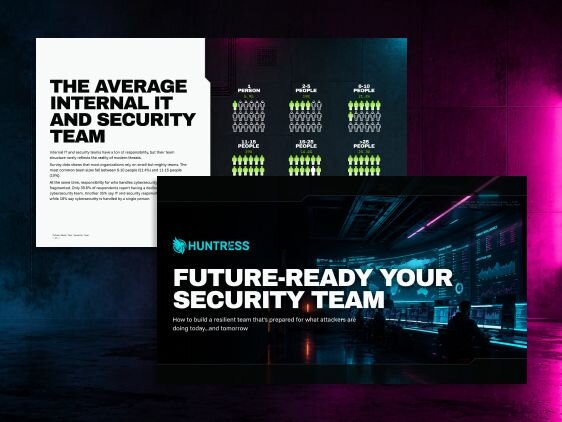
Watch the clip for the full breakdown, then dig into the survey data behind it in Future-Ready Your Security Team and the reference org chart.


Share

[PH] Learn More About Phishing

[PH] Huntress delivers everything you want from a security tool, all designed with the unique needs of outsourced IT and security teams in mind.
[PH] Phishing attempts can show up as messages from your bank, your boss, your utility providers, or even the government. One click from one user can compromise an entire network and inadvertently let hackers deploy ransomware, steal information, or worse.
[PH] The median time it takes for a user to click a link and enter information is less than 60 seconds. With a turnaround time that quick, it's no wonder phishing is one of the preferred methods used by hackers. (2024 Verizon Data Breach Report)