


The emergence of AI has been a major boon for cyberattackers. They're using it to chain together tools, automate credential theft and session hijacking, generate new malware, and write convincing phishing lures. The result is more campaigns, launched faster, against organizations that were already stretched thin.
Defenders still have to investigate every signal and act without delay. But more manual work isn't a realistic solution. Our Security Operations Center (SOC) lives that reality every day as they work to defend over 250,000 organizations.
That's why Huntress built Athena: a powerful agentic investigation system. Athena is not a replacement for human analysts, but an AI-powered "Iron Man suit" that helps our team move faster, more consistently, and at scale.
Why Athena?
In Greek mythology, Athena is the goddess of wisdom, defensive warfare, and reason, representing the intellectual, tactical, and disciplined side of combat. At Huntress, Athena brings those same traits to defending our partners and customers.
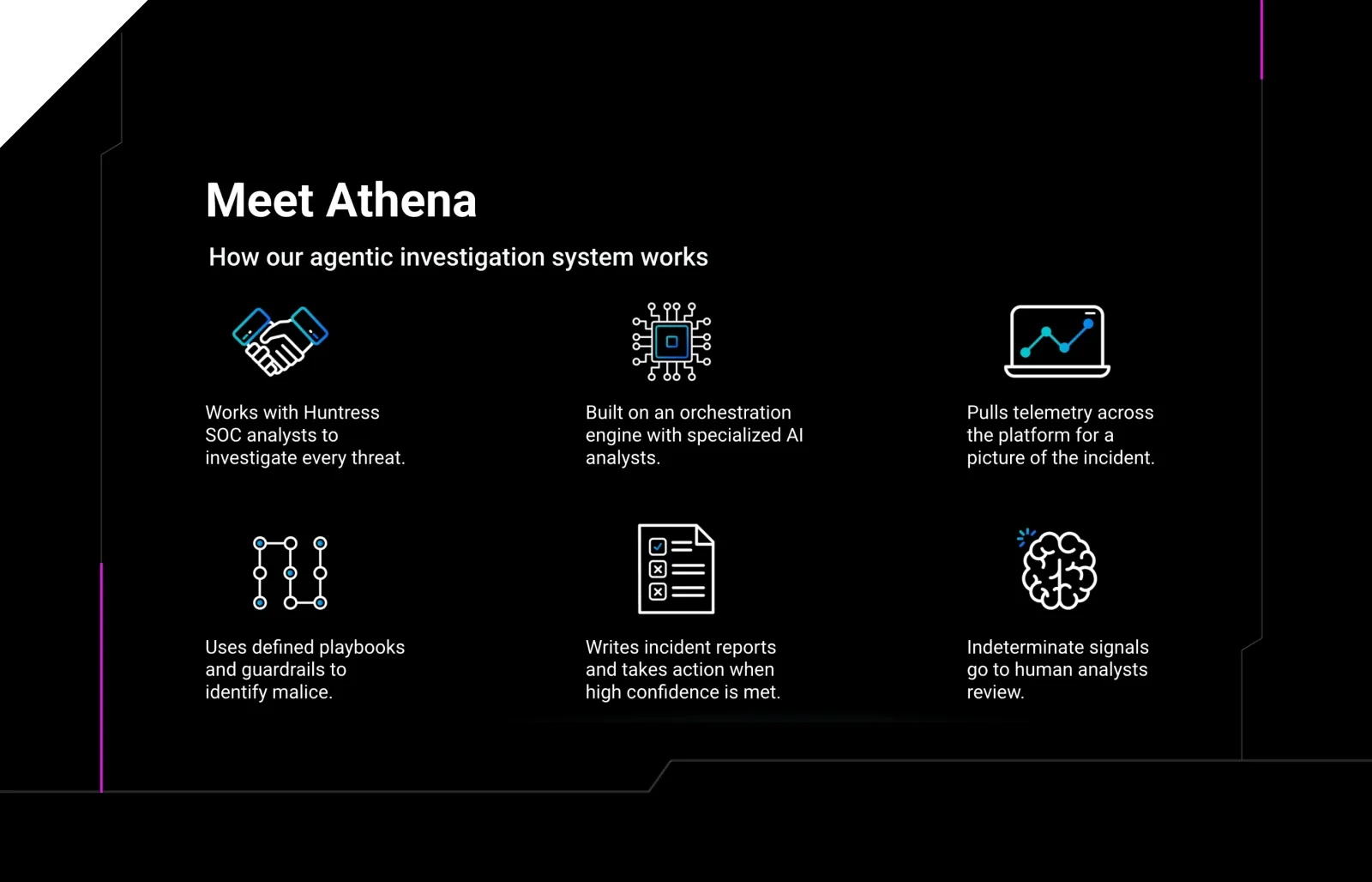
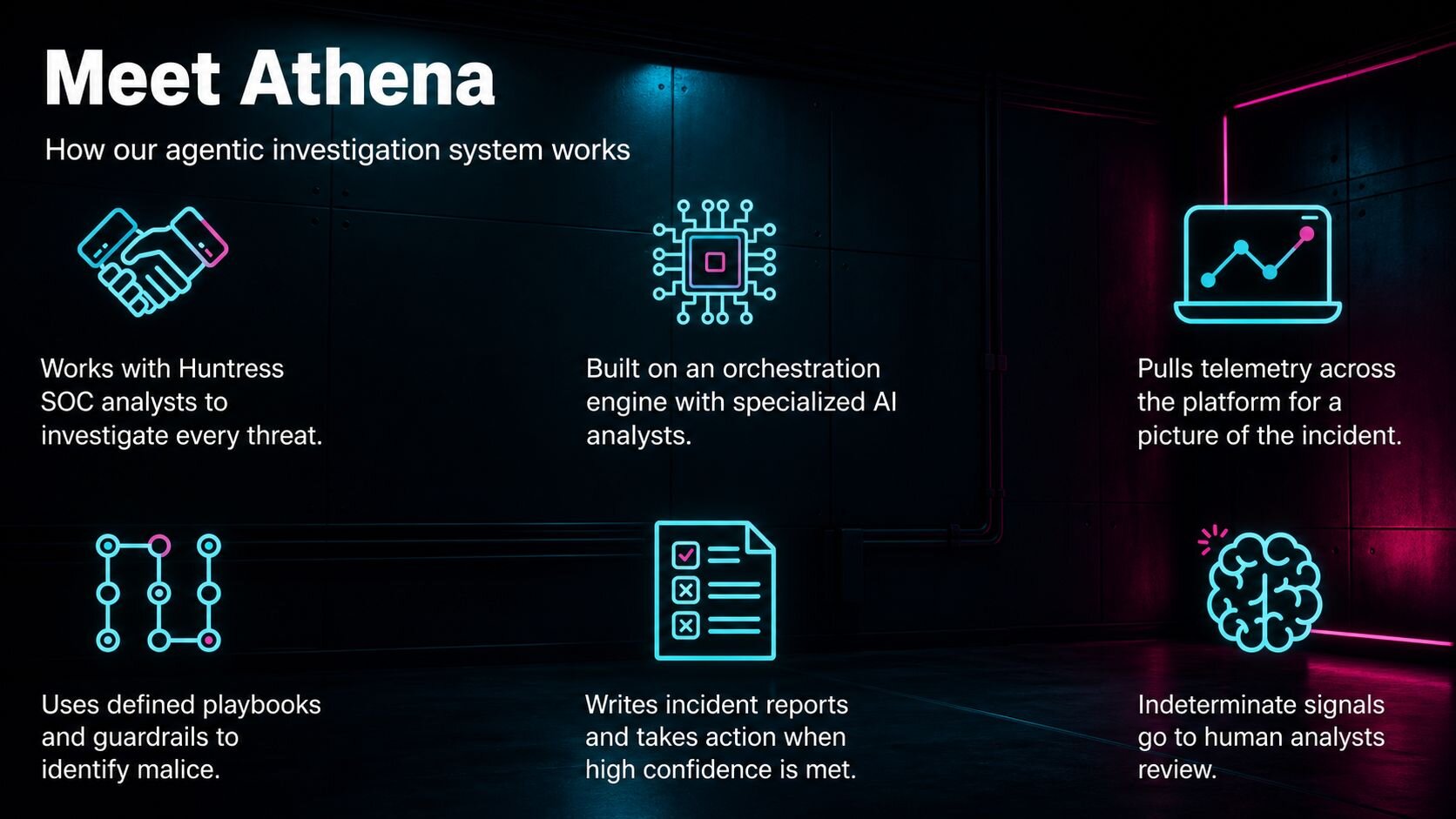
So what exactly is Athena? Athena is Huntress' agentic SOC system, made of over 40 specialized AI agents. It works hand-in-hand with our human analysts to investigate security signals end-to-end, the moment they appear.
Rather than simply flagging that something happened, Athena works to understand what it means, pulling together relevant context, following investigative steps consistently, and reaching a verdict on whether a signal is malicious or benign. It uses the same playbooks, telemetry, insights, and guardrails our human analysts rely on.
AI that actually investigates
Athena is not just AI for AI's sake. We've built Athena to use AI in a way that's extremely practical and operationally useful. Here's what that looks like in practice:
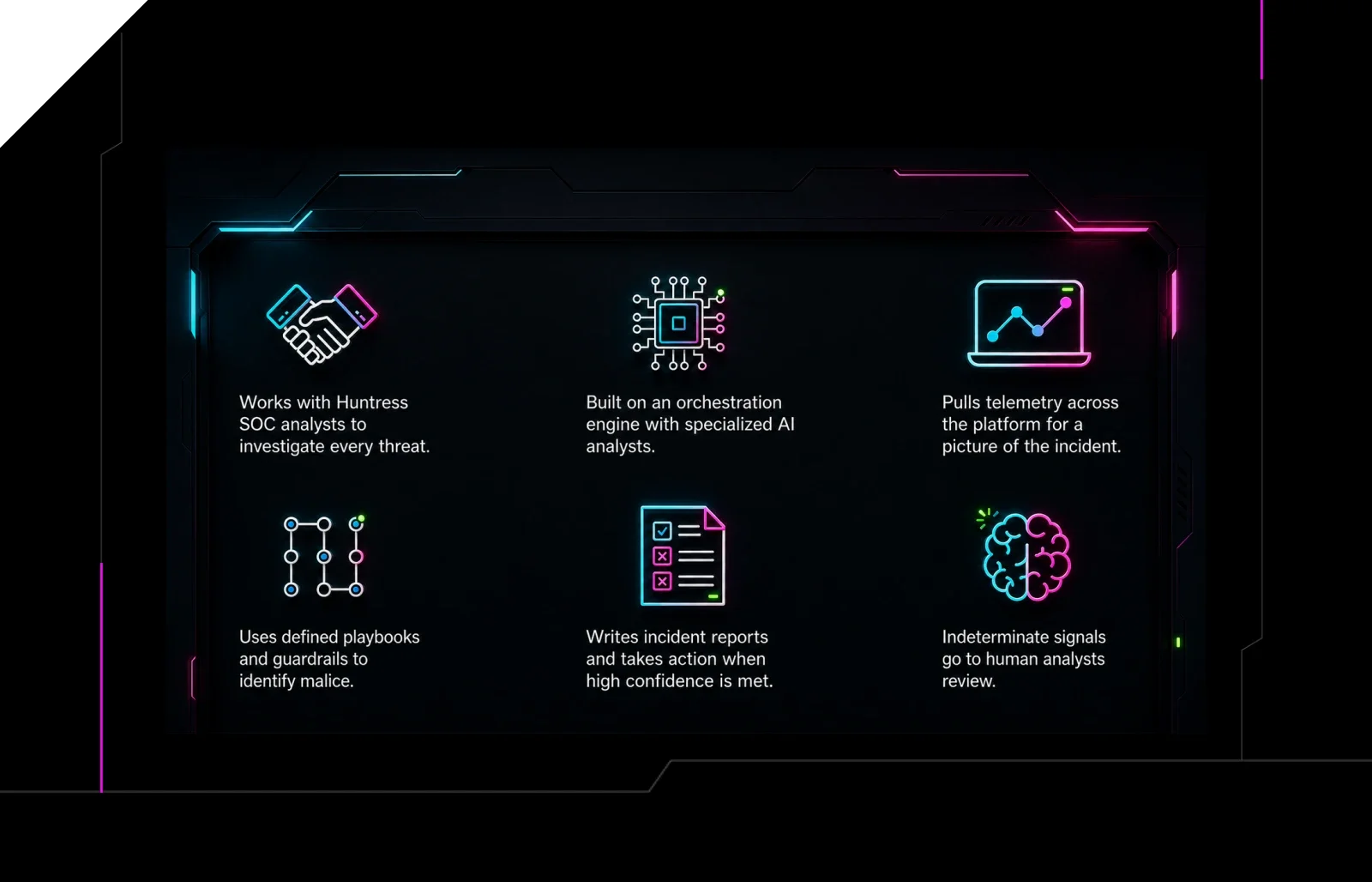
Bundles related signals. Instead of treating every alert as an isolated event, Athena groups related signals together so an investigation starts with the full picture, not a fragment.
Gathers the right context. It automatically pulls relevant telemetry across endpoints, identities, and logs, assembling the evidence an analyst would otherwise collect by hand.
Investigates with defined playbooks. Athena draws on the playbooks, tools, and investigative skills each unique case demands, applying the same rigor and guardrails every time.
Reaches a verdict. It reviews the evidence and makes a malicious or benign determination or passes inconclusive results to a human analyst, so the right action can happen without delay.
Generates incident reports: Produces clear, consistent incident reports that combine plain-language summaries with technical accuracy, including IoCs like file hashes, IP addresses, and affected accounts, so findings are easy to understand and act on, no matter who's reading.
Escalates to expert review: When a signal is ambiguous or below the confidence threshold, Athena automatically routes it to a Huntress analyst.
When confidence is high and the pattern is well understood, Athena can move an investigation forward quickly, and in vetted, high-confidence scenarios, complete it within the guardrails analysts have defined. When the situation is unclear, ambiguous, or novel, it brings in a human analyst for review. That balance is the point: Athena lets Huntress investigate at machine speed without giving up the human judgment needed for the hardest cases, like novel adversary tactics and tools.
Why an investigation-focused AI analyst matters
A lot of AI in cybersecurity is built to tell you that something happened. Athena is built to help determine what happened, what it means, and what should happen next. That distinction is important because detection alone isn't enough. Teams still have to investigate, validate, prioritize, and respond, and that's where time is lost and attackers keep the advantage.
An investigation-focused agentic analyst changes that in a few important ways:
Speed. Every minute matters when threat actors are inside an organization. Athena reacts to high-priority signals immediately, eliminating the delay between signal creation and investigation.
Consistency. Athena brings the same rigor and guardrails to every investigation while flexibly drawing on the right playbooks and skills for each case.
Scale. By handling well-defined and high-confidence investigations, Athena increases our SOC's capacity without lowering the high-quality, low-false-positive bar Huntress is known for.
Human analysts still matter
Athena is a force multiplier, not a replacement. Our SOC analysts remain in the lead, applying knowledge and experience gained from investigating and responding to attacks across over five million endpoints and 15 million identities (and counting). Just as important, analysts own the system itself. They curate and maintain Athena's playbooks and decide which scenarios are appropriate for full automation versus human involvement.
That human-and-AI approach matters because cybersecurity is full of edge cases. Some threats fit known patterns and benefit from speed and structured automation, which is where Athena can confidently carry more of the load. Others require context, skepticism, and experience that only tenured analysts can bring. Athena handles the repetitive, time-sensitive, well-understood work; human analysts take on the complex, ambiguous, and novel cases, then feed their findings and insights back to Athena so it gets better over time.
This is why the right comparison isn't "human versus AI." It's "human expertise amplified by AI" versus "human expertise left to fight machine-speed attacks on its own."
The benefits of an AI analyst working alongside humans
When an AI analyst complements human analysts, the benefits are tangible: faster investigations and response, fewer gaps for stealthy attackers to hide in, and an even higher level of consistency across incidents. Here's what our SOC has already achieved:
90% reduction in the time to generate an incident report
> 30% improvement in incident report quality
~2% reduction in rejected reports compared to human-only baseline
That's the real promise of Athena. Not a flashy AI feature. Not an abstract future vision. A practical operating model where AI accelerates investigation work, while human experts stay in control of the outcome.
Final thoughts
Attackers are already using AI to move faster. Defenders can't afford to answer that with more manual work and more alert fatigue. The better model is an AI-centric SOC where agentic analysts handle what can be investigated quickly and consistently, while human analysts lead wherever judgment, creativity, and experience make the difference.
That's what Athena represents for Huntress. It's a faster, more scalable way to investigate and stop threats without losing the human expertise customers depend on when it matters most.
To experience the power of the Huntress Agentic Security Platform and AI-centric SOC, start a free trial now or reach out to one of our experts for a demo.