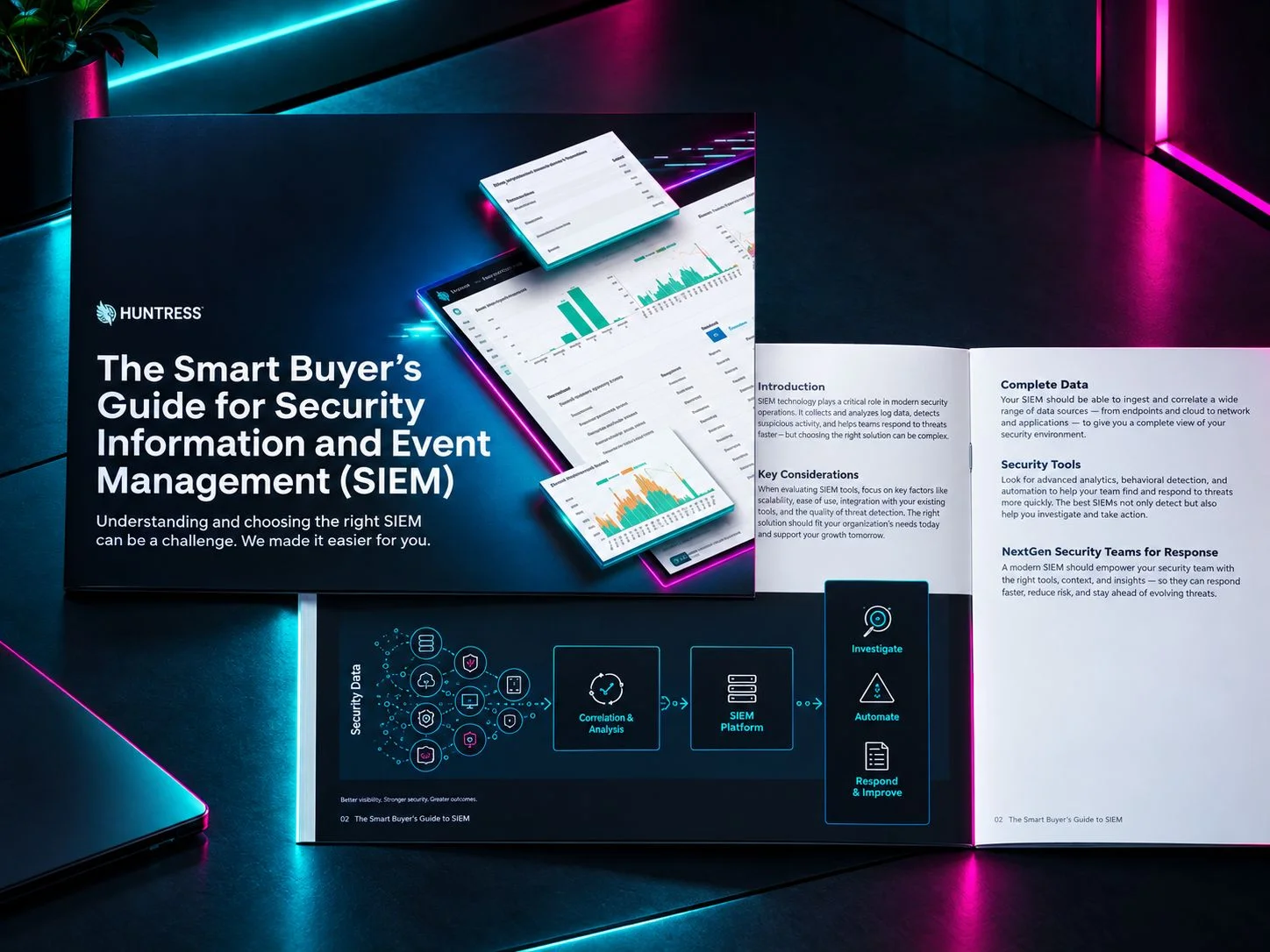
We compared 10 SIEM tools on deployment, 24/7 coverage, and where each one fits best. We started with Huntress Managed SIEM, then covered the other platforms most often on shortlists.
Platform | Best for | Deployment | 24/7 managed option | Standout |
|---|
Huntress Managed SIEM | Growing organizations and MSPs that want a SOC watching their logs | Cloud, fully managed | Built in | 24/7 SOC, predictable pricing, Microsoft 365 and identity coverage |
Microsoft Sentinel | Microsoft-centric, cloud-first organizations | Cloud-native (Azure) | Not built in | Native Defender integration, built-in UEBA and SOAR |
Splunk Enterprise Security | Large enterprises with dedicated platform teams | Cloud or self-managed, including air-gapped | Not built in | Huge integration ecosystem |
CrowdStrike Falcon Next-Gen SIEM | Existing CrowdStrike Falcon customers | Cloud-native SaaS | Separate (Falcon Complete) | Endpoint, identity, and cloud on one sensor |
Palo Alto Cortex XSIAM | Enterprises consolidating SIEM, XDR, and SOAR | Cloud-delivered | Managed XSIAM offered | Converged platform with heavy ML automation |
Rapid7 Incident Command (formerly InsightIDR) | Mid-sized teams wanting UEBA, SOAR, and MDR | Cloud-native | Available as a bundle | Asset-based pricing with built-in UEBA |
SentinelOne Singularity AI SIEM | Existing SentinelOne EDR customers | Cloud-native | Via SentinelOne managed services | One agent for EDR and SIEM |
Exabeam New-Scale Fusion | Teams focused on insider threats and UEBA | Cloud-native (LogRhythm for self-hosted) | Not built in | Behavioral analytics depth |
Elastic Security | Engineering-led teams that want an open architecture | Serverless, hosted, or self-managed | Not built in | Flexible deployment, compute-based pricing |
IBM QRadar SIEM | Regulated enterprises that need on-premises control | On-premises, or IBM-managed | IBM-managed option | Sigma rule support, no per-GB ingestion penalty |
1. Huntress Managed SIEM
Best for: Lean IT teams, MSP partners, and growing businesses that want threat detection and compliance logging without building an internal SOC.
Most SIEM tools hand you a platform and wish you luck. Huntress Managed SIEM flips that. The Huntress SOC runs it for you, 24/7, so there's a person looking at the alerts instead of a dashboard waiting for someone to care.
What it does well:
Human-led, AI-centric SOC. Huntress analysts monitor, investigate, and hunt around the clock, and can remediate confirmed threats.
Catches attacks earlier. Managed SIEM helps customers spot threats earlier in the attack chain than EDR alone. In one example, the SOC found an RDP brute force attack less than 15 hours after a customer deployed Huntress.
Wide log coverage. Huntress added 20+ log source integrations across firewall, password management, and identity tools, including Fortinet, Palo Alto Networks, SonicWall, Sophos, 1Password, Duo, and Bitwarden.
Microsoft 365 coverage. Managed SIEM pulls in Microsoft 365, Entra, Defender, and Azure logs. See how Huntress works with Microsoft.
Predictable pricing. Pricing is built around the data you actually need for threat hunting, investigation, and compliance, not around a runaway data lake.
Compliance-ready. Long-term searchable log storage supports audits and insurance requirements
Herd immunity. Because the Huntress SOC watches millions of endpoints and identities, what it catches for one organization helps it shut down the same tradecraft faster for the next.
Managed SIEM can catch zero-day vulnerabilities and alert the team before attackers can exploit them.
One customer called out how they like managing log collection from a single pane alongside other Huntress products.
"We have seen around a 20 to 30% reduction in manual alert triage effort, mainly because Huntress SOC filters and investigates many alerts before they reach our team."
Read the full Huntress Managed SIEM review on PeerSpot →
2. Microsoft Sentinel
Best for: Microsoft-centric, cloud-first organizations.
Sentinel is a cloud-native SIEM built into the Azure and Defender portal, with hundreds of built-in data connectors. UEBA and SOAR come with the base product, Security Copilot helps with investigations, and an AI-assisted tool converts detection rules from Splunk or QRadar.
What to validate: Sentinel runs on Azure only, and ingesting data from AWS or GCP adds cost. It's priced per GB, so log volume drives the bill. Monitoring is on you, or on a partner.
3. Splunk Enterprise Security
Best for: Large enterprises with the staff to customize and maintain it.
Splunk runs as Splunk Cloud or self-managed, including air-gapped environments. It has a huge ecosystem of integrations and apps, and compliance tracking for standards like PCI, HIPAA, and GDPR.
What to validate: Some capabilities, including UEBA, SOAR, and certain AI agents, sit in the higher Premier tier. Expect real operational overhead and specialized expertise.
4. CrowdStrike Falcon Next-Gen SIEM
Best for: Organizations already running CrowdStrike Falcon endpoint protection.
It's a cloud-native module built on the same sensor and console Falcon customers already use. Endpoint, identity, and cloud telemetry share one context, and Charlotte AI supports natural-language investigation.
What to validate: The single-sensor advantage fades if you run a different EDR. It's SaaS-only. Self-hosted needs a separate product, Falcon LogScale.
See full Huntress vs Crowdstrike comparison.
5. Palo Alto Cortex XSIAM
Best for: Enterprises that want SIEM, XDR, SOAR, and attack surface management in one platform.
XSIAM uses machine learning to group low-confidence alerts into higher-fidelity incidents, and automated playbooks cut time spent on routine triage. A managed XSIAM option exists for teams that want help running it.
What to validate: Pricing is sales-led and not published. Integration is strongest inside the Palo Alto ecosystem.
6. Rapid7 Incident Command (formerly InsightIDR)
Best for: Mid-maturity teams that want built-in UEBA, SOAR, and optional MDR.
It's cloud-native, collects log, network, and endpoint data, and correlates user and asset activity to flag suspicious behavior. Pricing is based on monitored assets rather than data volume, and managed detection services are available as a bundle.
What to validate: Check whether asset-based pricing stays friendly as you grow, and how far you can customize deep analytics and compliance reports.
7. SentinelOne Singularity AI SIEM
Best for: Organizations already standardized on SentinelOne for endpoints.
The pitch is one agent and one console for EDR and SIEM. Purple AI helps analysts investigate, and SentinelOne offers 24/7 managed detection and response separately.
What to validate: Some AI capabilities depend on your tier, and the consolidation benefit shrinks if you run a mixed endpoint estate.
See full Huntress vs SentinelOne comparison.
8. Exabeam New-Scale Fusion
Best for: Teams where insider threats and identity-based risk come first.
Exabeam's strength is behavioral analytics: dynamic risk scoring against baselines, plus AI agents that triage alerts and summarize cases. Its LogRhythm line covers self-hosted needs, with 1,100+ prebuilt correlation rules.
What to validate: Fusion is cloud-only. Pricing is quote-based. Deep UEBA works best with analysts who can tune it.
9. Elastic Security
Best for: Engineering-led teams that value open architecture and cost transparency.
Elastic deploys serverless, hosted, or fully self-managed, including air-gapped. Pricing follows compute and storage, and AI-assisted import helps translate detection rules from other platforms.
What to validate: It takes engineering time to configure and tune. Workflow automation isn't native, so expect to add a SOAR tool.
10. IBM QRadar SIEM
Best for: Regulated enterprises that need on-premises data processing.
QRadar deploys as on-premises hardware or virtual appliances, with an IBM-managed option. It supports community Sigma rules and UEBA, and its licensing avoids per-GB ingestion penalties.
What to validate: It's heavier to deploy and maintain than any cloud-native platform here, and IBM sold its QRadar SaaS business in 2024.