Law Firm Data Breach Causes, Costs, & Prevention
Written by: Lizzie Danielson
Published: 9/10/2026
Law firms are attractive targets for cyber criminals because they handle highly sensitive client data—from personally identifiable information (PII) and financial records to mergers and acquisitions (M\&A) and litigation strategy. That information commands a high price for threat actors, yet many firms still operate without dedicated security monitoring. When a breach does happen, investigation, downtime, and legal exposure can quickly drive total costs into the millions.
Law firms looking to shore up their defenses should read on. We’ll cover why attacks are common, what happens if threat actors steal client data, and how to prevent law firm data breaches.
Key Takeaways
- Law firms are prime targets for attacks because they store sensitive data.
- Most breaches start with phishing, stolen credentials, or weak endpoint security.
- A simple response plan and stronger security understanding can lower risk.
- Huntress Managed EDR, Managed ITDR and Managed Security Awareness Training help firms reduce risk without building their own 24/7 SOC.
What a law firm data breach really means
A law firm data breach is any unofficial access to a firm’s systems, files, or communications. That could mean a threat actor getting into:
- Client case files
- Trust account data
- Email threads
- M\&A documents
- Litigation strategies
Lawyers have a strict obligation to protect this data. Under the ABA Model Rule 1.6(c), part of a lawyer’s job is making efforts to stop the accidental or unapproved release of a client’s information.
Attacks don’t need to be a system shutdown to cause serious damage. Sometimes, just a single compromised email account exposes months of privileged conversations and personal details. Clients share information with their lawyers they wouldn't with anyone else. With that data exposed, clients’ suits are at risk, and the firm earns a reputation for not taking care of sensitive information.
Why law firms are a hacker's prime target
Threat actors seek out valuable data, and law firms store a lot of it. And since most firms use lean IT teams with no dedicated security staff, their high-value information is easier to reach.
The proof is in the numbers. A U.S. Legal Support survey of over 2,000 respondents found that 21% experienced a cyberattack in 2025. Reports from 2024 were similar—threat actors aren’t giving up on law firm attacks any time soon.
What happens after a law firm is hacked
After an attack, firms face digital forensics and recovery costs, regulatory scrutiny, and reputation damage. Depending on what was exposed, malpractice claims and class action lawsuits may follow soon after.
What makes this worse is that many firms still aren’t prepared. Without a documented incident response plan, decision-makers are forced to improvise their next steps in the middle of a breach instead of following a tested playbook.
Four common cyber threats to law firms
Let’s go over the four most common types of attacks law firms face.
1. Law firm ransomware
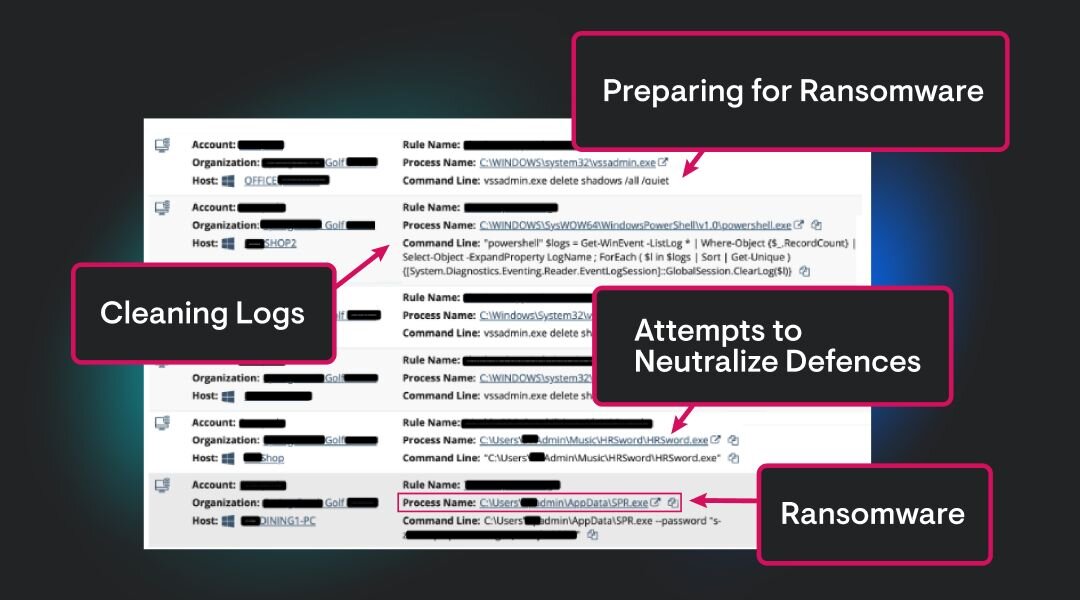
Ransomware can get in through a phishing email or a remote access point with weak credentials. Once inside, the ransomware encrypts case files and client records. Then, threat actors demand a fee (ransom) to give back the files.
Unfortunately, this threat style is evolving. Now, attackers steal data and threaten to leak or sell your information rather than encrypting it. But even if you pay the ransom or restore data from backup, there’s no guarantee the data will stay private.
Law firms are at a high risk for this type of attack. A recent survey of public incidents found a record 45 ransomware attacks that added up to roughly 1.5M legal records.
2. Phishing & business email compromise
Phishing and business email compromise (BEC) create issues for law firms. Emails carry client messages and sensitive personal details, and attackers know how to pressure busy staff into clicking a fake link or opening a malicious attachment.
The goal is simple: Steal credentials, get into an email account, and use that access to snag valuable information. What starts as a simple mistake turns into fraud or data exposure. The Robinhood data breach is a good example of this—through social engineering, attackers exploited one employee and compromised millions of records.
3. Lost devices & weak endpoint controls
Lost, unencrypted, or unmanaged devices can quietly expose sensitive data. A misplaced laptop or phone may give attackers access to client files, firm emails, or cloud accounts. When staff work on their personal device or remotely, endpoints are harder to secure and manage, increasing the risk of a breach.
4. IT impersonation & messaging attacks
Threat actors now use messaging platforms like Microsoft Teams to manipulate their victims. Recently, Microsoft Threat Intelligence reported threat actors imitating help desk or IT support in Teams. By posing as a helpful point of contact, attackers gain employees’ trust and manipulate them into willingly giving up their credentials.
How to prevent a data breach in a law firm
You don't need a large security team to lower risk. What matters most is having a clear response plan and reducing the risk of a click turning into a compromised account. Here are a few steps you can take.
Build a simple incident response plan
Only 34% of law firms have a response plan. The rest have to make high-pressure decisions in the middle of a breach. To prevent this, create an incident response plan that clarifies who makes decisions, who brings in outside counsel or forensic experts, and how the firm will handle notifications of exposed data.
Strengthen law firm information security fundamentals
Use multi-factor authentication (MFA) for email and remote access to reduce the risk of account takeover. Encrypt work devices, keep secure backups to shorten recovery time, and secure permissions to limit the data an attacker can reach. Review third-party vendors, too. Weak outside access can create the same issues as internal mistakes, like the data breach at the U.S. Treasury.
Reduce human risk with security awareness training
Human behavior still drives many incidents. Phishing, MFA fatigue prompts, and other social engineering tactics work because of the sheer volume of messages and information legal staff handle on a daily basis. Training helps staff spot suspicious messages and avoid small mistakes that lead to stolen credentials.
Why managed detection changes the outcome
Prevention still matters, but it won’t stop every breach. What changes the outcome is spotting and containing a threat fast. The longer an attacker stays in an environment, the more time they have to move laterally, steal data, or deploy ransomware.
That matters even more for law firms with lean internal IT teams. Most can’t provide 24/7 monitoring and response while managing day-to-day operations. Managed detection closes this gap with continuous monitoring, investigation, and containment, cutting down dwell time and limiting data disruption costs.
How Huntress supports cybersecurity for law firms
Huntress Managed Endpoint Detection and Response (EDR) gives law firms fully managed protection without the overhead of building an in-house Security Operations Center (SOC).
Our solution includes:
- Fully managed coverage: Our team handles the monitoring, investigation, and response work of cybersecurity for you.
- Around-the-clock visibility: An AI centric SOC spots and contains threats 24/7, before they turn into bigger problems.
- Low false positives: Huntress keeps alert noise low and points out which threats actually need attention.
- Clear pricing: We offer enterprise-level SOC protection without the cost and burden of building one in-house—no tiers or add-ons needed.
Reduce law firm breach risk without building a SOC
Law firm data breaches aren’t slowing down, and many firms feel unprepared if something goes wrong. With recent data showing 20% of firms being targeted in the past year, it’s easy to understand how these attacks cost companies millions.
You don’t need to build a SOC to lower risk. Huntress Managed EDR, Managed ITDR and Managed Security Awareness Training (SAT) tighten up your endpoint and identity protection, limit human risk, and boost responses without adding headcount.
Reach out today to book a demo or start a free trial.
FAQs
The average law firm data breach costs about $5.08M, though this varies by firm size and incident. Expenses add up because of:
- Investigation
- Downtime
- Legal review
- Client notification
- Recovery work
- Long-term reputational damage
Below are a few steps law firms should take to control breaches:
- Contain the incident first.
- Isolate affected systems.
- Preserve evidence (don't wipe logs).
- Contact legal counsel and forensic experts.
- Reset all potentially compromised accounts.
- Follow your incident response and notification plan.
To improve your security, start with the basics that lower risk the fastest. Use MFA, keep secure backups, and invest in managed protection and security awareness training for your team.
Additional Resources
- Read more about What is AutoScanning? Cybersecurity Defense GuideLearn how AutoScanning provides 24/7 automated cybersecurity protection. Discover benefits, types, and best practices for continuous threat detection.
- Read more about What Is DNS Poisoning? Attacks & Prevention GuideWhat Is DNS Poisoning? Attacks & Prevention GuideLearn what DNS poisoning is, how it works, and ways to detect and prevent attacks. Protect your network from cache poisoning with these expert tips!
- Read more about Secure Your Digital Presence – Protect, Own, and ThriveSecure Your Digital Presence – Protect, Own, and ThriveSafeguard your digital footprint with expert tools and strategies. Schedule a free consultation to protect your brand, stay secure, and succeed in a digital-first world.
- Read more about What is Quantum Cryptography?What is Quantum Cryptography?Learn how quantum cryptography uses physics for unbreakable security. Discover its role in protecting data against advanced threats and the future of cybersecurity.
- Read more about What is TLS Encryption?What is TLS Encryption?Learn what TLS encryption is, how it secures data, and why it’s essential for cybersecurity. Beginner-friendly insights from Huntress.
- Read more about What Is a Text Bomb? How to Protect Your PhoneWhat Is a Text Bomb? How to Protect Your PhoneLearn what a text bomb is, how text bombing happens, the risks, and what you can do to protect your phone from cyber harassment.
- Read more about What a Skimmer? Stay Protected from Credit Card ScammersWhat a Skimmer? Stay Protected from Credit Card ScammersLearn essential tips to detect and avoid credit card skimmers. Stay vigilant with these security measures to safeguard your financial data.
- Read more about Configuration Management Tools: Types & How They WorkConfiguration Management Tools: Types & How They WorkLearn what configuration management tools are and how they work, discover top market options, and see how Huntress Managed ESPM closes their security gaps.
- Read more about What Does a Security Director Do? | Security ExpertsWhat Does a Security Director Do? | Security ExpertsLearn what security directors do, their evolving role in cybersecurity, required qualifications, and career opportunities in this comprehensive guide.