What Is ESPM (Endpoint Security Posture Management)?
Written by: Lizzie Danielson
Published: 11/21/2025
Updated: 03/31/2026
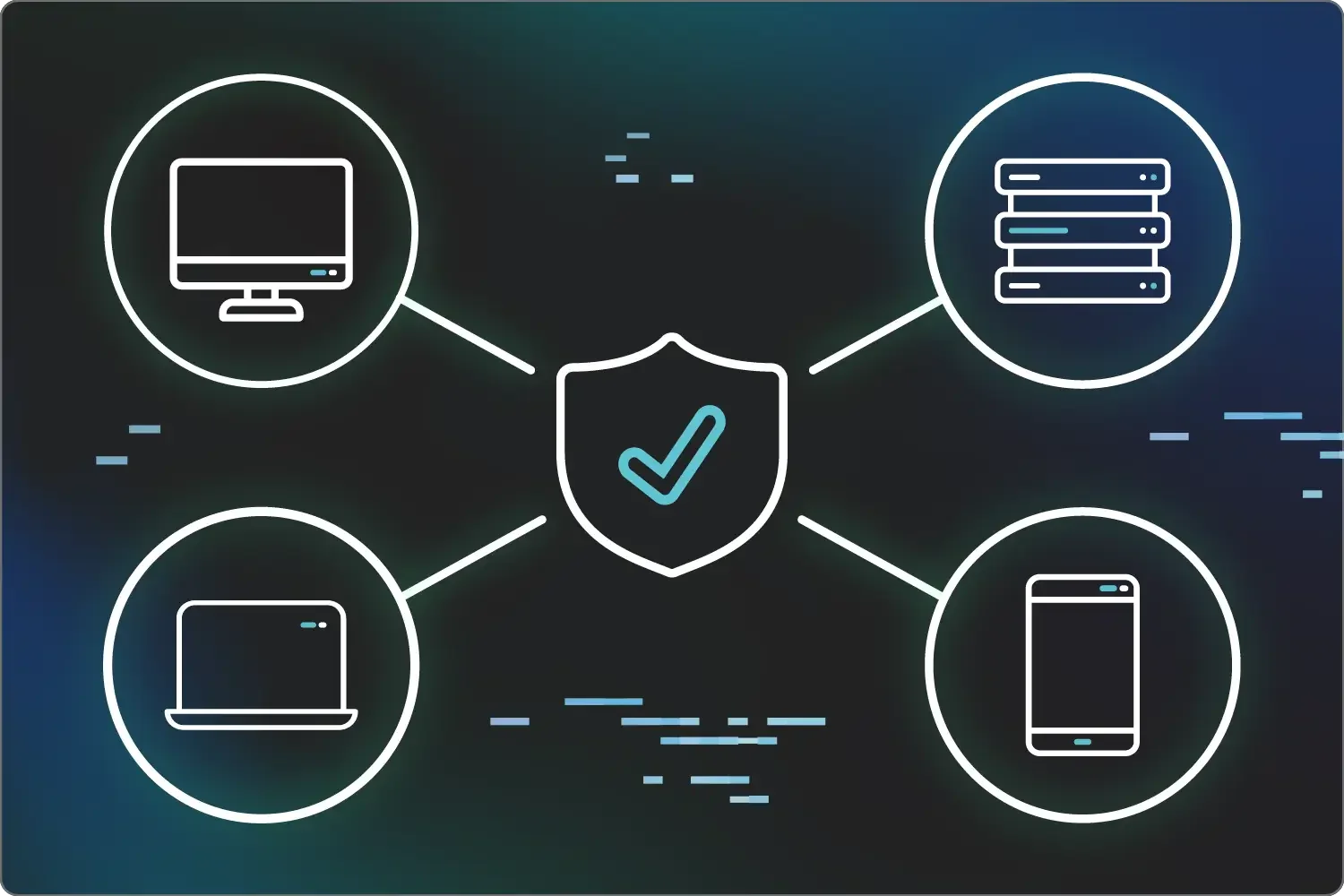
ESPM—or Endpoint Security Posture Management—is a continuous, automated audit of every device connected to your network.
Its job is to find "posture" weaknesses. Think: risky settings, missing updates, or security gaps on any laptop, server, or mobile phone.
Why care? Because endpoints are the frontline of cybersecurity. A single unpatched laptop or a misconfigured server is a wide-open invitation for an attacker to bypass your defenses and gain access to your entire network.
Key Takeaways
ESPM is a continuous, automated audit of every managed endpoint that replaces manual checklists and guesswork with real-time visibility into endpoint security health — identifying risks like missing patches, disabled firewalls, encryption gaps, and risky configurations before attackers can exploit them.
Endpoints are the frontline of cybersecurity, and device sprawl across laptops, remote desktops, cloud servers, and mobile phones makes it nearly impossible for IT teams to maintain a clear picture of their attack surface without an automated solution like ESPM.
ESPM is distinctly proactive, not reactive — unlike Antivirus (which blocks known malware) or EDR (which detects active threats and suspicious behavior), ESPM focuses exclusively on hardening the endpoint's configuration and state to close security gaps before a breach occurs, like knowing which applications are running on endpoints and blocking the ones that can increase an endpoint’s attack surface.
A complete endpoint security strategy requires all three layers — AV to catch low-hanging fruit, ESPM to proactively harden devices, and EDR to detect advanced attackers who manage to get through. ESPM is the first pillar of comprehensive endpoint security, working alongside AV and EDR.
Why endpoint security posture management is critical for cybersecurity resilience
Device sprawl is a real problem. Your organization's data is accessed across laptops, remote workers' desktops, cloud servers, and mobile phones — many of which sit outside your direct line of sight.
This makes it nearly impossible for IT and security teams to maintain a clear, real-time picture of their attack surface. Did that remote employee actually install the latest security patch? Is the new server configured correctly? Is a user trying to install a printer driver that’s really an infostealer? Does every laptop have its firewall enabled and its antivirus running?
That uncertainty is risk. And in cybersecurity, uncertainty is exactly what attackers rely on.
ESPM cuts through that chaos. It replaces manual checklists and guesswork with 24/7 visibility and control of your endpoint security health—giving your team the insights needed to know exactly how your endpoint security posture is at any moment, and be able to prove it to internal stakeholders and external parties.
What does ESPM look for?
ESPM is built around finding and fixing the "unforced errors" in your security posture. It's a proactive hardening tool, not a reactive one.
An ESPM solution continuously scans your devices and compares their current state against established security best practices and benchmarks. It's designed to surface common—but dangerous—endpoint risks that often go undetected, including:
Missing patches: Laptops or servers are left vulnerable to known exploits because they're behind on critical software updates.
Security tool gaps: Workstations where the antivirus is disabled, the EDR agent has gone offline, or the host firewall has been turned off.
Risky configurations: ESPM also enforces practical application control, preventing unapproved or risky applications from running on endpoints in the first place
Encryption gaps: Mobile phones or laptops with access to company data that don't have disk encryption enabled.
Unauthorized software: Risky or unapproved applications—like RMMs – tools—installed on company devices without IT awareness.
Each one of these represents a real, exploitable gap in your defenses. ESPM finds them systematically, continuously, and without depending on your team to manually go looking.
How is ESPM different from EDR or Antivirus?
This is one of the most important distinctions in endpoint security—because these tools serve fundamentally different purposes. Together, they form the pillars of a complete endpoint security strategy, consistent with frameworks like theNIST Cybersecurity Framework.
Antivirus (AV): Your baseline protection. AV scans for known malware signatures—think of it as a digital "Most Wanted" list. If a file matches a known threat, it's blocked. It's reactive and signature-based, and while essential, it's not designed to catch what it doesn't already recognize.
EDR (Endpoint Detection and Response): Your active threat hunter. EDR goes beyond known bad files and watches for suspicious behavior—flagging a legitimate tool like PowerShell being used in a malicious way. EDR is built for detecting and responding to active breaches, including sophisticated attacks that slip past AV.
ESPM (Endpoint Security Posture Management): Your proactive hardener. ESPM doesn't look for active attacks or malicious files. Instead, it inspects the configuration and state of the endpoint itself—finding the unauthorized applications, missing patches, the disabled firewalls, and the bad settings before an attacker ever gets the chance to exploit them.
The key insight is this: you need all three working together. AV stops the low-hanging fruit. ESPM hardens the endpoint so attackers have less to exploit in the first place. And EDR catches the advanced attacker who manages to get in anyway.
Relying on detection and response alone—without proactively managing your endpoint posture—means you're always playing catch-up. ESPM shifts the balance in your favor.
How ESPM boosts security resilience
Cybersecurity resilience isn't just about stopping attacks—it's about reducing your attack surface so that fewer attacks succeed, and recovering faster when they do.
ESPM directly builds that resilience by:
Shrinking the attack surface continuously. Rather than waiting for a quarterly audit or a breach to reveal gaps, ESPM helps close exposures – like vulnerabilities and unexpected apps – in real time—before attackers have a window to act.
Eliminating configuration drift. Endpoints change constantly. Software gets installed, settings get changed, agents go offline. ESPM detects that drift and flags it immediately, keeping your environment aligned with security best practices.
Giving teams hard data, not guesswork. Security teams can prioritize remediation based on real risk exposure rather than assumptions—making every hour of effort count more.
Supporting compliance and audit readiness. Continuous posture visibility means you can demonstrate the security health of your environment at any time, not just when an auditor asks.
Removing implementation and management overhead. For organizations without large, dedicated security teams, a managed ESPM solution ensures posture hardening happens consistently—without requiring the expertise or headcount of an enterprise security operation.
The result is an environment that's fundamentally harder to attack, and a security team that's always ahead of the curve rather than reacting to the last incident.
The Strongest Foundation for Endpoint Resilience: Huntress EDR + Managed ESPM
Detection and response are essential—but it's not enough on its own. If your endpoints have misconfigured settings, disabled security tools, or unpatched vulnerabilities, you're handing attackers a head start before your EDR even has a chance to respond.
That's why Huntress pairs its enterprise-grade Managed EDR with Managed ESPM—giving you both pillars of a complete, resilient endpoint security strategy in one solution built specifically for organizations without enterprise-sized security teams or budgets.
Huntress Managed ESPM continuously audits your endpoint attack surface, finds the gaps that make breaches possible, and removes the implementation and management complexity that makes posture hardening impractical for most teams. It doesn't just provide data—it provides managed action, so your environment gets harder to attack without adding burden to your team.
Huntress Managed EDR then watches over that hardened environment 24/7, with a Security Operations Center actively hunting for the threats that still try to get through.
Together, they work as the first and second line of defense:
ESPM proactively closes the gaps attackers would otherwise exploit.
EDR actively detects and responds to the sophisticated threats that attempt to breach your defenses anyway.
Unlike complex enterprise platforms built for large security teams with deep budgets, Huntress delivers both capabilities in a managed model—purpose-built for MSPs and midmarket organizations who need real protection without the overhead.
Stop guessing about the security health of your endpoints.
ESPM vs. EDR vs. CSPM: Understanding the Differences
The acronym landscape is genuinely confusing, and readers searching "espm" likely need these distinctions clarified. ESPM (Endpoint Security Posture Management) focuses on the configuration state of endpoints — identifying gaps before attacks happen. It answers: "are all my endpoints hardened correctly?" EDR (Endpoint Detection and Response) focuses on behavioral monitoring and active threat response — detecting and containing attacks in progress. It answers: "is something malicious happening on my endpoints right now?" CSPM (Cloud Security Posture Management) applies the same configuration-assessment concept to cloud infrastructure — identifying misconfigured S3 buckets, overly permissive IAM roles, and missing encryption on cloud resources. These three categories address different phases and surfaces of the security lifecycle: ESPM prevents, EDR detects and responds, CSPM protects cloud infrastructure. In a mature security program, all three work together. For organizations earlier in their security journey, ESPM is a logical starting point because it catches the misconfigurations that make EDR detections more frequent — a hardened, correctly configured endpoint is harder to compromise and easier to monitor. Link to EDR, CSPM, and endpoint security pages.
What ESPM Checks: Common Configuration Weaknesses
ESPM evaluates endpoints against a baseline of security controls and surfaces specific failures — not risk scores, not vague warnings. Here's what it actually finds in real environments:
Encryption disabled. BitLocker or FileVault not enabled on endpoints. A lost or stolen laptop means every file on it is accessible to anyone who picks it up. The NSA's BitLocker Guidance and NIST SP 800-171 (Control 3.13.11) both treat encryption at rest as a baseline requirement — not optional.
Endpoint protection turned off. Windows Defender real-time protection disabled — sometimes by users who found it inconvenient, sometimes by malware that shut it down before running. Defense tampering — including disabling Defender — is documented in the Huntress 2025 Cyber Threat Report as standard attacker behavior, not an edge case.
Unpatched software with known vulnerabilities. Applications running with publicly documented critical CVEs. According to the Verizon 2025 Data Breach Investigations Report, vulnerability exploitation rose to the #2 initial access vector at 20% of breaches — a 34% year-over-year increase.
AutoRun enabled. Any USB drive plugged into the machine can execute code automatically on connection. CISA explicitly recommends disabling AutoRun to prevent malicious USB-based code execution — a risk documented since the Conficker worm's mass spread via infected USB drives.
Weak local administrator credentials. Local admin accounts with default or simple passwords. NSA and CISA identified default credentials and shared local admin passwords as the #1 most common misconfiguration across 1,000+ federal network assessments — and the primary enabler of lateral movement via credential reuse.
RDP exposed to the internet. Remote Desktop Protocol accessible without additional controls. According to the Microsoft Digital Defense Report 2024, RDP access accounts for 53% of offerings sold by access brokers — making it the most traded initial access commodity in the cybercrime economy.
Unmanaged endpoints. Security software not installed or not reporting in. Microsoft's research found that 80–90% of successful ransomware compromises originate through unmanaged devices — endpoints on the network but outside IT's visibility.
For MSPs, ESPM findings translate directly into client conversations. Instead of abstract risk discussions, you can show a specific list of specific issues on specific machines. "Three of your 20 endpoints have encryption disabled" is concrete and actionable — the kind of detail that makes quarterly business reviews productive. Security posture becomes a scorecard with measurable improvement over time rather than a vague concept you have to sell.

FAQs
Related Resources
- Read more about What Is Identity Security Posture Management (ISPM)What is Identity Security Posture Management (ISPM)? Learn how ISPM helps organizations reach cybersecurity resilience with identity hardening.
- Read more about What Is SaaS Security Posture Management?What Is SaaS Security Posture Management?SaaS security posture management (SSPM) monitors your cloud app settings to catch misconfigurations and security gaps before attackers do. Learn more.
- Read more about What is an Endpoint in CybersecurityWhat is an Endpoint in CybersecurityLearn what endpoints are and why they matter in cybersecurity. Explore endpoint vulnerabilities, threats, and best practices for securing your devices.
- Read more about What is Security Posture and How to Improve ItWhat is Security Posture and How to Improve ItLearn what security posture is, key components of a strong cybersecurity posture, and actionable steps to improve your organization’s defenses.
- Read more about What is Application Security Posture Management (ASPM)?What is Application Security Posture Management (ASPM)?Learn how ASPM provides continuous security visibility across the software development lifecycle, helping organizations prioritize risks and streamline remediation.
- Read more about What is Mobile Device Management (MDM)? | Cybersecurity 101What is Mobile Device Management (MDM)? | Cybersecurity 101Learn how Mobile Device Management (MDM) secures business data on employee devices. Discover key features, benefits, and implementation strategies.
- Read more about What is a Generic Device? | Cybersecurity GlossaryWhat is a Generic Device? | Cybersecurity GlossaryLearn about generic devices, how they interact with networks, and why identifying these devices is essential to improving your organization’s cybersecurity posture.
- Read more about What Is Osquery? A Beginner's Guide to Endpoint SecurityWhat Is Osquery? A Beginner's Guide to Endpoint SecurityLearn what osquery is and how it transforms endpoint security with SQL-like queries. Explore its features, use cases, and enterprise applications
- Read more about What is Hacklore? Debunking Common Cybersecurity MythsWhat is Hacklore? Debunking Common Cybersecurity MythsJoin the Hacklore initiative to separate cybersecurity fact from fiction. We audit our own content to reveal the truth about VPNs, charging stations, and how to focus on threats that actually matter in 2026.