


Huntress vs. Bitdefender
Bitdefender GravityZone is a strong platform. But a platform isn't a managed security partner. Huntress gives you a fully managed security platform. See why businesses choose Huntress over other managed threat detection solutions for broader coverage, deeper transparency, and simpler pricing.
-
Managed EDR, ITDR, SIEM, and security awareness training all backed by a 24/7 expert-led, AI-Centric SOC that investigates and responds before you even open the alert.
-
24/7 managed SOC included by default – Every Huntress product comes with an AI-centric, human‑led SOC that investigates, triages, and helps remediate incidents for you, instead of just alerting your team or requiring a separate “complete” tier.
-
Simple, predictable pricing – Single‑tier, volume‑based pricing with no big endpoint minimums or SKU maze, so you aren’t paying enterprise premiums for features you’ll never fully use.
Enterprise-grade protection, industry-leading threat expertise — built for every business.
Huntress vs. the competition
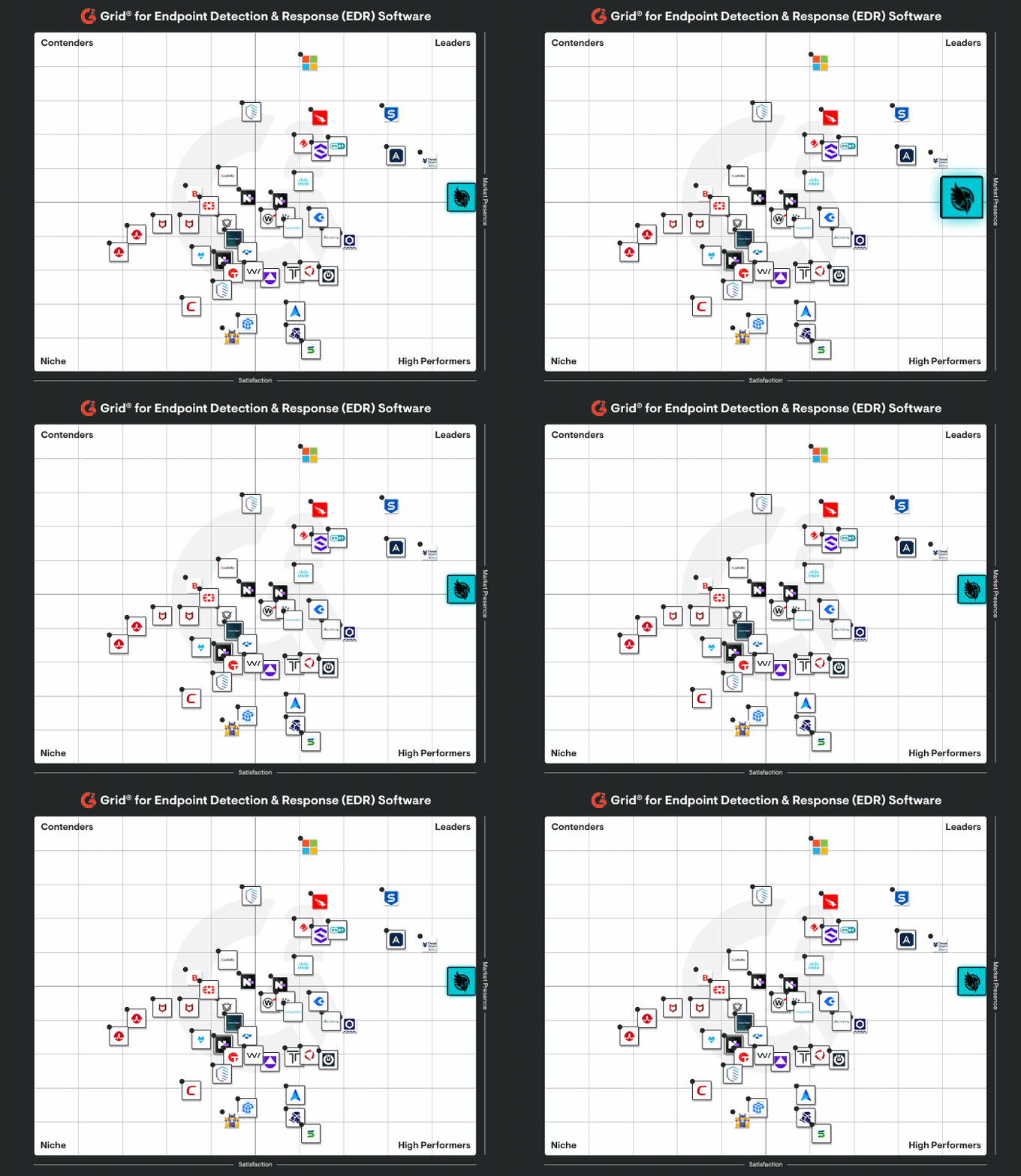
Highly Rated by Our Verified Users
Don’t just take our word for it—see why businesses like yours trust Huntress over other competitor platforms.



Purpose-built for results for the 99%


SOC-driven protection across EDR, ITDR, SIEM, and SAT. Human-validated, actionable reports with near-zero false positives.

24/7 SOC/MDR is only available through separate MDR/MDR PLUS services on top of GravityZone.
Purpose-built EDR with high-accuracy behavioral detection, ransomware canaries, and a 24/7 SOC that investigates and responds. Works alongside your existing AVs, including Microsoft Defender, SentinelOne, and others—no rip-and-replace required.
GravityZone EDR (available in Business Security Enterprise and above) delivers automated detection with cross-endpoint correlation. EDR is absent in the three lower tiers. Threat hunting and live search are self-service—managed SOC response requires a separate MDR purchase.
Native Managed ITDR for Microsoft 365, Entra ID, and Google Workspace. Detects account compromise, privilege escalation, MFA bypass, and more.
Bitdefender offers Identity Threat Detection & Response as a separate module. To pair identity detection with human-led response, customers must layer MDR/MDR PLUS on top of GravityZone. Bitdefender does not publish MTTR for identity incidents.
Compliance-ready, with long-term retention by default (one year, with options for up to seven years) and Smart Filtering to store only security-relevant data. Fully managed SIEM built natively into the Huntress platform.
No dedicated managed SIEM offering; log aggregation and analytics are handled via Security Data Lake and XDR, typically as higher-tier add-ons. Pricing is quote-based, with no published per-source rates and no Smart Filtering–style model to limit data volume.
Fully managed SAT with simulated phishing, just-in-time lessons, compliance modules, and custom content creation tools. Built by Emmy-winning animators and adult-learning and security experts, using the latest threat intelligence.
No fully integrated, managed SAT platform.. Phishing simulation available as a custom-quoted engagement. Standalone eLearning content lacks GravityZone integration, automated campaigns, and adaptive learning.
Every incident includes a human-written report: what happened, how, remediation steps taken, and timeline. Built for audits, QBRs, and boards.
MDR portal and monthly reports summarize activity and major incidents; deeper root-cause and impact analyses are delivered as after-action reports rather than per-incident, real-time narratives.
SOC-driven containment and remediation. Every incident includes a custom report with explicit next steps. Speak to a SOC analyst 24/7.
MDR pre-approved actions enable prompt endpoint response. Full cross-surface outcomes (identity remediation, log correlation) require add-ons. Response actions and reporting are split across GravityZone and MDR Portal.
One simple, volume-based price per product. No tiers required to unlock full capabilities.
Tiered pricing model. Access to full capabilities requires higher-tier commitments, while some products require quote-based pricing.

An expert-led, layered security solution
Both platforms offer 24/7 human-led SOCs, but only Huntress does for every tool at no extra cost. Bitdefender endpoint security and identity security tools require purchasing higher tiers just to get automated EDR and ITDR monitoring. For a human-managed SOC response, MDR must be purchased on top of upgraded solutions.
Huntress EDR and ITDR continuously monitor for persistent footholds, malicious process behavior, and suspicious identity activity across endpoints and identities (Microsoft 365, Google Workspace). Huntress EDR features ransomware canaries that quickly detect active encryption to stop ransomware attacks in their tracks. High-confidence alerts trigger automatic attack disruption, and every alert is validated by a human analyst before it reaches your queue.
Huntress works seamlessly alongside your existing AV. If you're running Microsoft Defender, Huntress manages it for you at no extra cost, so there's no migration project or coverage gap during transition. Bitdefender primarily positions its own AV as a replacement for Defender, adding migration overhead and vendor lock-in.
For organizations protecting endpoints, Google Workspace, and Microsoft 365 identities, Huntress delivers deep, cross-layer detection in a unified platform with no tier upgrades required.
Threat response performance: Speed and automation capabilities
When an attack is in progress, every minute counts. Here's how the two platforms compare on response:
Huntress: ~8-minute mean time to respond to endpoint incidents. Under 3 minutes on identity threats. For high-confidence alerts, EDR and ITDR automatically isolate hosts, kill malicious processes, disable compromised accounts, and revoke sessions. Other alerts are validated by SOC analysts, who respond and then notify you with a clear remediation summary and any remaining action items.
Bitdefender: Purchasing Business Security Enterprise (BSE) as well as MDR provides a 24/7 SOC with active response capabilities. Pre-approved actions trigger an automatic response. Bitdefender doesn’t publish response times.
Both platforms automate responses. The difference is in what gets automated, how fast it fires, and how clearly the outcome is communicated. Huntress delivers a human-written incident report every time.
Managed security operations differences for SMBs
For small and mid-sized businesses and the MSPs that serve them, operational simplicity is the whole point.
Huntress was built so IT generalists can run it day to day without a dedicated security team. Get up and running in under 20 minutes. The SOC handles the heavy lifting, like triage, investigation, and most of the response. You see a small number of high-fidelity incidents with clear next steps, not hundreds of raw alerts.
Bitdefender's GravityZone is a capable platform for teams with in-house security staff to manage it. The MDR layer helps, but it's still a product-first stack, which some users report has a steeper learning curve.
If you want a managed platform that covers endpoint, identity, SIEM, and SAT in one intuitive portal, without complicated pricing, Huntress is the more complete choice.
Deployment, maintenance, and customer support comparison
Huntress makes deploying an enterprise-grade security platform frictionless. Managed maintenance and industry-leading customer support ensure your security platform works for you, not the other way around.
Getting started
Huntress supports Windows, macOS, and Linux, and is live in under 20 minutes. Deploy agents via RMM, Intune, or GPO. No professional services required. Onboarding support is included in every subscription.
Bitdefender MDR is also noted for fast deployment. Users consistently call out ease of setup as a strength.
Ongoing maintenance
With Huntress, the SOC, detection engineering, and Smart Filtering continuously tune the platform for you, with no in-house security engineer or specialist required. Updates ship on an ongoing, high-frequency cadence.
With Bitdefender, the SOC handles active incidents, but users note that integration breadth is limited. Bitdefender offers an API, but Huntress's open API enables broader RMM and PSA integrations out of the box. Tuning is up to your internal teams (with no Smart Filtering equivalent) unless you purchase MDR.
Support and transparency
Huntress delivers human-written incident reports with every confirmed threat. Every signal investigated is closed with a written reason (benign, business-accepted risk, or pen test), so you always know why an alert was or wasn't raised.
Bitdefender’s MDR portal delivers monthly reports, and Incident Advisor provides human-readable root cause reports. Huntress, on the other hand, gives a full attack timeline, on-demand and fully auditable, plus 24/7 SOC access. Call and talk to an analyst, not just read a portal.
Pricing and value analysis
Both platforms use volume-based pricing, but the structure differs in ways that matter at scale.
Huntress: Simple, per-product pricing based on volume. EDR monitors endpoints, ITDR guards identities, SIEM correlates logs, and SAT educates teams. No tiering required to unlock core capabilities. The full managed service and SOC are included by default. No surprise overages.
Bitdefender: Tiered pricing model. Full functionality requires higher pricing tiers and add-ons. To achieve similar cross-layer coverage to Huntress, Bitdefender requires GravityZone BSE + MDR add-on + ITDR add-on + XDR sensors + Security Data Lake — and it still lacks a native security awareness training offering. Bitdefender does have a $100K breach warranty with MDR.
For MSPs building a per-seat or per-client pricing model, Huntress's flat, predictable structure is easier to bundle and margin-protect. You pay for what you use, and every product delivers full functionality from day one

Huntress vs Bitdefender: A Multi-Layer Security Solution
Testimonials






The Huntress Managed Security Platform




Huntress vs Bitdefender FAQs
You can start by running Huntress alongside Bitdefender or plan a full move to Microsoft Defender plus Huntress—both are supported. Our Managed EDR agent is designed to operate with other AV/EDR tools, so you don’t have to rip out Bitdefender to get value.
Over time, a lot of partners simplify to Huntress Managed EDR plus Managed Microsoft Defender Antivirus, using Defender as the AV layer and letting our team manage it at no extra cost. That’s usually where you see the biggest gains in visibility, management, and total cost of ownership.
Yes—you can safely run Huntress and Bitdefender together. The Huntress agent is built to coexist with third-party AVs; the main limitation is that Managed Microsoft Defender can’t fully manage Defender while a third-party AV like Bitdefender is the active engine.
Even when Defender is disabled, our EDR agent still collects its own telemetry and can detect intrusions, malware, and ransomware. To keep things smooth, we recommend allow-listing Huntress inside Bitdefender (we publish specific paths and processes for BitDefender and other AVs) and making sure endpoints are patched and healthy if you ever see CPU or performance spikes.
Huntress doesn’t manage Bitdefender the way we manage Microsoft Defender. Managed AV only talks to Microsoft Defender; it can’t configure or respond through Bitdefender.
You can still bring Bitdefender into the picture as a log source. Huntress Managed SIEM integrates with the tools you already use and supports third-party AV/EDR feeds (for example, CrowdStrike, Cisco AMP / Secure Endpoint, SentinelOne) as SIEM data. In that model, Bitdefender events become part of your overall log story, while Huntress Managed EDR plus Microsoft Defender gives you the deepest AV telemetry, policy control, and SOC-backed response.
Defender plus Huntress gives you a prevention-plus-response stack: Defender handles AV, while our agent and 24/7 SOC focus on detecting and responding to footholds, lateral movement, and ransomware that get past preventive tools.
On our side, you get behavioral detections, persistent footholds, ransomware canaries, and Managed Host Isolation, all tuned for real-world attacker tradecraft. To get similar managed coverage with Bitdefender, you typically need GravityZone Business Security Enterprise plus Bitdefender MDR or a staffed SOC, often across multiple SKUs.
Huntress is built to consolidate a lot of what you’re doing with multiple MDR/SOC, SIEM, and awareness tools into one managed platform, while still coexisting with tools you want to keep. Our EDR agent can run next to other AV/EDR, and Managed SIEM is designed to ingest logs from your existing firewalls, cloud platforms, identity systems, and third-party EDR products.
In one stack, you can cover endpoints (Managed EDR), identities in Microsoft 365/Google Workspace (Managed ITDR), logs and compliance (Managed SIEM), and user risk (Managed Security Awareness Training)—all backed by the same 24/7 SOC. Many customers use that to retire a standalone MDR overlay, a separate SIEM/SOC-as-a-service, and legacy SAT tools, then decide case-by-case whether to keep or phase out things like Bitdefender. Because Huntress EDR can run alongside any AV and third-party detections can be pulled into SIEM as log sources, you can simplify without losing visibility.
Most teams that switch are looking for one managed security platform instead of a pile of SKUs and add-ons. With Huntress you get: a single-tier Managed EDR service with 24/7 SOC included, Managed AV for Microsoft Defender at no extra cost, and optional Managed ITDR, Managed SIEM, and Managed Security Awareness Training under the same SOC and portal.
Bitdefender can absolutely work well, but to reach similar managed coverage you typically need GravityZone Enterprise plus Bitdefender MDR or your own SOC, and managed services are sold as extras. With Huntress, our team is watching endpoints, identities, and logs 24/7, tuned for post-compromise activity and identity-based attacks in SMB environments, while leaning into the Microsoft stack you probably already own. For MSPs and lean internal IT teams, that mix of simplicity, coverage, and 24/7 SOC baked in is usually the deciding factor.