





Huntress vs. K365 Bundle
Focused security. Better outcomes. A security partner that actually shows up.
If you're looking for fully managed, 24/7 threat protection without getting locked into bundled platforms, flex funds, or multi-year contracts just to turn key features on, here’s what you need to know:
24/7 AI-centric SOC included by default: Every Huntress product ships with an AI-centric, human-led SOC that investigates, triages, and helps remediate incidents for you, instead of dropping noisy alerts into your queue or forcing you to bolt on a separate managed service.
Built for lean IT teams, not sprawling Kaseya-style stacks: Huntress is optimized for <1% false positives and response times measured in minutes, so smaller teams get real outcomes instead of juggling multiple consoles, connectors, and tuning projects.
Simple, predictable pricing: Single-tier, volume-based pricing with no big endpoint minimums, bundles, or SKU maze, so you’re not subsidizing a full IT platform or paying enterprise premiums for features you’ll never fully use.
Kaseya is built as a broad, bundled IT and security platform for organizations with deep budgets and in-house security operations. Huntress is built for everyone else — and that’s exactly the point.
Huntress vs. the competition
Highly Rated by Our Verified Users
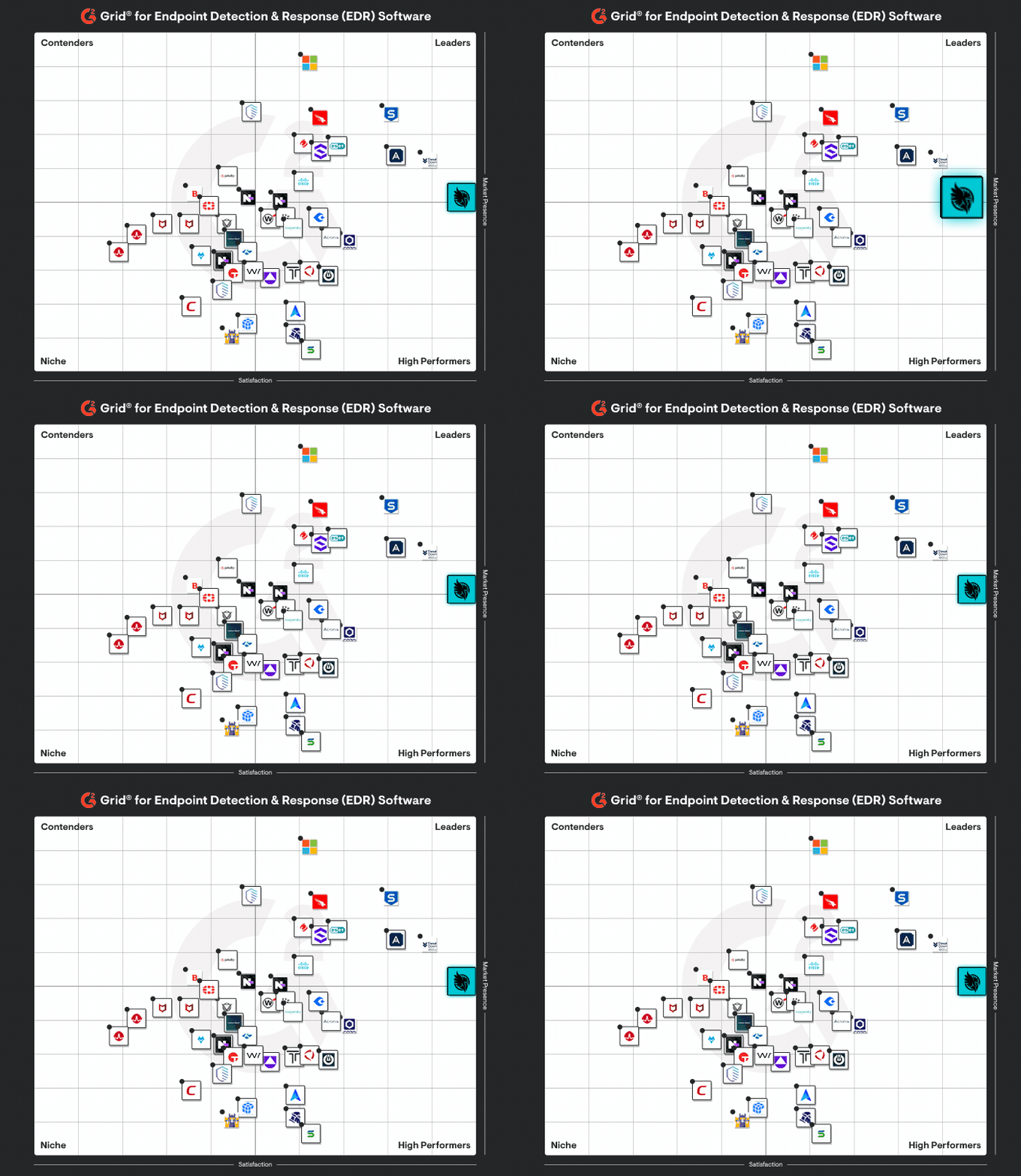
Don’t just take our word for it—see why businesses like yours trust Huntress over other competitor platforms.



Purpose-Built, Expert-Backed Cybersecurity


One simple, volume-based pricing per product. You don't need to buy different levels to get comprehensive capabilities and coverage.

Mix of bundles and à la carte modules across Kaseya 365, RocketCyber, and add-ons; often involves multi-year contracts, separate SKUs, and extra fees (like onboarding or upgrades) to match comparable coverage.
Included with every product – 24/7 fully operated by Huntress.
Primarily tool-centric; MSPs are responsible for tuning, alert triage, and remediation unless they bolt on managed services, which adds cost and operational overhead.
Industry-leading MTTR: ~8 minutes for EDR and ~3 minutes for ITDR, driven by a 24/7 human led AI-Centric SOC.
Response time is highly dependent on your internal team or outsourced SOC, since most offerings are sold as tools; partners are responsible for investigating alerts and deciding when to respond.
Global, 24/7 support included with every Huntress product.
Fragmented support and account management are split across multiple product lines; partners report frequent AM turnover and a more fragmented experience across the Kaseya stack.
Purpose-built EDR that delivers high-accuracy threat detection, <1% false positive rate, 24/7 monitoring with fast response.
EDR/MDR delivered via products like Kaseya 365 and RocketCyber; tends to be less configurable and tool-driven, with alert handling and many remediation workflows owned by the MSP team.
Managed ITDR for Microsoft 365 (and Google Workspace) with 24/7 monitoring, human-validated detections, and rapid response to account compromise and attacker behavior.
Identity and SaaS threat coverage is spread across tools like SaaS Alerts, dark web monitoring, and Kaseya 365; visibility and response quality depend on which modules you license and how your team configures and operates them.
Built from the ground up to reduce the complexity and cost of log collection, analysis, and storage. Simple pricing per log source backed by our 24/7 SOC.
Multiple log/SIEM options woven into the broader Kaseya stack; partners report deployment and visibility challenges, including unclear integration with PSA/BMS and uncertainty about what they're actually getting for SIEM-type SKUs.
Simple-to-manage SAT with engaging, expert-backed content based on real-world tradecraft to reduce human risk and build a strong security culture.
SAT and phishing simulation via tools like BullPhish ID and related offerings; typically more DIY, with MSPs responsible for content selection, campaign configuration, and reporting across multiple Kaseya security products.
Managed Identity Security Posture Management that continuously hardens Microsoft 365 against misconfigurations and excessive permissions, enforced by Huntress experts.
Identity posture and hardening are handled through a mix of native M365 controls and Kaseya tools; there’s no single, fully managed ISPM service focused solely on ongoing identity hardening comparable to Huntress Managed ISPM.
Managed Endpoint Security Posture Management that continuously reduces endpoint risk for any size team—no complex tooling or heavy operational lift required.
Endpoint posture is driven through RMM policies and various Kaseya add-ons; posture management is largely a self-managed effort rather than a dedicated, fully managed ESPM service.

Why Huntress Is the Best Kaseya Alternative
1. Managed Detection That Actually Closes the Loop
With Kaseya’s security stack, partners tell us alerts still land in their lap. They describe alert fatigue, noisy dashboards, and workflows that demand constant attention from their team.
With Huntress, the 24/7 AI-centric, human-led SOC investigates and remediates. Partners regularly report that by the time they log in, incidents are already contained and a clear report is waiting explaining what happened, what was done, and what to do next.
Far fewer false-positive rabbit holes, far more closed-loop outcomes.
2. Outcomes, Not Activity
MSPs and lean IT teams don’t need more tools to manage; they need results they can trust. One long-time partner put it simply: Huntress “does what I need it to do without me telling it to,” and catches real-world credential abuse before they can even finish logging in to respond.
Kaseya’s approach often puts more operational burden on your team to tune, triage, and respond. Huntress is designed to take that work off your plate so your team can focus on everything else.
3. A Security Vendor That Does One Thing Exceptionally Well
Kaseya has aggressively acquired tools across the IT and security space to build a broad platform.
Partners tell us this can make security feel bolted on — something that’s bundled with RMM, backup, and PSA rather than a singular focus.
Huntress is laser-focused on security. Many partners who tried an “all-eggs-in-one-basket” strategy come to Huntress specifically because they want a vendor that does nothing but managed security — and does it exceptionally well.
4. A Partner Experience Built for MSPs — Not Just Managed Against SLAs
Huntress partners consistently flag the contrast in how each company treats them. On the Kaseya side, some report going through “30 account managers in three years,” constantly re-explaining their business to someone new.
Huntress invests in stable, partner-first relationships. That shows up in how renewals are handled, how migrations are supported, and why large Kaseya-standardized groups still choose Huntress for security.
5. Products That Deliver What They Promise
Kaseya’s security components, from vulnerability scanners to SIEM to remote tools, often come up in partner conversations as falling short of expectations: scanners that only flag Microsoft and Chrome issues, SIEM offerings that don’t integrate cleanly with BMS, and remote tools that engineers actively want to replace.
Partners come to Huntress looking for best-in-class managed security, not a compromise that happens to be bundled with their RMM.
6. Straightforward Pricing. No Contract Games.
Kaseya’s contracting and renewal process — including aggressive terms, multi-year commitments, and cancellation requirements — is a recurring friction point that pushes partners to explore alternatives.
Huntress offers transparent, partner-oriented pricing: simple, volume-based pricing per product, no paid onboarding, and no nickel-and-diming through bundles or surprise upcharges.
When the relationship starts clean, everything that follows is easier.

The Impact of 24/7 SOC Oversight
What Customers Have to Say






The Huntress Managed Security Platform









Huntress Vs. Kaseya FAQs
Huntress and K365 serve different primary purposes. Kaseya is an IT management platform that bundles security capabilities alongside RMM, PSA, and backup tooling — security was largely added through acquisitions. Huntress is a cybersecurity-first managed security platform, built around a 24/7 SOC.
That difference in DNA shows up in day-to-day operations. Huntress delivers Managed EDR, Managed ITDR, Managed SIEM, Managed Security Awareness Training, Managed ISPM, Managed ESPM, and Managed Microsoft Defender Antivirus — which can all run through one SOC, one platform, and transparent pricing models. K365 stitches together components like Kaseya’s endpoint EDR, RocketCyber, SaaSAlerts, and BullPhish ID inside a broader IT management stack.
K365 does bundle security tools, but the 24/7 SOC is an add-on, and the model is generally built around forwarding alerts to your team to verify and act on. With Huntress, a 24/7 SOC is included across Managed EDR, ITDR, and SIEM — our analysts validate alerts, drive remediation, and dramatically reduce what ends up in your queue.
The practical difference: Huntress partners typically hear from us only when something real requires attention. Our EDR false positive rate is below 1%, and our SOC either remediates automatically or provides clear, step-by-step incident reports. Transparent per-asset pricing means no surprise SOC surcharges or tier-gated features.
There’s real overlap in the categories both address: endpoint protection, identity and SaaS threat detection, security awareness training, and log analysis/SIEM. The difference is in how those capabilities are delivered.
Huntress delivers all of these as a purpose-built managed security platform operated by a 24/7 SOC — with guided or automatic remediation, post-incident reporting, and a false positive rate under 1% on EDR. K365 is a multi-component bundle where the individual pieces (RocketCyber, SaaSAlerts, BullPhish ID) each have their own interfaces, licensing, and alert workflows. Investigation and remediation are largely the partner’s responsibility, and managing the combined stack introduces complexity that can add operational overhead over time.
Huntress is explicitly built for high-fidelity detection — our SOC filters out the noise before anything reaches you, so you only get notified about incidents that actually require your attention.
Our EDR false positive rate is below 1%; on identity threats, it’s under 5%. Managed SIEM adds Smart Filtering at the log source, so you’re not drowning in raw log volume or rule spam. The result is fewer alerts, better context on the ones that do come through, and less time spent triaging things that turn out to be nothing.
Huntress is designed to be able to coexist with your existing RMM, PSA, and backup tools. You keep Kaseya for IT management and use Huntress as your managed security layer.
Huntress Managed EDR works alongside other AV tools, including Microsoft Defender, and we provide Managed Microsoft Defender Antivirus at no additional cost. Managed SIEM ingests logs from whatever you’re already running — Windows events, firewalls, VPNs, identity providers, cloud platforms, and third-party EDR — so it extends your existing infrastructure with centralized visibility and 24/7 SOC coverage rather than competing with it.
For most MSPs, Microsoft Defender combined with Huntress Managed EDR is often a complete endpoint security stack — and in many cases there’s no need to run a separate Kaseya-supplied AV/EDR product on top.
Huntress brings purpose-built EDR technology, active SOC-driven remediation, and low-noise detections. Managed Microsoft Defender lets our team centrally manage Defender Antivirus configurations, exclusions, and detections at no additional cost, and integrates with Microsoft Defender for Endpoint where you use it. Many partners standardize on this combination to simplify operations, reduce agent sprawl, and stretch security budget.
K365 includes SIEM and XDR-style capabilities through RocketCyber and the broader Kaseya stack, but the multi-component approach can introduce complexity: multiple licensing layers and alert volume that requires partner-side triage.
Huntress Managed SIEM is built to make both threat response and compliance practical for MSPs. We collect logs from Windows, syslog, identity, firewall, VPN, cloud, and other sources; apply Smart Filtering to retain only security-relevant events; store data for up to seven years; and have our SOC write detections, tune filters, investigate, and escalate only real incidents. Pricing is per data source rather than raw log volume. If clean, audit-ready logging with managed threat response is the goal, Huntress SIEM is designed specifically for that outcome — either as a replacement for K365’s SIEM components or as a managed layer on top of existing infrastructure.